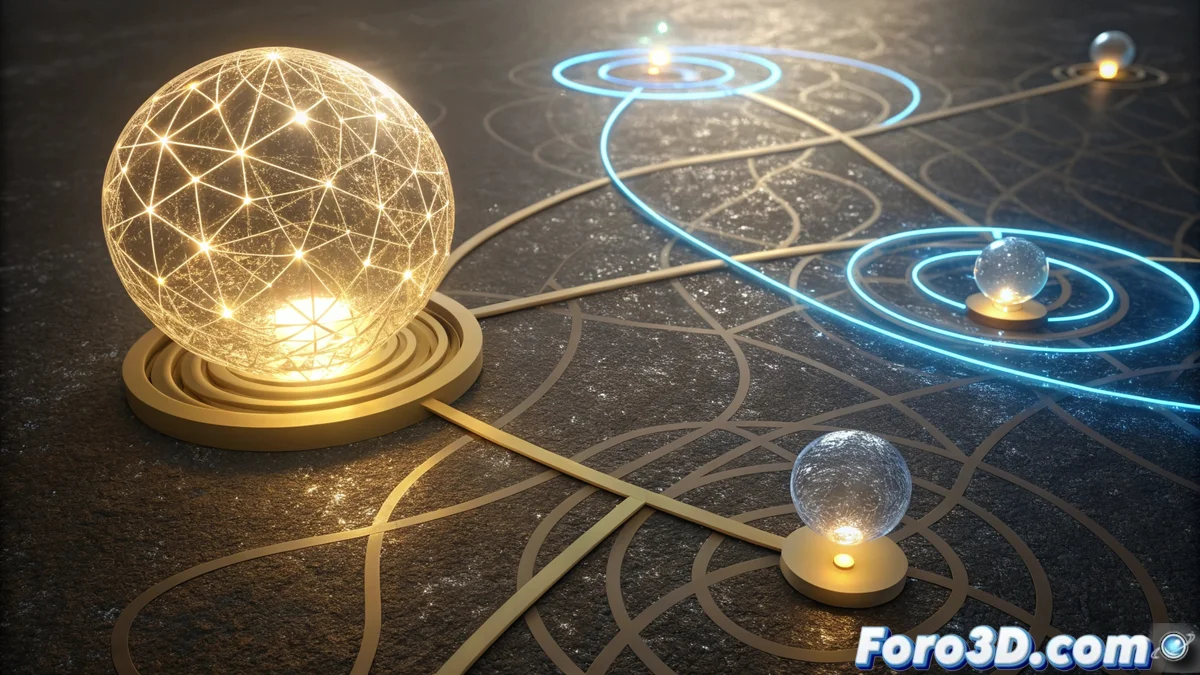
Bidirectional Path Tracing Connects Light and Camera Paths
Bidirectional Path Tracing (BDPT) is an advanced method for producing photorealistic images. Unlike classical path tracing, which only traces from the camera, this algorithm works from two fronts: the camera and the scene's own lights. Its power lies in how it later combines these two sets of data to simulate light more completely and efficiently in complex situations. 🎯
Mechanics of a Bidirectional Algorithm
The process is divided into two clear phases. First, eye paths (paths from the eye or camera) and light paths (paths from each light) are generated independently. The core of the algorithm consists of testing valid connections between the vertices of these paths. For each possible link, it verifies that there is a direct line of sight and calculates how much that complete path contributes to illuminating the final pixel.
Key Steps of the Process:- Generate paths from the camera position into the scene.
- Generate paths from each light source present in the scene.
- Evaluate and connect vertices from both types of paths to form complete light paths.
The strategy is similar to searching for someone in a forest by walking from both ends: it may be slower in open terrain, but it is crucial in a maze.
Advantages in Challenging Lighting Scenarios
This technique excels at calculating indirect lighting in interiors and caustic effects, such as the light patterns created by a glass of water. By actively sampling from the lights, it explores energy paths that conventional camera-based tracing might miss with high probability. This makes the noise in the image disappear faster in these specific cases.
Scenarios Where BDPT is More Efficient:- Interiors with little direct light, where bounced lighting dominates.
- Specular or refractive surfaces that generate concentrated light patterns (caustics).
- Scenes where light must pass through small openings or participating media.
Trade-off Between Accuracy and Computational Cost
The paradox of Bidirectional Path Tracing is that, to simulate light behavior more realistically, it must double the initial work by tracing two sets of paths. This makes it more resource-intensive than standard path tracing. However, this investment is compensated by faster convergence to a clean image in scenes with complex lighting problems, where other methods struggle to capture enough light. The final result justifies the greater processing effort. 💡