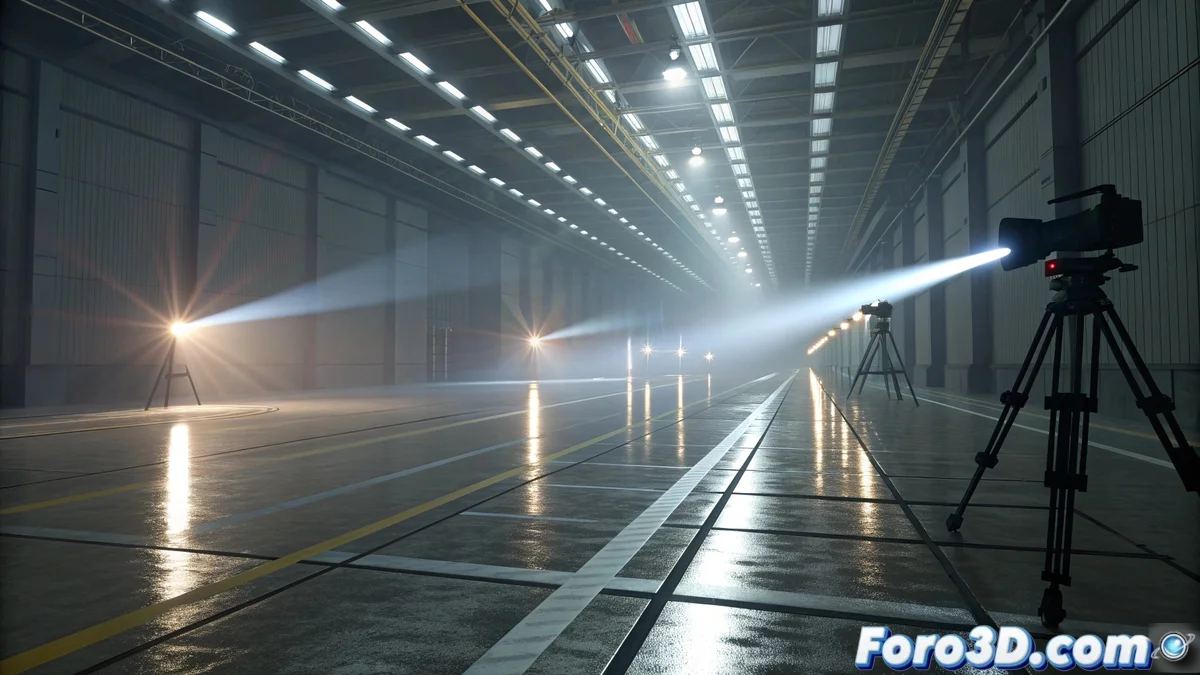
Bidirectional Path Tracing: connecting light and camera paths
In the field of 3D rendering, Bidirectional Path Tracing (BDPT) represents a significant advancement for simulating global illumination. Unlike classical path tracing, which only follows the trajectory of photons from the observer, this method generates and combines paths that start from both the camera and the light sources themselves. This dual strategy allows for more accurate calculation of how light interacts in complex environments. 🎯
A dual approach to capture light
The core of BDPT lies in building two sets of paths independently. Subsequently, the algorithm evaluates multiple ways of connecting these paths to estimate the light contribution reaching each pixel. This process is particularly effective for resolving situations where light bounces many times or concentrates in specific patterns.
Key advantages of this method:- Handles indirect lighting and complex phenomena like caustics more effectively.
- Can explore regions of the light space that other camera-based methods sample inefficiently.
- In suitable scenarios, converges to a noise-free image using fewer samples per pixel, helping to optimize processing time.
Connecting paths from the light and the camera is like organizing a meeting between photons: when the connection works, the lighting is resolved elegantly.
Complexity as a trade-off
Although its power is undeniable, implementing BDPT is not without challenges. The need to manage, store, and connect two distinct sets of paths increases the code complexity and the memory consumed during rendering.
Considerations when using BDPT:- The computational cost per sample is higher due to the additional logic for connecting paths.
- It does not always speed up rendering; in scenes with primarily direct lighting, standard path tracing may be faster and more straightforward.
- For these reasons, many modern rendering engines use it selectively or integrate it within a hybrid of techniques.
Evaluating when to use it
Bidirectional Path Tracing is a specialized tool in the rendering arsenal. Its true potential unfolds when simulating scenes with intricate lighting challenges, where other algorithms may fail or be very slow. The decision to use it should be based on evaluating the complexity of the scene's lighting against the additional cost of implementing and running this method. Understanding this balance is key to optimizing any visual production pipeline. ⚖️