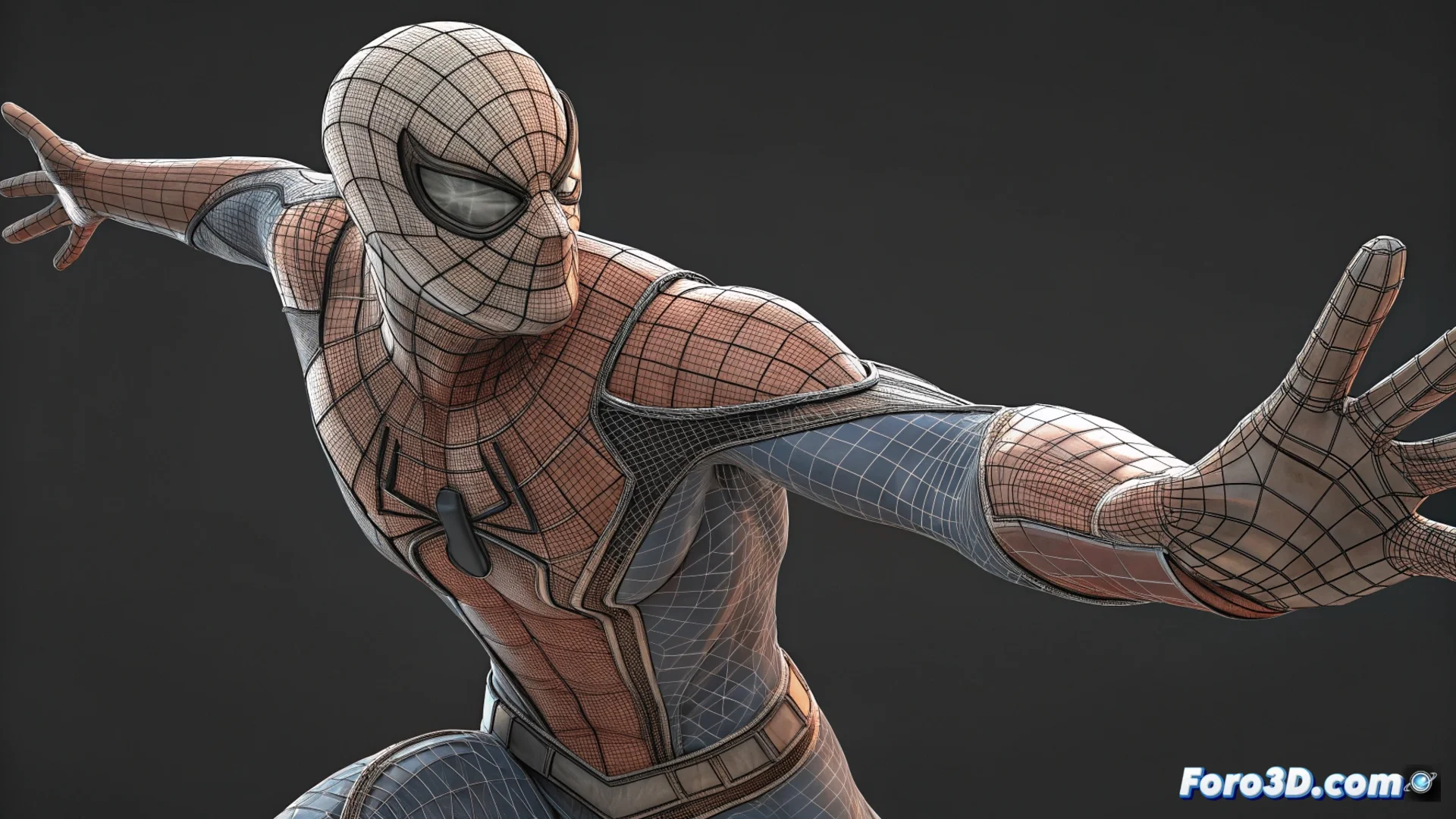
Biharmonic Coordinates for Deforming 3D Meshes
In the world of 3D animation, deforming character meshes in a believable way is a constant challenge. Biharmonic coordinates emerge as an elegant mathematical solution, calculating bone influence by solving the biharmonic equation. This process generates exceptionally smooth weight functions that behave organically, overcoming limitations of techniques like linear skinning or dual quaternions, especially with complex rotations. 🌀
Key Advantages over Traditional Methods
This system stands out for how it preserves mesh details and prevents collapse in joint areas. Unlike linear approaches, it distributes deformation globally across the entire geometry, not just in the immediate proximity of the bone. This produces more natural and consistent movements.
Main Differences:- Extreme Smoothness: Weight functions lack abrupt changes, eliminating common visual artifacts.
- Volume Conservation: The mesh better maintains its original shape under extreme deformations, crucial for animating characters.
- Less Corrective Work: Reduces the need to manually adjust hundreds of controls or blendshapes to fix the skin.
Every rigger's dream is a method that deforms well without needing an infinity of corrective controls. Biharmonic coordinates come close to that ideal.
Ideal for Non-Realistic Character Designs
This technique shines especially when animating stylized silhouettes or with exaggerated proportions. For models with very thin limbs, voluminous hair, or complex organic shapes, linear influence methods often fail. Biharmonic coordinates handle these geometries more reliably, allowing extreme poses without the mesh folding unnaturally. 🎨
Optimal Use Cases:- Cartoon Characters: Where exaggerations are fundamental and classic skinning struggles to maintain volume.
- Organic Creatures: Complex shapes that require smooth deformation transitions across their entire surface.
- High-Quality Preproduction: In pipelines where the final visual result takes priority over real-time iteration speed.
Performance Considerations
Implementing this method involves a significant computational cost. Calculating coordinates for each vertex involves solving a large sparse system of linear equations, which is typically done in a preprocessing phase. Once the weights are calculated, deforming the model in real-time is more efficient. Therefore, it is a technique adopted where deformation quality is paramount and resources are available for precomputation. It is not the fastest solution, but one of the most robust for specific visual styles. ⚙️