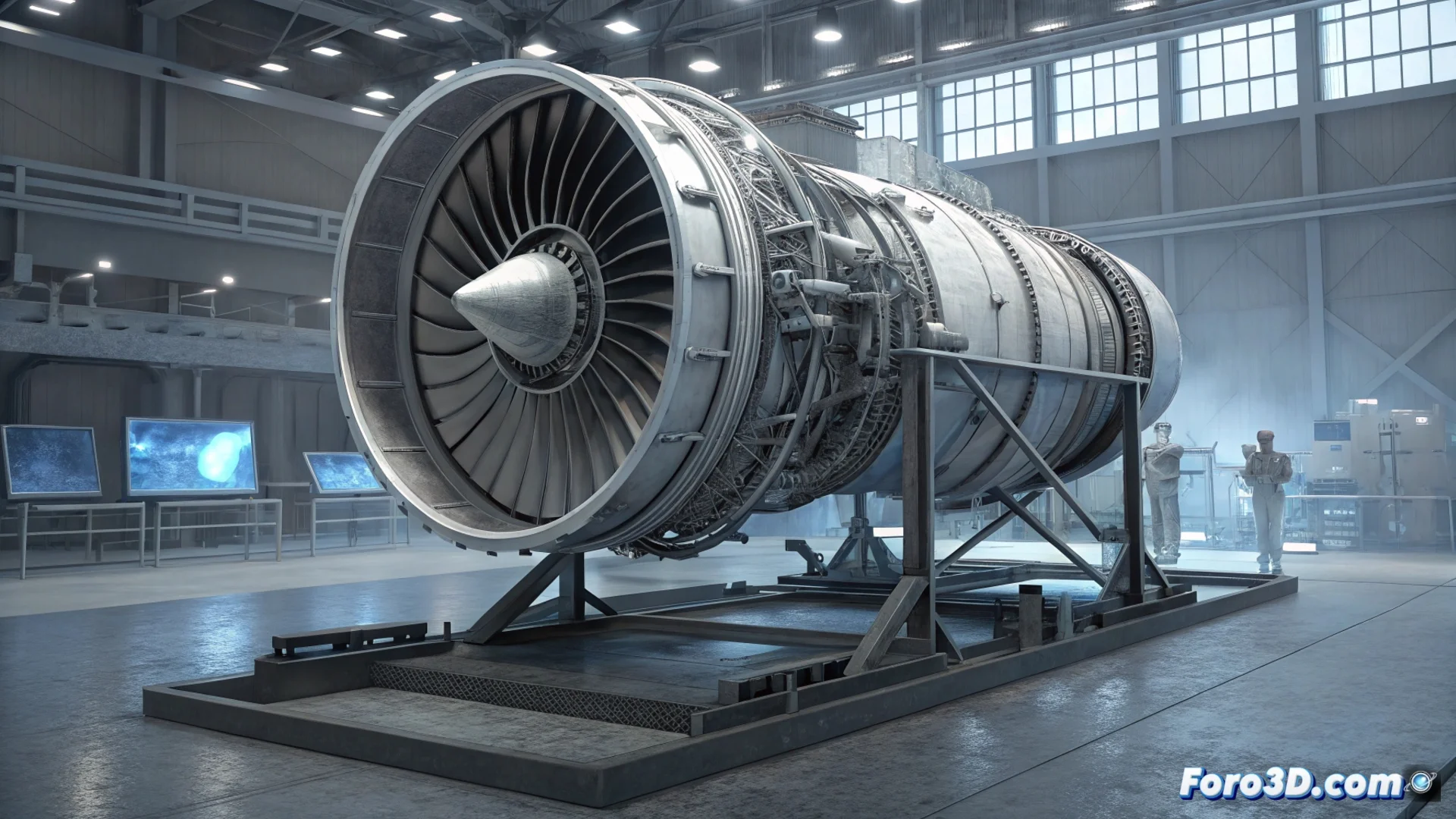
Beehive Industries Validates Its 3D-Printed Frenzy Engine in High-Altitude Tests
The company Beehive Industries has announced a technical milestone by completing high-altitude tests of its aeronautical engine Frenzy. This propulsor, manufactured mostly using additive manufacturing, has demonstrated its performance under conditions simulating real flight environments, bringing the company closer to certifying this technology for commercial use. 🚀
The Frenzy Engine Overcomes the Hostile High-Altitude Environment
During the tests, the engineering team subjected the Frenzy engine to low atmospheric pressure and extreme temperatures, accurately replicating the environment found at thousands of meters altitude. The data obtained confirmed that the engine operates as expected, maintaining its key thrust and efficiency parameters. This result is fundamental to advancing the company's goal: to offer a lighter alternative with fewer components for drones and small aircraft.
Key advantages validated in the tests:- Stable operation in rarefied atmosphere and extreme cold.
- Maintenance of nominal thrust and fuel efficiency.
- Validation of the integrated design that reduces parts and total weight.
This milestone brings Beehive Industries closer to its goal of offering a lighter alternative with fewer parts for drones and small aircraft.
3D Printing Redefines How Engines Are Produced
The use of metal 3D printing allows Beehive Industries to consolidate multiple parts into a single monolithic piece. This approach not only reduces the total weight of the engine but also drastically simplifies the assembly process and reduces potential failure points. Additionally, additive manufacturing accelerates the development cycle, as it enables iterating and testing new complex geometry designs at a speed impossible with traditional machining methods.
Impact of additive manufacturing on development:- Consolidating components into unique and optimized structures.
- Reducing the time from design to functional prototype.
- Enabling internal geometries that would be unfeasible or very costly to produce otherwise.
A Future Built Layer by Layer
The success in the Frenzy engine tests underscores the transformative potential of 3D printing in the aerospace industry. This approach could profoundly influence how propulsors are designed, tested, and manufactured in the future, prioritizing efficiency, weight reduction, and development agility. The buzz of Beehive Industries thus establishes itself as the sound of a new era in propulsion, built literally layer by layer. 🛩️