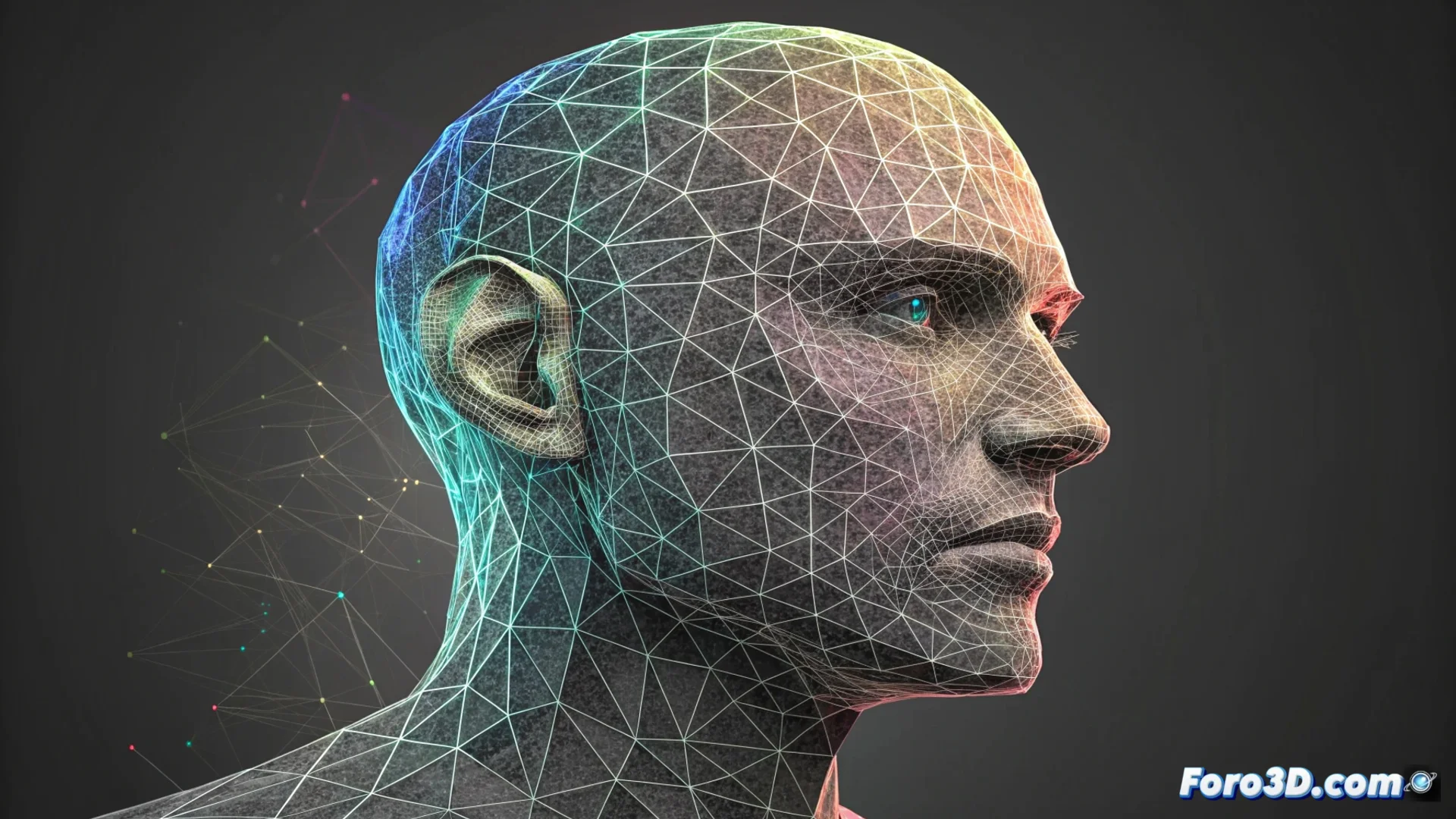
Barycentric baking: transferring data between 3D meshes
In the 3D workflow, you often need to transfer detailed information from a complex model to a simpler one. Barycentric Baking is a technique that achieves this precisely, using direct geometric correspondence between two meshes. Unlike other methods, it does not rely on ray casting, making it more robust in intricate geometries. 🎯
The core of the process: barycentric interpolation
This system works by locating each vertex of the low-resolution mesh within a specific triangle of the high-resolution mesh. It calculates the barycentric coordinates, which are three weight values that always sum to one. These weights define how much each vertex of the source triangle influences the final result. Any data, such as color, position, or texture map information, is blended using these weights and assigned directly to the destination vertex.
Key steps of the interpolation:- Locate the triangle: For each vertex of the low mesh, the software finds the corresponding triangle in the high mesh where it is located.
- Calculate the weights: The barycentric coordinates are determined, which represent the proximity of the vertex to each corner of the high-resolution triangle.
- Interpolate and assign: The desired value is blended proportionally with the weights and "baked" or stored in the vertex of the simple mesh.
The real challenge is not baking the mesh, but finding which high-resolution triangle corresponds to each low-resolution vertex without the software taking too long to think.
Advantages over raycast baking
The traditional raycast method shoots rays from the low mesh surface, which can fail in complex areas. Barycentric Baking overcomes these limitations by relying on direct geometric correspondence, producing cleaner and more precise results.
Main benefits of this technique:- Avoids occlusion artifacts: It handles deep cavities and folds better, where a ray might not hit correctly or generate erroneous shadows.
- Precision in fine details: It is excellent for transferring information in areas with complex geometry or very small surface details.
- Topological independence: It works well with meshes that have very similar shapes but do not share the same vertex and polygon structure.
Practical applications in production
This technique is fundamental in several stages of digital production. It is frequently used to create high-fidelity normal or displacement maps, capturing the details of a sculpted model into an optimized mesh for rendering. It is also crucial in animation, for transferring skin data or rig weights from a complex rig to a simplified version of the model, speeding up the animation process without losing deformation quality. Its strength lies in ensuring reliable data transfer where other methods might fail. 🚀