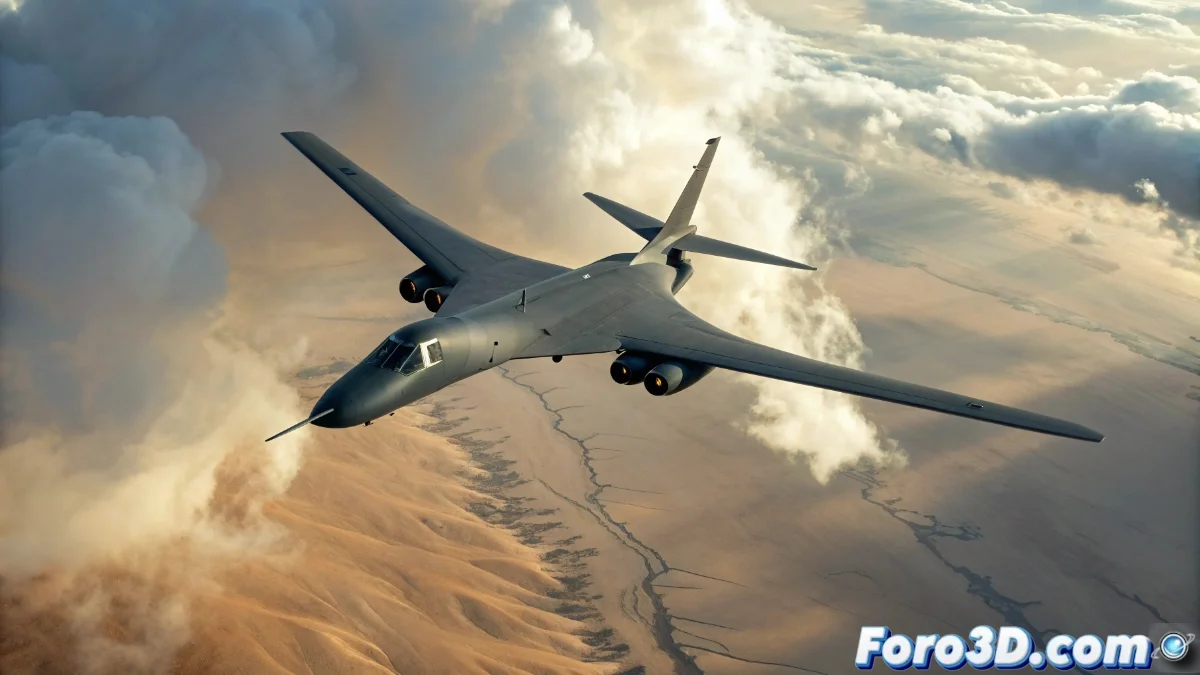
B-1B Lancer: the strategic bomber with variable-geometry wings
The B-1B Lancer represents one of the most advanced developments in supersonic bombers of the United States Air Force, standing out for its innovative variable-geometry wings system that dynamically adapts to different flight conditions. With a length of 44.5 meters and a wingspan ranging from 41.8 meters extended to 24.1 meters in folded configuration, this aircraft maintains an optimized aerodynamic profile for long-range missions. Its structure incorporates four engines in twin nacelles and radar-absorbent materials, significantly reducing its electromagnetic signature. ✈️
Weapons configuration and operational versatility
This strategic bomber features an impressive weapons payload capacity of up to 34,000 kilograms, distributed in three internal bays that accommodate a wide range of munitions. Among its weapon systems are conventional free-fall bombs, precision-guided munitions, and up to 24 AGM-158 JASSM cruise missiles, designed to neutralize targets at extreme distances. This flexibility allows it to execute interdiction missions, close air support, and nuclear deterrence, using rotary launchers and multiple racks that maximize its effectiveness in real combat scenarios. 💥
Key weapons features:- Modular internal bays for conventional and guided bombs
- Capacity for 24 long-range AGM-158 JASSM cruise missiles
- Rotary launch systems that optimize payload distribution
The adaptability of the B-1B Lancer in conventional and nuclear missions makes it a pillar of modern strategic deterrence.
Essential technical details for 3D modeling
For precise 3D modeling of the B-1B Lancer, it is crucial to capture the complexity of its variable wing articulations, which adjust automatically based on speed and altitude. The twin nacelles house General Electric F101 engines with a combined thrust of 136,000 newtons, requiring detailed attention to their geometry and arrangement. The fuselage integrates numerous access panels, avionics sensors, and antennas, while the tricycle landing gear must reflect its robustness for operating on semi-prepared runways. Applying realistic textures that include fuel lines, maintenance panels, and aerodynamic control surfaces will visually enrich the model, complemented by animations of weapons bay doors and movable surfaces. 🎨
Critical elements for texturing and animation:- Variable wing articulations with automatic adjustment mechanisms
- Details of twin engine nacelles and exhaust systems
- Animations of weapons bay doors and aerodynamic control surfaces
Final considerations for 3D enthusiasts
The B-1B Lancer combines stealth capabilities with an advanced aerodynamic design, although its reduced profile does not always avoid misidentifications during identification exercises, where it can be mistaken for unconventional objects. For 3D modelers, it represents a rewarding challenge due to its complex mechanical systems and the need to balance structural realism with resource optimization. Mastering the recreation of its components, from the landing gear to the movable surfaces, will enable the generation of highly detailed models suitable for simulations and high-quality renders. 🚀