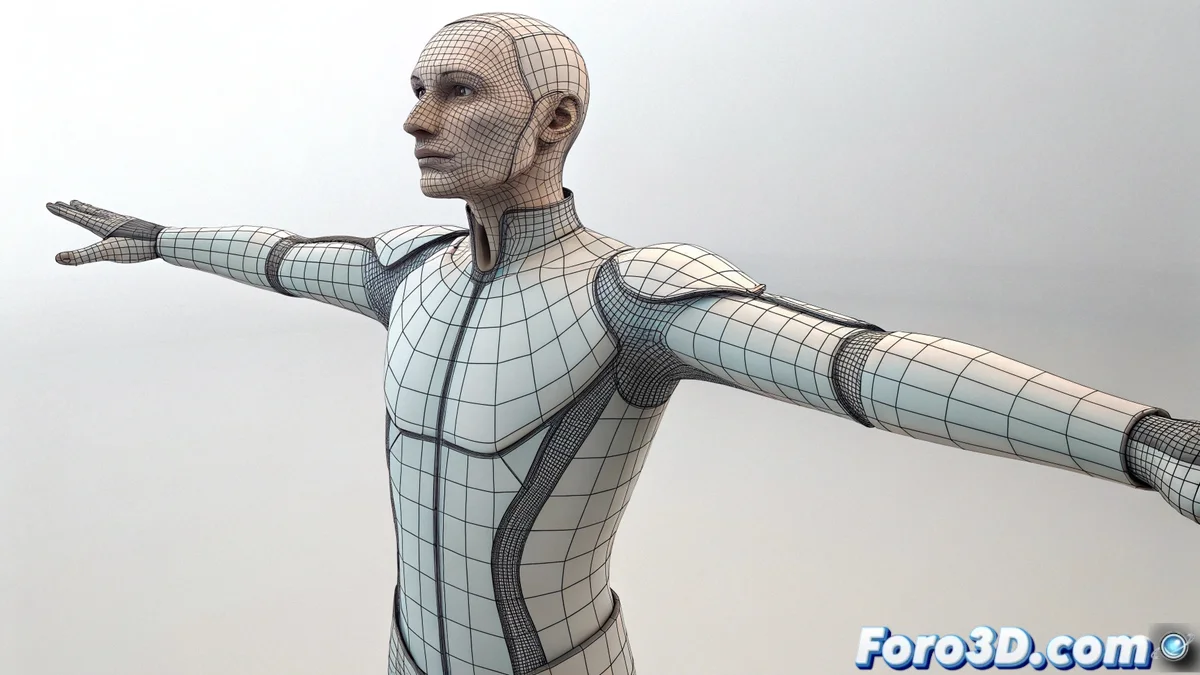
Avoiding Animated Characters Moving Like Robots
In animation, a common mistake that causes characters to lose credibility is the twinning effect. This occurs when arms and legs move in a perfectly symmetrical and synchronized manner, creating a mechanical and unnatural appearance. The key to solving it lies in a fundamental principle called staggering or offset. 🎬
Breaking Symmetry with Offsets
The main solution is to not animate both sides of the body simultaneously. Instead of the left and right arms starting on the same frame, one should begin its action a few frames later. Additionally, it is crucial to vary the final and intermediate poses, avoiding them being an exact mirror reflection. One arm may flex more, or a hand may trace a slightly different arc. This asymmetry applies equally to the legs when walking or running, where body weight transfers from one side to the other in an alternating and uneven manner.
Key actions to implement:- Offset in time: If one arm starts on frame 1, the opposite can start on frame 3 or 4.
- Vary trajectories and arcs: Hands and feet should not follow identical paths.
- Differentiate poses: Avoid mirror images in key and in-between poses.
A character waving with both arms at the same speed looks more like an automaton in an air safety demonstration than a living being.
Study Reality and Stylize
Analyzing reference videos of people in action is essential to capture natural asymmetry. Even in apparently symmetrical movements, like jumping, there are small differences in how we position our limbs. In animation, this principle is often exaggerated to make it clearer and more visually stylized. More weight or prominence can be given to one side of the body, while the other side acts as support or counterweight, generating a more dynamic and believable line of action.
Steps for organic movement:- Observe real references: Study how people move to understand natural imperfections.
- Exaggerate differences: Slightly amplify asymmetry to make it perceptible on screen.
- Define a main side: Assign a dominant action to one side of the body and use the other to balance.
Conclusion for Animating with Life
Avoiding the twinning effect is fundamental to bringing characters to life. Applying the staggering principle through temporal offsets and spatial variations in the limbs simulates human organic movement. Combining this technique with the study of real references and controlled exaggeration allows creating animations that viewers perceive as natural, dynamic, and full of weight. The goal is always for the movement to flow, not to be executed robotically. 🤖➡️🧍