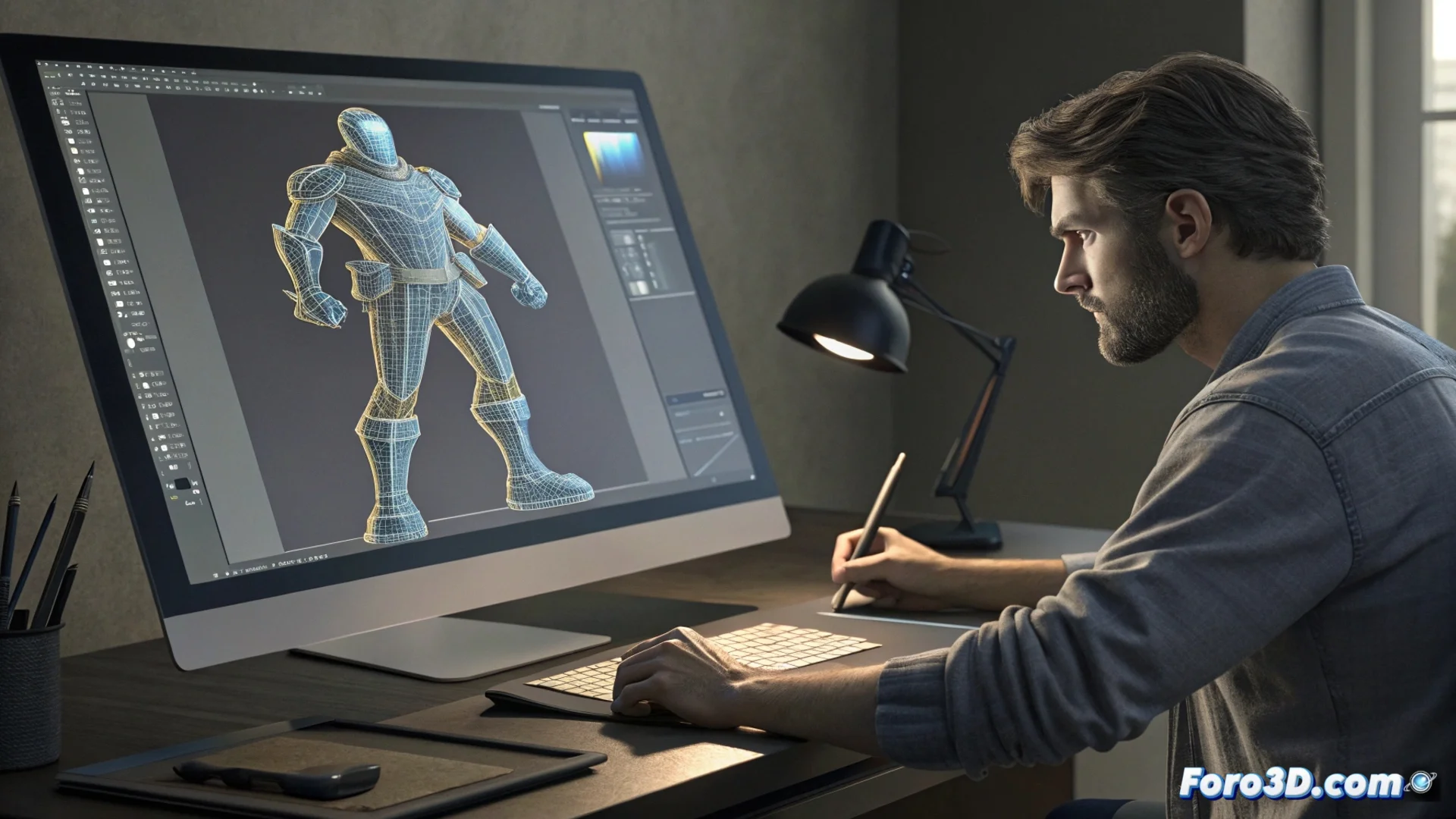
AutoUV in Wings 3D: Automating UV Coordinate Unwrapping
Creating a UV map from scratch is a time-consuming task. Wings 3D includes the AutoUV tool, designed to automate much of this initial process. It analyzes the geometry of a 3D model, decides where to cut, and projects the surfaces onto a 2D plane, organizing the resulting pieces efficiently. 🛠️
How does the automatic process work?
AutoUV operates through an algorithm that examines the mesh of the object. Its main goal is to identify optimal edges for making cuts, breaking down the three-dimensional shape into flat parts called UV islands. Once generated, the tool organizes them within the available UV space, trying to minimize empty areas and make the most of the 0-1 quadrant. This provides a solid foundation to work on.
Key parameters you can control:- Projection method: Allows choosing between options like cylindrical or spherical to better adapt to the base shape of the model.
- Seam angle limit: Defines the angle from which the algorithm will automatically create a cut or seam in the mesh.
- Tolerance for merging UV vertices: Sets the proximity needed for vertices in UV space to merge, avoiding unwanted overlaps.
AutoUV is a great initial ally, until you closely examine how it unwrapped an apparently simple face and question its internal logic.
The importance of subsequent manual adjustment
Although it greatly accelerates the workflow, the result of AutoUV is rarely production-ready. Automation can place cuts in unintuitive locations or distort complex geometries. Therefore, its role is to serve as a powerful starting point that eliminates the most tedious part, but requires the artist's intervention to perfect the details. 🔍
Common refinement actions after using AutoUV:- Manually reorganize islands: Move and rotate the islands to achieve a more logical distribution and more efficient UV space packing.
- Redo specific cuts: Remove automatic seams in critical areas and create new ones where the algorithm did not consider them necessary.
- Correct distortions: Manually adjust the scale and proportion of islands in areas where the automatic projection stretched or compressed the texture too much.
Integrating AutoUV into your workflow
To get the most out of this tool, it is recommended to use it on models with clean topology. Understanding and experimenting with its parameters allows obtaining a more coherent base unwrap. The final step should always be a thorough manual review and adjustment to ensure the UV map meets the quality standards necessary for texturing or rendering. AutoUV does not replace the artist, but gives them a significant initial advantage. ✅