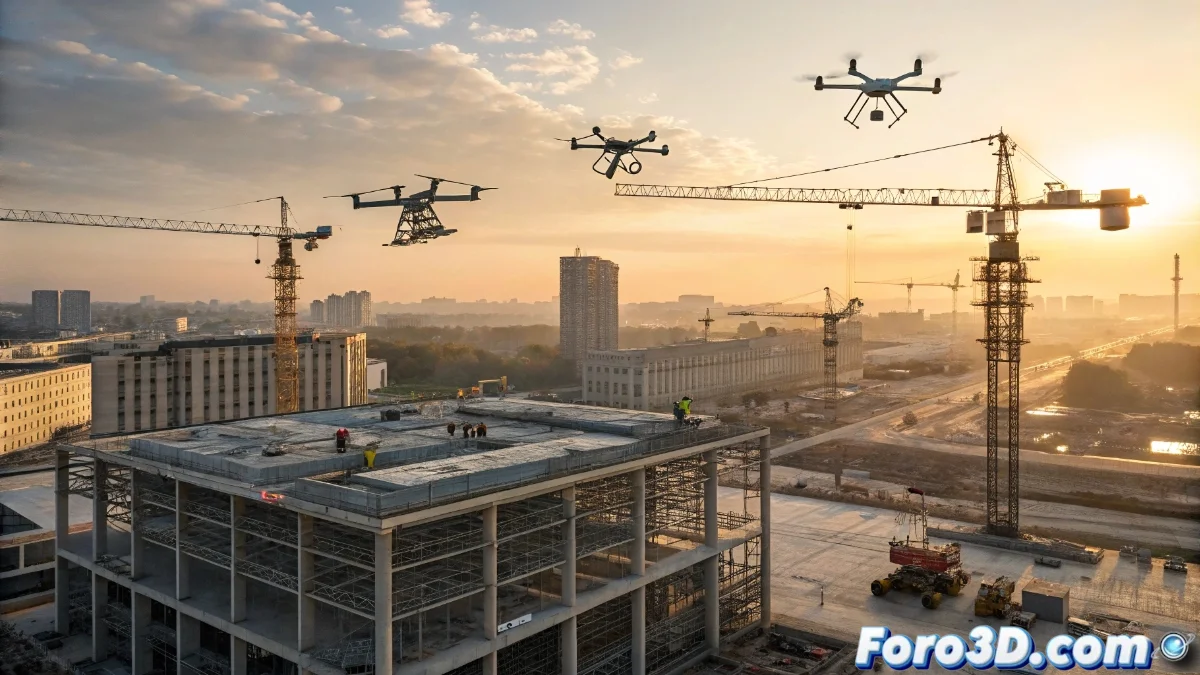
Autonomous Drone Swarms Revolutionize Construction and Mapping
Autonomous drone fleets are completely redefining traditional paradigms in the construction and mapping sectors through their capacity for intelligent collaborative work. These coordinated systems operate under principles of collective intelligence that enable the execution of complex operations with unprecedented efficiency in the industry 🚀
Collaborative Systems Architecture
The technological foundation of these autonomous swarms is based on sophisticated coordination algorithms and real-time obstacle avoidance mechanisms. Each aerial unit incorporates LiDAR sensors, multispectral cameras, and communication systems that facilitate environmental perception and instantaneous data exchange.
Key technological components:- LiDAR sensors for precise three-dimensional capture of the environment
- Inter-drone communication systems for real-time information exchange
- Collaborative route planning algorithms and collision avoidance
The symbiosis between centralized control and individual autonomy allows the collective to function as a unified and highly efficient organism
Transformative Applications in the Industry
In the field of digital construction, these systems perform everything from autonomous material transport to 3D printing of complex structures. Simultaneously, they monitor project progress by comparing digital models with captured reality, generating orthomosaics and elevation models in fractions of the traditional time.
Practical implementations:- Automated transport and placement of lightweight construction components
- Generation of three-dimensional digital models of large areas in hours
- Detailed inspection of critical infrastructure from multiple simultaneous angles
Considerations and Future Perspectives
The implementation of these drone swarms represents a qualitative leap in precision and speed, although it introduces new challenges in project management. The dynamic adaptability of these systems allows for immediate responses to changing conditions, optimizing resources and significantly reducing execution times. The evolution toward fully decentralized architectures promises even greater levels of autonomy and operational efficiency in the near future 📈