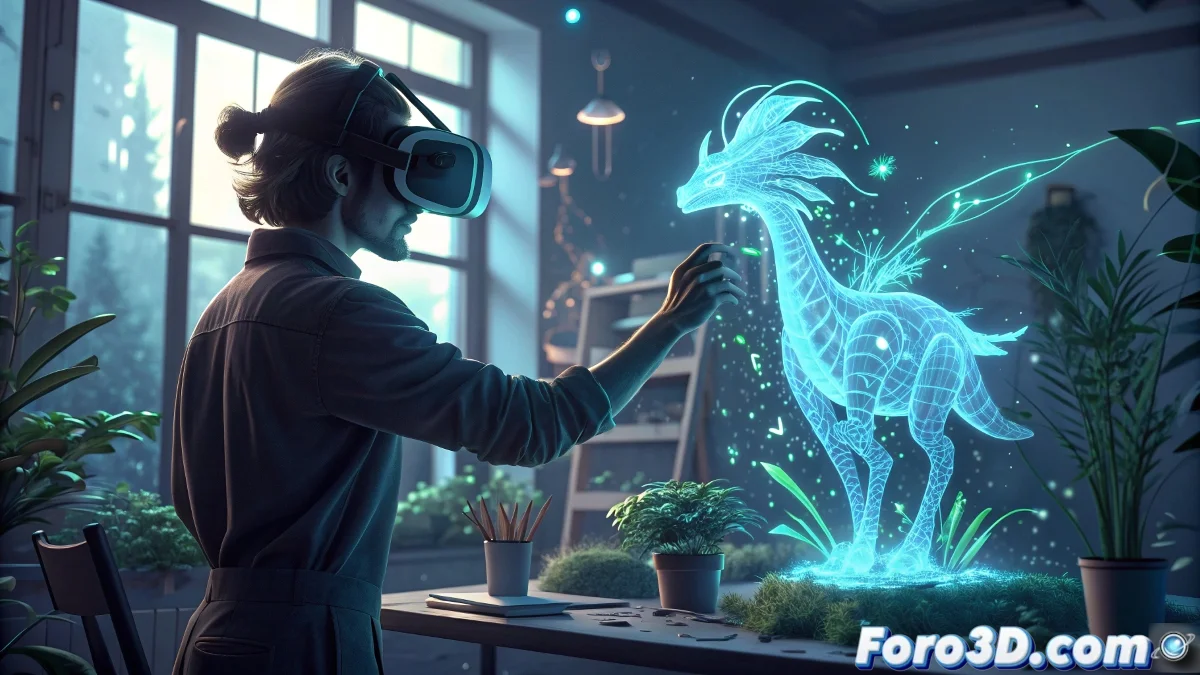
The Immersive Revolution: How AR and VR Are Transforming the 3D Job Market
The commercial explosion of Augmented Reality (AR) and Virtual Reality (VR) technologies has triggered an unprecedented demand for 3D modelers, creating a job landscape where specialized skills in creating assets for immersive environments have become the most sought-after in the digital industry. What began as niche technologies has evolved into a mass market requiring industrial quantities of 3D content, permanently transforming expectations and requirements for digital artists. 🕶️🎨
The New Digital Gold Rush: Why Every Pixel Counts Triple
The interactive and immersive nature of AR and VR has raised quality standards while introducing entirely new technical requirements. Modelers no longer create just for flat screens—their work must function perfectly in three-dimensional spaces where users can examine every detail from centimeters away, creating a need for optimized geometry and ultra-high-resolution textures.
Booming Specializations Within 3D Modeling
The demand has generated a specialized fragmentation within the 3D modeling field, with specific roles emerging for different aspects of immersive content creation.
Modeling for Augmented Reality
AR specialists must master the art of creating models that integrate seamlessly with the real world. This requires deep understanding of surface tracking, environmental lighting matching, and mobile device optimization. Assets must look credible when overlaid on variable physical environments.
Modeling for Virtual Reality
VR artists face the unique challenge of creating complete worlds that run at 90 fps while maintaining total immersion. This demands expertise in extreme LOD (Level of Detail), draw call optimization, and user comfort understanding in 360° spaces.
New Specialized Roles:- Artist for mixed reality environments
- XR Optimization Specialist
- 3D Interaction Designer
- Spatial Computing Technician
Technical Requirements Redefining 3D Skills
The unique demands of AR and VR have created a specific skill set that differentiates traditional modelers from immersive content specialists.
Extreme Optimization as the Norm
Where a 50,000-polygon model was once acceptable, limits can now be 5,000 polygons to maintain stable framerates. Artists must master advanced retopology techniques, texture baking, and normal map creation that simulate complexity without geometry.
Texturing for Close Inspection
Textures must withstand inspection from very short distances, requiring 4K and 8K resolutions as standard. PBR (Physically Based Rendering) has become mandatory to maintain visual consistency under different real and virtual lighting conditions.
The modern 3D modeler is no longer just an artist—they are an experience engineer who must balance aesthetics, performance, and user comfort in every vertex created.
Job Market: Opportunities and Compensation
The shortage of specialized talent has created an extremely favorable market for modelers with AR/VR skills, with salaries significantly exceeding those of traditional 3D roles.
Sectors with Highest Demand
From retail and e-commerce implementing virtual try-ons, to the healthcare sector developing medical simulations and education creating immersive learning environments—virtually all industries seek to incorporate 3D capabilities into their operations.
Competitive Compensation
Senior AR/VR specialists can command salaries 40-80% higher than their counterparts in traditional 3D industries, reflecting both the talent shortage and the strategic value these skills represent for companies.
Industries with Highest Growth:- Retail and Product Visualization
- Corporate Training and Simulation
- Tourism and Cultural Experiences
- Automotive and Architecture
Impact on Tools and Workflows
The AR/VR boom has forced the accelerated evolution of 3D software and the creation of new tools specific to the immersive pipeline.
Integration with Real-Time Engines
Blender, Maya, and 3ds Max have developed native connectivity with Unity and Unreal Engine, while tools like Substance Painter have become essential for creating materials that look perfect under dynamic lighting.
New Collaboration Paradigms
Teams now work in real-time collaborative development environments, where multiple artists can edit the same scene simultaneously from different locations, reflecting the distributed nature of the global industry.
Training and Talent Development
The gap between supply and demand has driven an explosion in specialized educational programs, from intensive bootcamps to university master's degrees focused specifically on XR content creation.
Cross-Cutting Skills Required
Beyond technical mastery, successful modelers in this space must understand 3D UX/UI principles, human-computer interaction, and even basic programming concepts to collaborate effectively with developers.
The Future: When Everything Will Be 3D and Interactive
With the arrival of the metaverse and web3, the demand for 3D content is far from reaching its peak. Experts predict that within five years, more than 50% of consumed digital content will have interactive 3D components, ensuring the continued relevance of these skills.
Evolution Toward Real-Time Creation
Tools are evolving toward creation systems directly in headsets, allowing artists to sculpt and texture in the final medium, eliminating barriers between creation and consumption.
The convergence of AR and VR is not just a technological trend—it is a fundamental shift in how we interact with the digital, and 3D modelers find themselves in the unique position of shaping this new landscape where physical and digital worlds merge into seamless experiences that are redefining reality itself. 🌐✨