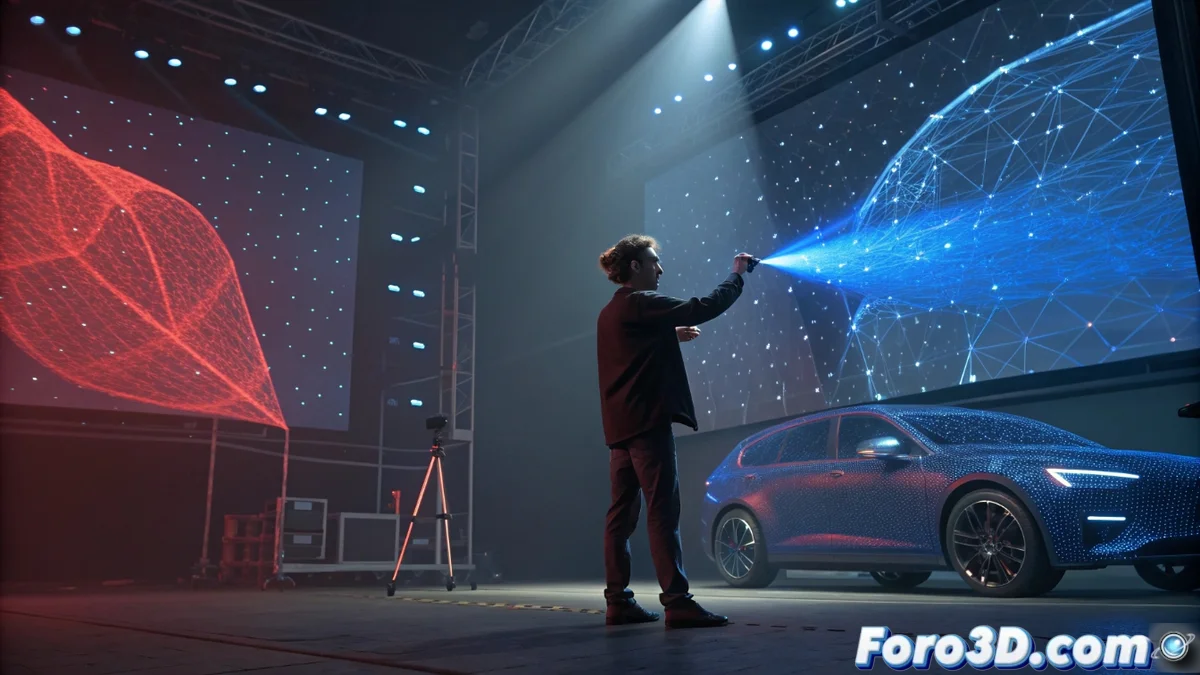
Attribute Painting in 3D Simulation: Precise Control of Visual Effects
In the fascinating world of digital simulation, attribute painting emerges as a revolutionary methodology where creators apply specific attributes directly onto three-dimensional geometries. This artistic approach allows for localized and intuitive manipulation of simulation parameters, using virtual brushes to demarcate specific regions where certain physical behaviors should be intensified or softened 🎨.
Technical Fundamentals of Attribute Painting
Common attributes include vertex colors, weight maps, friction coefficients, humidity levels, thermal values, and variable densities, which later feed into simulation engines to generate more believable and customized results. This technique transforms homogeneous surfaces into physically varied environments, where each brushstroke contributes to the final realism of the simulation.
Essential Attributes in Simulations:- Friction Maps to control interactions between surfaces and objects
- Density Distribution in fluid and atmosphere simulations
- Humidity Patterns that affect absorption and evaporation
Attribute painting works as the secret language between the artist and simulated physics, where each stroke tells a story of forces and behaviors.
Applications in Professional Software
In specialized platforms like Houdini, attribute painting is deeply integrated into the VFX workflow. Artists use this methodology to direct fluid simulations, cloth dynamics, particle systems, and rigid body behaviors, defining high-friction zones on floors, wet regions on surfaces, or variable density areas in clouds and smoke. This granular control prevents simulations from behaving uniformly, incorporating variability and authenticity where default physics would be overly homogeneous or predictable.
Main Use Cases:- Fluid Simulations with different viscosities and behaviors
- Cloth Dynamics with areas of different elasticity and weight
- Particle Systems with non-uniform property distribution
Integration into Production Pipelines
Attribute painting acts as a fundamental connector between modeling and simulation stages, enabling rapid iterations without the need to adjust complex global parameters. Painted maps are stored as vertex attributes or specialized textures that simulation solvers interpret during computation, providing immediate visual feedback in the viewport. This operational immediacy significantly accelerates the creative process, as artists observe how their interventions affect dynamic behavior in real time, adjusting attribute intensity and transitions with millimeter precision ⚡.
The Art of Controlled Chaos
It is always fascinating to understand that our digital experiments can generate meticulously controlled chaos in simulated universes, where a brush overly loaded with friction transforms an elegant cloth into a towel persistently stuck to the virtual ground. This manipulation capability represents the very essence of attribute painting: converting artistic intuition into precise physical behaviors that elevate the realism of digital simulations to extraordinary levels 🚀.