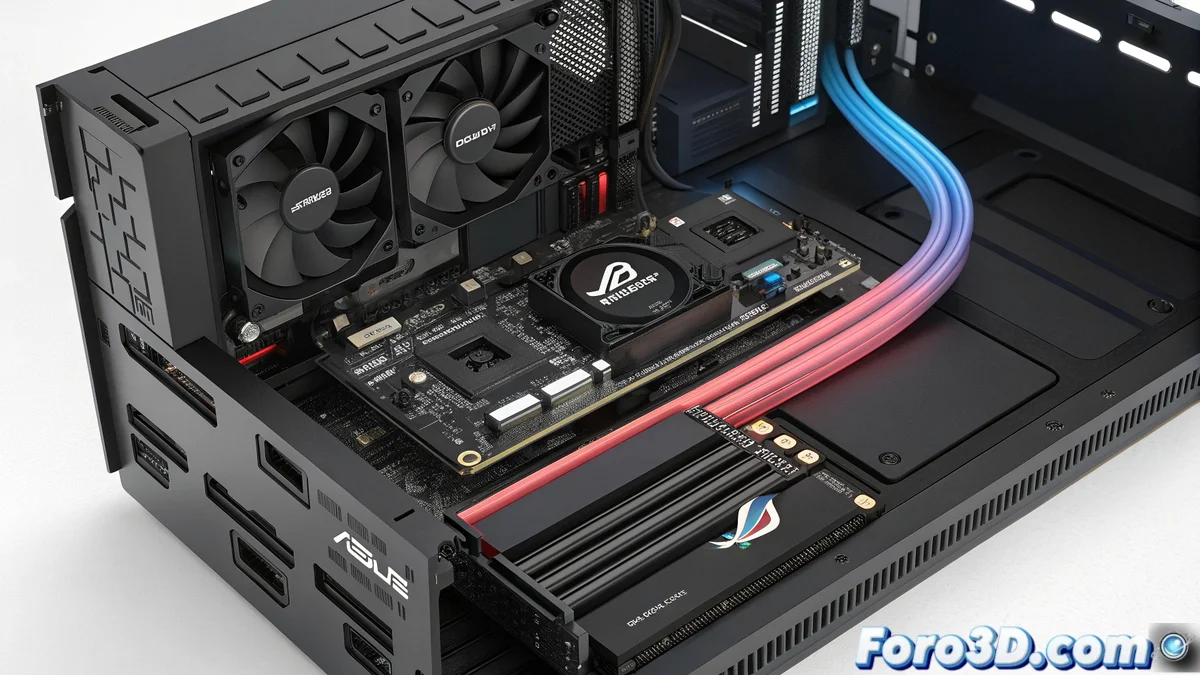
The End of the Cable Jungle in Your PC
ASUS may have found the solution to one of the most common headaches for PC builders: graphics card power cables. Their prototype, dubbed GC-HPWR, is a PCIe connector that integrates power delivery directly into the motherboard slot, completely eliminating the need for cumbersome 8 or 16-pin cables. 🔌 This innovation not only promises to greatly simplify the assembly process but also to achieve a cleaner interior with better airflow. It's such a simple idea that one wonders why it wasn't implemented before.
How Does This Engineering Marvel Work?
The GC-HPWR concept is elegant in its simplicity. Instead of relying on separate cables that connect to the top or side of the GPU, power travels through the motherboard's own traces to the reinforced PCIe slot. 🚀 This requires, of course, that both the motherboard and the graphics card be designed for this new standard. ASUS aims for this technology to be adopted by manufacturers in future hardware generations, which could mark a turning point in the design of high-performance computers.
Advantages Beyond Aesthetics
The absence of cables isn't just about looks. A clear interior allows for better air circulation, which translates to lower temperatures for all components. For custom liquid cooling enthusiasts, it means removing an obstacle when planning tube routes. 💨 Furthermore, it reduces the risk of a poorly connected or low-quality cable causing stability issues, a surprisingly common failure in builds with very demanding GPUs.
The greatest innovation is sometimes not adding something new, but removing what has always been in the way.
The Implementation Challenge
Like any prototype, the GC-HPWR faces significant challenges. The main one is the electrical power it must handle. The most powerful graphics cards can consume over 450 watts, and safely and stably conducting that energy through the motherboard requires a robust design of the power traces and connectors. Another challenge is achieving mass adoption by GPU manufacturers, who would have to redesign their products to be compatible.
The key advantages of this system are:
- Simplified Assembly: Installing a GPU would be as easy as inserting it into the slot.
- Thermal Improvement: Fewer obstructions for airflow inside the case.
- Superior Aesthetics: Minimalist builds free of messy cables.
- Reduced Errors: Eliminates the risk of improperly connecting power cables.
What Does It Mean for the Future of PCs?
If the GC-HPWR standard is adopted, we could be looking at a paradigm shift similar to the arrival of PCIe slots in their day. Power supply manufacturers would also have to adapt, possibly developing models with fewer peripheral cables. 🔧 For the end user, it would mean a more intuitive and less error-prone assembly experience, bringing the world of high-performance PCs closer to a less technical audience.
A Final Thought with Humor
So, in the not-too-distant future, the act of wrestling with a 16-pin cable in a tight space might become a nostalgic memory. Veteran PC builders will be able to tell new generations: "Back in my day, we had to connect cables! And we liked it!". 😅 Meanwhile, ASUS continues to work so that the only complication when building your PC is deciding which game to install first.