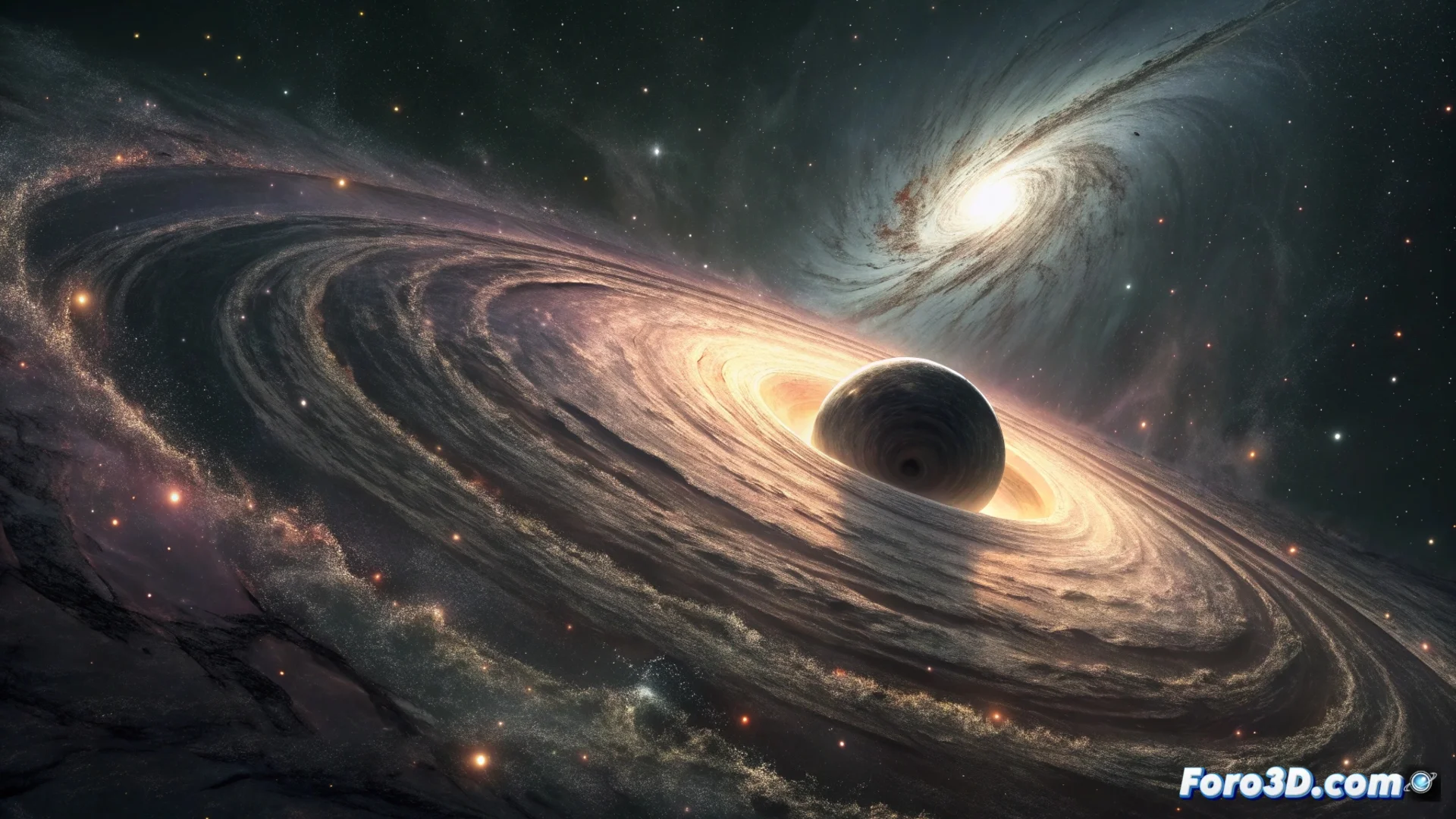
Astronomers Seek to Create a 3D Video of a Black Hole
A global team of astronomers has launched an ambitious project to produce the first three-dimensional video that captures the activity of a black hole. This goal extends the boundaries of the iconic 2019 static photograph, now seeking to visualize how matter moves and behaves in real time near these gravitational monsters. 🌀
From the Still Image to the Dynamic Sequence
The central plan is to go beyond the historic snapshot of the M87* black hole. Researchers will coordinate a worldwide network of radio telescopes to obtain multiple observations over time. They will combine this real data with new computational techniques to process images and reconstruct a coherent visual sequence. The ultimate goal is to reveal the structure and dynamics of gas in the universe's most extreme environment.
Fundamental Pillars of the Project:- Integrate observations from the Event Horizon Telescope (EHT) and other observatories.
- Develop more complex and powerful algorithms to interpret weak and distorted radio signals.
- Coordinate global observation campaigns to collect data at different times.
If they succeed, we might finally see how a black hole has breakfast, lunch, and dinner on spacetime, although the menu remains a mystery on the card.
Overcoming Monumental Technical Obstacles
Generating this video involves overcoming considerable challenges. The amount of information they must collect and process is colossal. Additionally, methods must be perfected to form an accurate animation from fragmentary data, testing fundamental physics theories under extreme gravity conditions.
Main Challenges to Face:- Handle and store massive volumes of data from multiple simultaneous observations.
- Create algorithms that can reconstruct a reliable temporal sequence from interferometric signals.
- Validate visual results against theoretical models and supercomputing simulations.
A New Chapter for Visual Astrophysics
This effort not only seeks to produce an innovative video but also to offer an unprecedented tool for testing general relativity. By capturing motion, scientists will be able to analyze processes such as matter accretion and plasma ejections with unprecedented detail, marking a milestone in how we perceive the cosmos's most energetic phenomena. 🔭