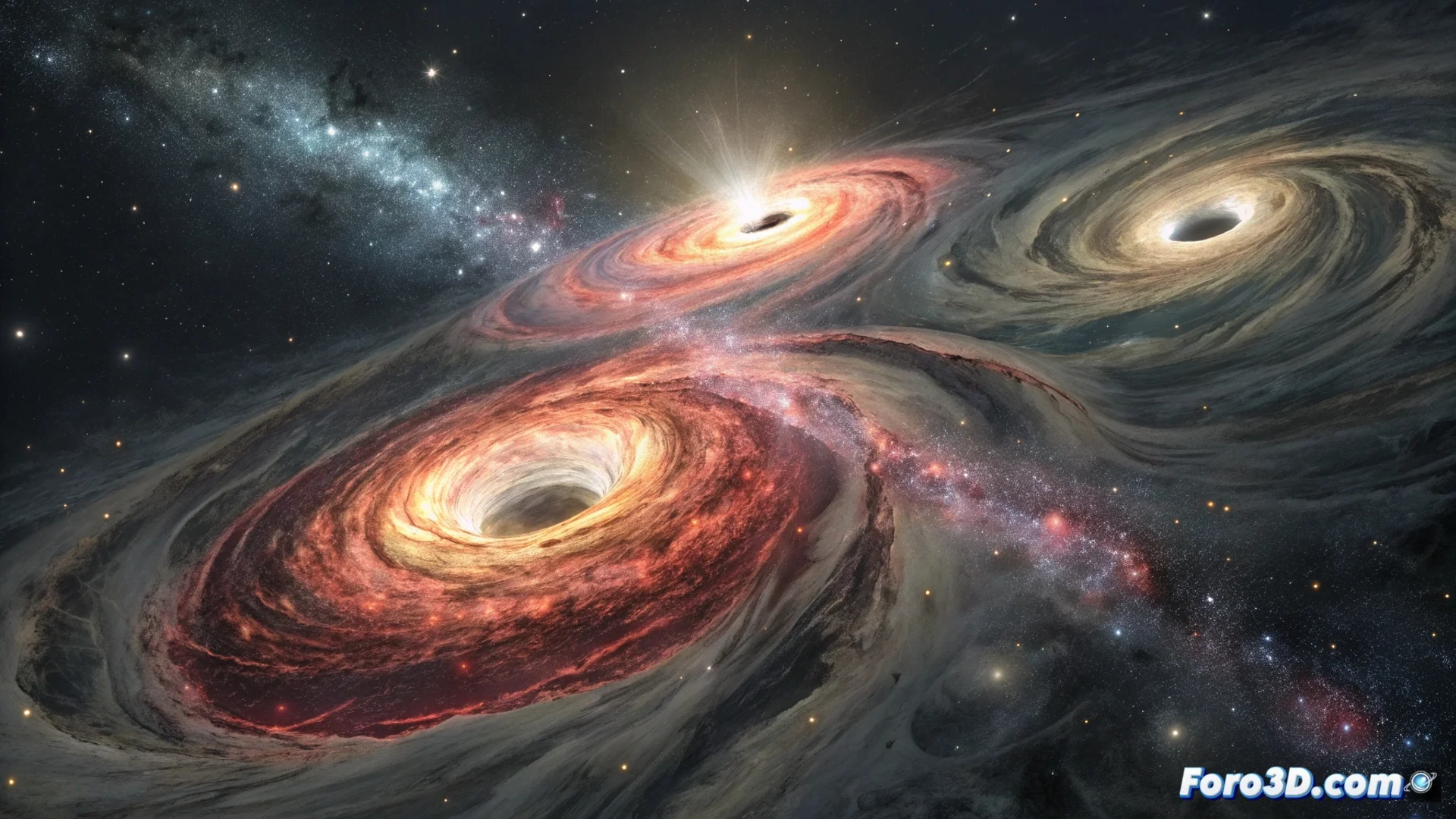
Astronomers Detect a Triple Supermassive Black Hole System
Astronomy records an exceptional cosmic event: the first confirmed detection of a trio of supermassive black holes actively feeding while their host galaxies merge. This system, cataloged as J1218/1219+1035, is located at a colossal distance of approximately 1.2 billion light-years from our planet. Observing this triple interaction is a stroke of scientific luck, as it freezes a fleeting moment on the universe's timescale. 🌌
The Gravitational Dance of Three Titans
The three galaxies containing these cosmic monsters are in a very advanced phase of collision. Combined data from radio and optical observations confirm that the three active galactic nuclei are consuming matter at a frenzied rate, releasing enormous amounts of energy. Over eons, gravitational interaction will cause them to lose orbital energy and inexorably draw closer.
The Future of This Cosmic System:- The three black holes and their galaxies will merge to form a single massive elliptical galaxy.
- At the heart of that new galaxy will reside a single supermassive black hole, the product of the union of the original three.
- This process is a fundamental mechanism for building the largest structures we see in the current cosmos.
"This discovery confirms that multiple galaxy mergers are a key engine for forming the most massive structures we see today."
Scientific Implications of the Discovery
Detecting this triple system is not just a curiosity; it opens a unique window to study how the universe's most massive objects grow. It allows scientists to directly analyze the role of successive mergers in the evolution of galaxies and their nuclei.
Key Research Areas:- Understanding how supermassive black holes grow through cosmic cannibalism.
- Modeling more accurately what happens when galaxies collide with each other.
- Searching for the ultra-low frequency gravitational waves that systems like this must generate, although detecting them will require future instruments like the LISA space mission.
An Ephemeral Moment on a Cosmic Scale
This discovery underscores that even the universe's most titanic phenomena occur in brief time windows compared to cosmic age. Capturing a triple black hole system in full merger dance is direct testimony to the violent and fundamental processes that sculpt the cosmos. The finding suggests that, to reach colossal sizes, even black holes must join forces (and masses) with their neighbors. ⚫⚫⚫