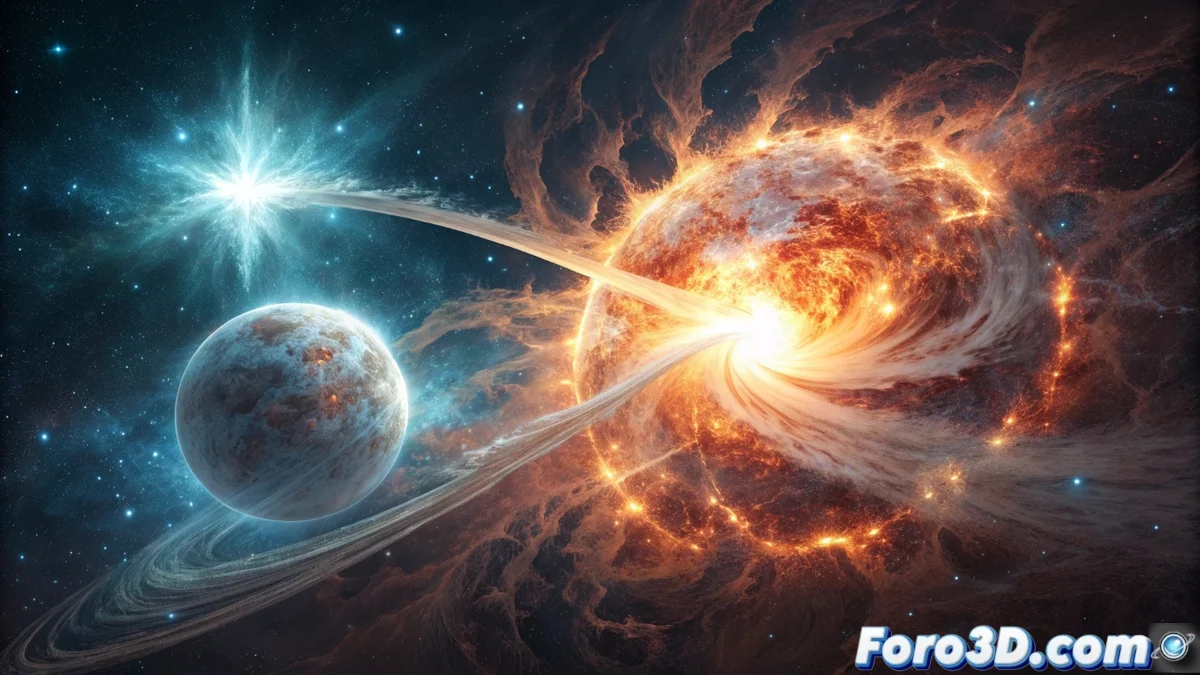
Astronomers Capture Nova Explosion in Real Time for the First Time
A group of astronomers has published in Nature Astronomy an unprecedented finding: the first direct images showing how two classical novas explode. Using the CHARA optical interferometer in the United States, the team was able to observe the process evolve with unprecedented detail, revealing a dynamic that surprises the scientific community. 🔭
The Power of the CHARA Interferometer
The Center for High Angular Resolution Astronomy (CHARA) employs a technique called interferometry, which combines light from six telescopes to simulate a giant instrument. This allows distinguishing the finest details in extremely distant astronomical objects. Thanks to this extreme resolution, the researchers were able to resolve the changing structure of the novas V1674 Herculis and V1405 Cassiopeiae shortly after their brightness increased dramatically.
Keys to CHARA's Success:- Combines six telescopes to achieve resolution equivalent to an instrument hundreds of meters in diameter.
- Optical interferometry technique allows seeing details that conventional telescopes cannot capture.
- Enables observing transient events, such as stellar explosions, practically in real time.
"We managed to see how the explosion's structure evolves with unprecedented detail," the researchers highlight about the process.
A Morphology that Challenges Theories
The obtained images do not show the simple spherical shape that some theoretical models predicted for these explosions. Instead, they reveal elongated and asymmetric structures. This indicates that the ejected material interacts with the environment in a complex way or that the accretion process in the progenitor binary system directly influences the final geometry of the explosion.
Implications of the Discovery:- The non-spherical shape suggests that the local environment or the binary system's dynamics shape the explosion.
- These findings force a review and adjustment of current theories on how classical novas develop.
- It shows that cosmic phenomena are often more complex and less symmetric than imagined.
Impact on Cosmic Understanding
This work demonstrates that the universe has a preference for abstract and asymmetric shapes, challenging our tendency to imagine perfectly symmetric explosions in space. Capturing the nova explosion in real time is not only a monumental technical achievement but also opens a new window to understand the violent physics and mass ejection processes in binary stellar systems. The data continues to be analyzed to unravel the exact mechanisms behind these unexpected morphologies. 💥