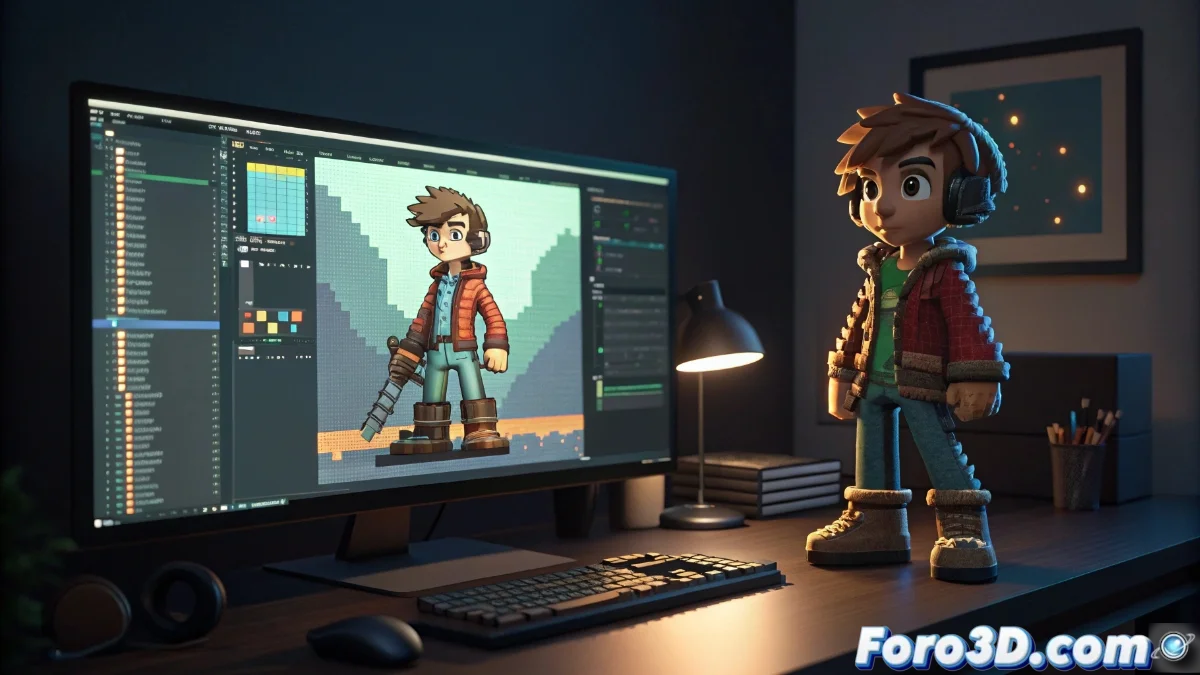
Aseprite vs Goxel: Two Approaches to Creating Game Assets
In the universe of independent video game development, the choice between Aseprite and Goxel represents two fundamentally different creative philosophies. While Aseprite dominates the realm of traditional pixel art with its specialized two-dimensional approach, Goxel revolutionizes the process through three-dimensional voxel modeling that is later transformed into 2D assets. 🎮
The Two-Dimensional Domain of Aseprite
Aseprite establishes itself as the definitive tool for pixel art, offering a meticulously designed workspace for the creation and animation of two-dimensional sprites. Its minimalist and highly specialized interface allows artists to exert absolute control over each individual pixel, with a workflow optimized specifically for projects requiring millimeter precision in flat visual compositions.
Key Features of Aseprite:- Frame-by-frame animation system with an intuitive timeline and real-time preview
- Advanced layer management and limited color palettes to maintain stylistic coherence
- Specialized drawing tools such as customizable brushes and advanced blending modes
"Aseprite transforms the creative process into a digital craftsmanship experience where every pixel matters"
The Three-Dimensional Revolution of Goxel
Goxel introduces a radically different perspective by incorporating three-dimensional voxel modeling into the asset creation pipeline. Artists can sculpt complete 3D models using voxels as fundamental building blocks, then export specific views as 2D sprites from any desired angle. This methodology proves particularly powerful for projects requiring multiple perspectives of the same element.
Advantages of the Goxel Approach:- Consistent generation of rotating sprites and isometric tiles from a single 3D model
- Complete visualization of the asset from all angles before 2D export
- Significant acceleration in asset production for games with dynamic views or simulated 3D perspective
Contrasting Creative Philosophies
The dichotomy between these tools reflects two deeply distinct creative mindsets. Aseprite evokes traditional craftsmanship where the artist works directly on the final canvas, eliminating distractions and focusing on the exact visual composition. Goxel, in contrast, suggests a more architectural or sculptural approach, where the third dimension serves as a prototyping space before meticulous flattening into usable sprites. 🎨
The fundamental irony lies in how these tools approach dimensionality: while Aseprite celebrates the purity of the 2D plane, Goxel uses three-dimensional space primarily as a means to achieve two-dimensional ends, demonstrating that in game development, we sometimes build 3D worlds specifically to compress them into the second dimension. ✨