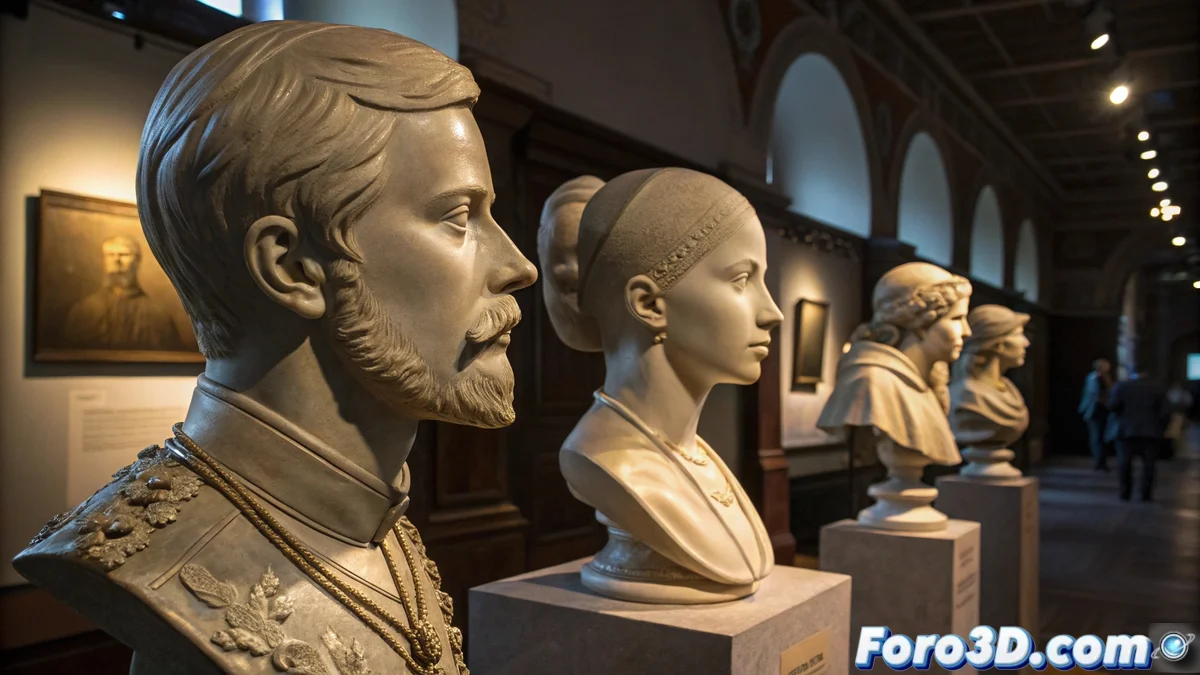
Scrutinizing history through digital sculpting 👑
A team of geneticists has studied the remains of the Romanov family and discovered an anomaly in the DNA of one of the children that does not match historical records, reopening debates about their final fate. This finding, which blends science, history, and mystery, finds in ZBrush the ideal medium for its visual interpretation. Far from seeking scientific accuracy, digital sculpting allows for creating an artistic narrative that gives a face to the genetic enigma, using tools like Dynamesh, ZRemesher, and Polypaint to combine anatomical precision with creative license.
Sculpting the busts with historical basis
The process begins by importing photographic references of the Romanovs as background images in ZBrush. Using Dynamesh with medium resolution, the basic shapes of each bust—skulls, jawlines, facial volumes—are blocked out, ensuring historically accurate proportions. Tools like Move Brush and Clay Buildup refine volumes, while Dam Standard defines details like cheekbones, eye orbits, and lips. The key is to work with symmetry initially, then subtly break it to add humanity. 🎭
Incorporating the genetic anomaly symbolically
To represent the reported anomaly, subtle variations are introduced in one of the busts:
- Slight facial asymmetry in interocular distance or jaw shape
- Slightly altered cranial volume using localized Inflate Brush
- Differentiated skin texture with Polypaint in specific areas
- Distinct facial expression suggesting genetic divergence
These changes are deliberately subtle, requiring a careful look to be noticed—just like the scientific finding.
Sculpting an anomaly is like whispering a historical secret in digital clay; only those who know how to listen will hear it.
Texturing with Polypaint and realistic materials
Polypaint is applied directly to the mesh to create believable skin tones, using roughness and specular channels to simulate pores, sebaceous shines, and areas worn by time. The color palette remains subdued—ivories, pale pinks, grayish shadows—evoking both aristocratic pallor and the passage of a century. The bust with the anomaly receives subtly different chromatic treatment, perhaps greater translucency in the skin or altered reflectivity in the eyes.
Composition and narrative presentation
The busts are organized in a unified scene where:
- The family is grouped but the anomalous bust slightly separated
- Lighting focuses on the different member with a soft spotlight
- Surface finish varies—some busts more eroded, others sharper
- Common base but with subtle pedestal differences
This arrangement guides the viewer without being explicit, inviting interpretation.
Rendering and final effects
Rendering is done in ZBrush using BPR with soft shadow settings and high sampling to capture texture details. Basic post-production on the render includes:
- Level adjustments to increase contrast in key areas
- Light vignette to direct attention to the center
- Selective sharpening on faces over anatomical details
- Optional sepia tones for historical atmosphere
The result is an image that works both as art and historical speculation.
The irony of the creative process
While geneticists analyze nucleotide variants, we analyze brush variants in ZBrush. In the end, our "genetic anomaly" might end up being more of a sculptural anomaly—but hey, at least our digital Romanovs don't require exhumation. And if the bust looks a bit strange, we can always blame the DNA... or pressing Shift too hard. 😅