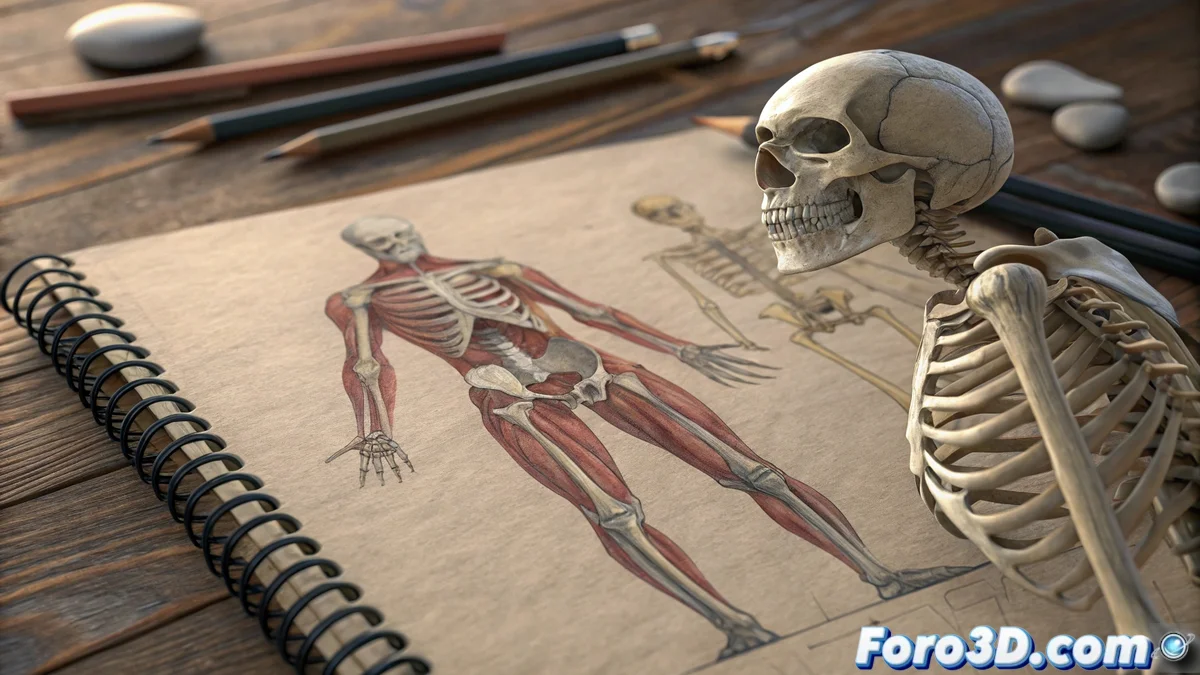
Artistic Anatomy for Realistic Drawings of the Human and Animal Body
Mastering artistic anatomy is a fundamental tool for creators who aspire to represent organic figures with authenticity and visual coherence. This discipline goes beyond the simple memorization of names, involving a deep understanding of how structural components interact to generate believable and expressive forms 🎨.
The Skeleton as the Foundation of Anatomical Drawing
The skeletal structure functions as the invisible scaffold that determines the basic proportions, posture, and overall balance of any figure. By analyzing the skeleton, artists identify crucial reference points such as joints, the rib cage, and the pelvis—elements indispensable for representing both static and moving figures. The spinal column, for example, establishes the natural curves of the back, while the length of long bones directly influences the stability of poses.
Key Points of Skeletal Study:- Identification of major joints and their range of motion
- Understanding the proportional differences between male and female skeletons
- Practice with simplified skeletal schematics for quick compositions
A well-understood skeleton is the key to avoiding disproportions and biomechanically impossible postures in your illustrations.
Musculature as an Element of Expression and Volume
Once the bony foundation is assimilated, the next level of mastery involves deciphering how muscle groups intertwine and contract to produce movement and expression. Each muscle has a specific function—such as the biceps when flexing the arm or the calf muscles when raising the heel—and its visual form changes depending on its state of contraction or relaxation.
Essential Aspects of the Muscular System:- Visualization of superficial and deep muscles for precise three-dimensional shading
- Study of comparative anatomy between species to expand the artistic repertoire
- Application of muscular knowledge to create dynamism and apparent tension
Anatomical Integration in Artistic Practice
True mastery emerges when bones and muscles cease to be separate concepts and become a unified system that the artist internalizes. This integrated understanding allows for the creation of figures that convey weight, balance, and energy, avoiding those common errors that make characters look like rigid or disjointed dolls. Constant practice with anatomical models and observation from real life develops a critical eye capable of detecting inconsistencies before they solidify in the final work. After hours of meticulous study, you can create figures so convincing that you almost expect them to breathe, though they might protest those acrobatic poses you assigned them 🤣.