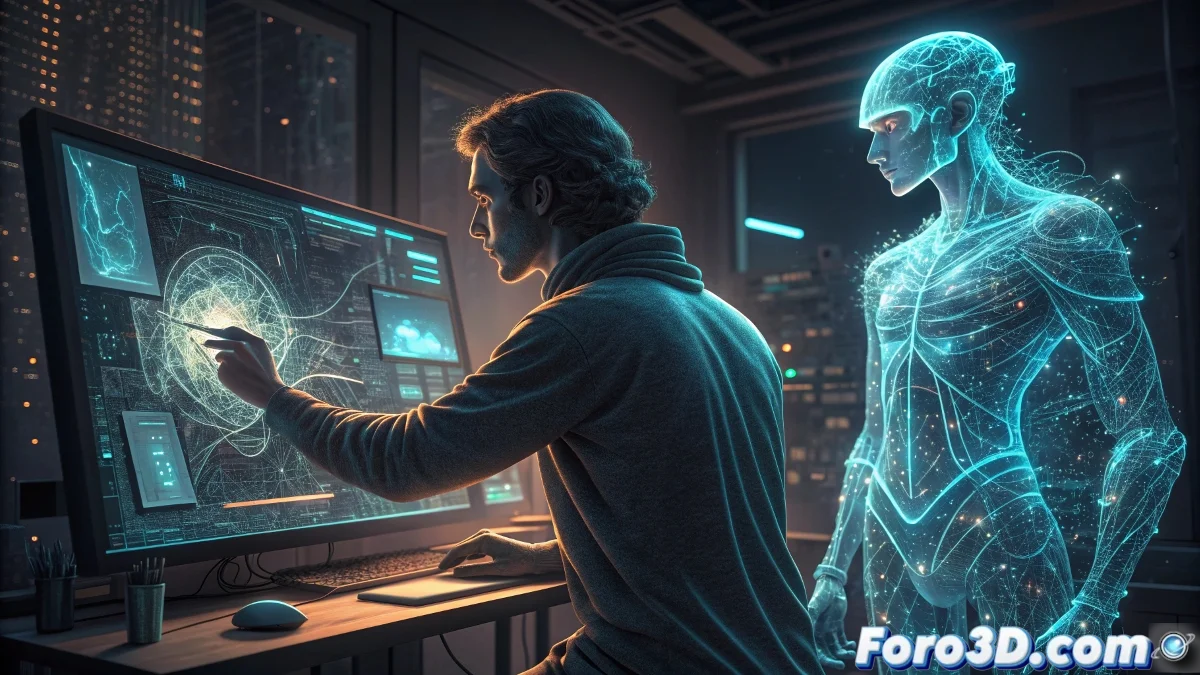
Artificial Intelligence Revolutionizes the 3D Pipeline: Less Technical, More Creative
Artificial intelligence is radically transforming 3D workflows, massively integrating into major tools like Blender, Autodesk Maya, and ZBrush. What began as experimental features has become productive capabilities that are redefining how artists approach complex projects. From automatic texturing based on textual descriptions to intelligent character rigging that learns from real anatomy, AI is eliminating technical barriers and allowing creators to focus on what really matters: the artistic vision. This evolution represents the most significant shift in production pipelines since the transition to digital. 🤖
Intelligent Automation versus Human Creativity
The most fascinating aspect of this integration is not simply the automation of repetitive tasks, but how AI is learning to collaborate with artists rather than replacing them. In Blender, for example, the modeling suggestion system analyzes the artist's intent and proposes complementary geometries that maintain stylistic coherence. In Maya, auto-rigging generates plausible bone structures that can then be manually refined. This symbiosis allows humans and machines to do what they do best: AI handles technical complexity, humans direct the creative vision.
Specific Features Changing Daily Work
The implementation of AI in 3D software is no longer limited to technical demonstrations, but offers concrete tools that artists are using in production. These capabilities are maturing rapidly, transitioning from interesting toys to indispensable assistants.
Intelligent Texturing and Material Generation
New AI texturing systems allow the generation of complex materials from simple descriptions like rain-eroded oak wood or scratched chrome metal. Blender has integrated tools that not only create the base texture, but intelligently apply coherent normal, roughness, and displacement maps. What previously required hours of manual tweaking is now resolved in seconds, with the possibility of iterative refinement through natural human language feedback.
Advances in AI Texturing:- material generation from textual descriptions
- automatic application of coherent PBR maps
- style transfer between materials
- intelligent correction of seams and stretching
Assisted Rigging and Animation
Character rigging, traditionally one of the most technical and time-consuming tasks, is experiencing a silent revolution. Auto-rigging systems analyze the character's mesh and propose optimized bone structures, predicting natural flexion points and plausible motion ranges. For animation, intelligent inbetweening tools generate intermediate frames that maintain physics and the animator's intent, dramatically accelerating keyframe animation workflows.
AI does not replace the artist, but gives them superpowers: superhuman speed with absolute creative control.
Modeling and Geometric Optimization
Modeling suggestions represent perhaps the most magical application of AI in 3D. When sketching basic shapes, the system can propose complex geometries that align with the model's style. Automatic retopology tools have improved exponentially, generating clean meshes that respect edge flows and are animation-ready. For optimization, AI algorithms can reduce polygon counts while preserving critical visual details, a process that previously required expert artistic judgment.
Improvements in AI Modeling:- contextual geometry suggestions
- automatic retopology with detail preservation
- detection and repair of geometric issues
- generation of optimized LODs
Impact on Roles and Professional Skills
This transformation is redefining what skills production studios value. Deep technical knowledge remains important, but the ability to direct and refine AI outputs is becoming equally crucial. Artists are evolving from technical executors to augmented creative directors, focusing on aesthetic judgment, art direction, and storytelling rather than manual vertex manipulation. This is democratizing access to quality production, allowing smaller teams to achieve results that previously required large studios. 💡
New Valued Skills:- ability to direct and refine AI outputs
- aesthetic judgment and art direction
- knowledge of effective prompting
- integration of multiple AI systems
In the end, AI in 3D tools is not about replacing artists, but eliminating technical friction, although it will probably make future portfolios look more like art direction galleries than demonstrations of pure technical skill. 🎨