Artificial Intelligence Revolutionizes Material Discovery
Finding new compounds with specific properties was a slow and costly process based on trial and error. Now, artificial intelligence is changing the rules of the game. Through inverse design, algorithms learn the deep relationship between a material's atomic arrangement and its behavior, enabling intelligent exploration of an almost infinite universe of chemical combinations. 🧠⚛️
The Limitation of Traditional Generative Models
Techniques like Generative Adversarial Networks (GANs) or diffusion models have shown their utility. However, they usually operate with a single type of information, such as only the crystalline structure. This partial view is a problem because a material's characteristics emerge from the complex interaction between its atomic architecture, its electronic nature, and its thermodynamic robustness. Ignoring any of these facets generates unreliable predictions.
What does multimodal learning bring?:- Combines diverse data sources: Integrates structural, electronic, mechanical, and stability information into a single system.
- Creates an enriched latent space: This space encodes the fundamental rules governing materials more accurately.
- Improves prediction and generation: The model can predict properties with greater accuracy and propose more viable and novel candidates.
Integrating diverse modalities is not just adding data; it allows the model to learn the hidden synergies that define a stable and useful material.
MEIDNet: A Multimodal Success Case
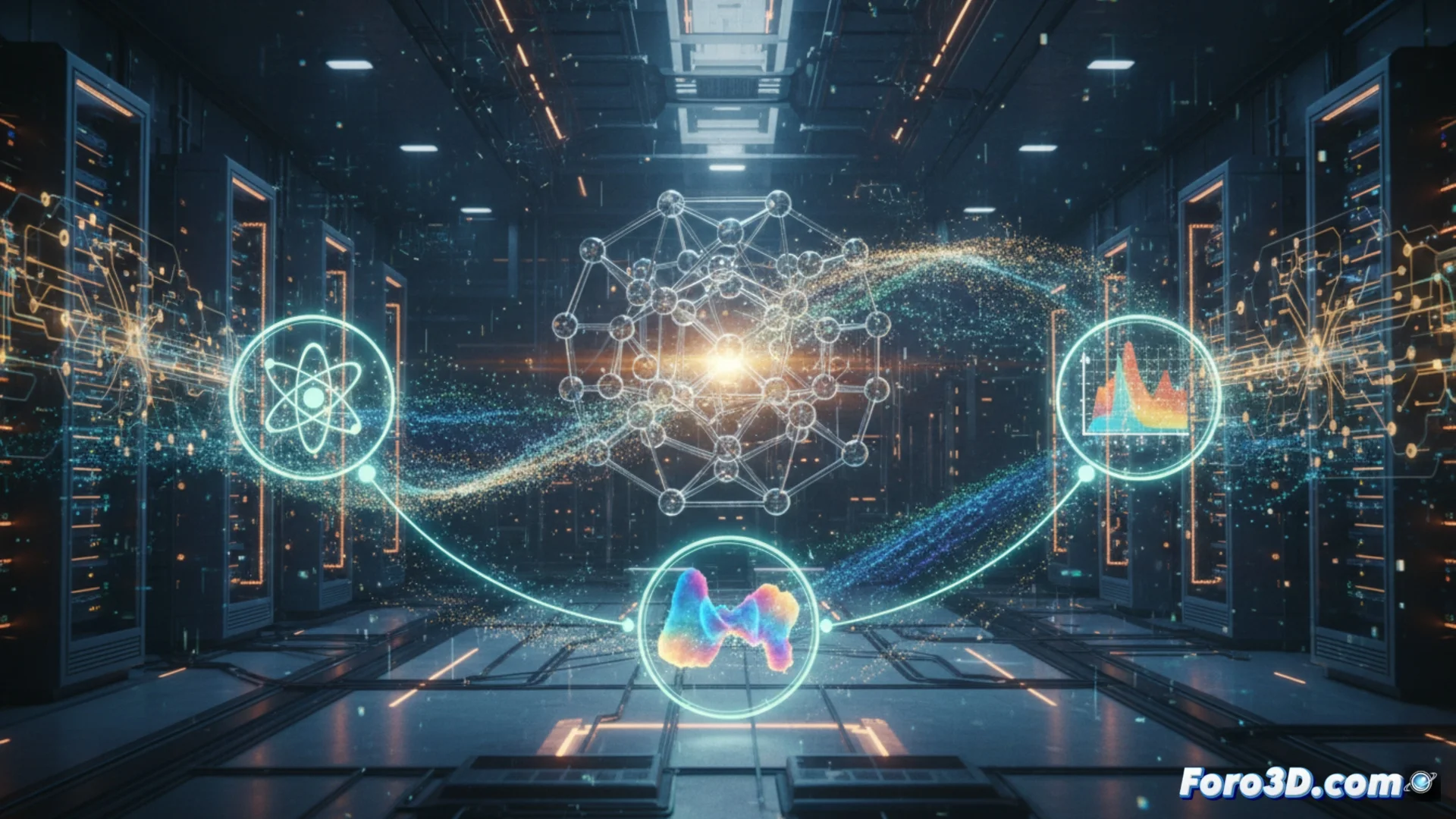
MEIDNet is a model created to overcome these barriers. Its architecture is designed to process and align three key modalities: structural, electronic, and thermodynamic data. It employs neural networks to encode crystals and contrastive learning techniques to synchronize information from different sources.
Results with perovskites:- The model generated 140 candidate perovskite structures.
- Of them, 19 turned out to be stable, unique, and unregistered in known databases.
- This represents a success rate above 13%, a record for multimodal approaches in materials science.
The Future Is Already Here
This advance is not just theoretical. The ability to discover materials quickly and guided accelerates the path to tangible applications: higher-capacity batteries, more efficient electronic devices, or more precise biomedical sensors. The next technological innovation could be born from an algorithm that, far from choosing atoms at random, understands the rules of matter to assemble it intelligently. 🚀🔬