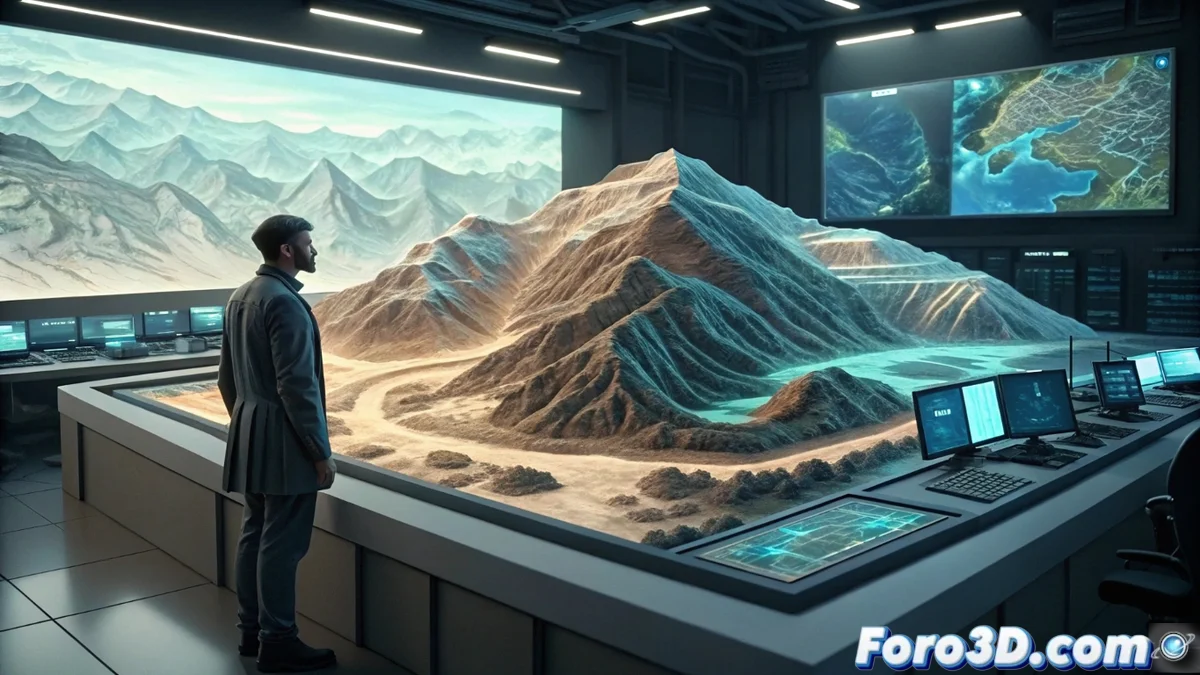
Artificial Intelligence Redefines Geological Exploration
The landscape of geological exploration, once dominated by decades of fieldwork and costly expeditions, is being redrawn by artificial intelligence. This technology is transforming a traditionally uncertain search into a systematic, data-driven process, optimizing resources and minimizing the ecological footprint. 🧠⛏️
Zanskar's Algorithmic Approach
Pioneering companies, such as the startup Zanskar, are at the forefront of this change. Their methodology relies on machine learning models trained on vast historical exploration archives. These algorithms synthesize multispectral, gravimetric, and seismic information to produce probability maps that highlight zones with high mineral potential.
Key advantages of the system:- Predictive localization: Not only points out likely locations but also estimates the composition and extent of the deposits.
- Effort optimization: Allows field teams to focus exclusively on the most promising targets, ruling out sterile areas in advance.
- Comprehensive analysis: Cross-references geochemical and geophysical data layers that would be impossible to correlate manually at scale.
The technology turns the proverbial search for a needle in a haystack into a high-precision task, reducing financial risk and accelerating discovery.
Transformative Impact on the Industry
The implementation of AI in exploration is drastically shortening discovery cycles. This advancement is crucial for securing the supply of critical raw materials, such as lithium and copper, essential for the transition to clean energies.
Future and democratization:- Risk reduction: Decreases the inherent financial uncertainty in mining and hydrocarbon exploration.
- New industry standard: Algorithmic analysis is expected to become the norm, establishing a new paradigm in geosciences.
- Democratized access: Opens up previously unfeasible geological frontiers, allowing more players to participate in resource exploration.
Conclusion: From Hammers to Algorithms
The future of geology points toward a symbiosis between expert knowledge and computational power. The figure of the geologist is evolving, complementing field tools with powerful data analysis platforms. The next great expeditions might not head to remote deserts, but to processing centers where algorithms light the way to tomorrow's resources. 🔍💻