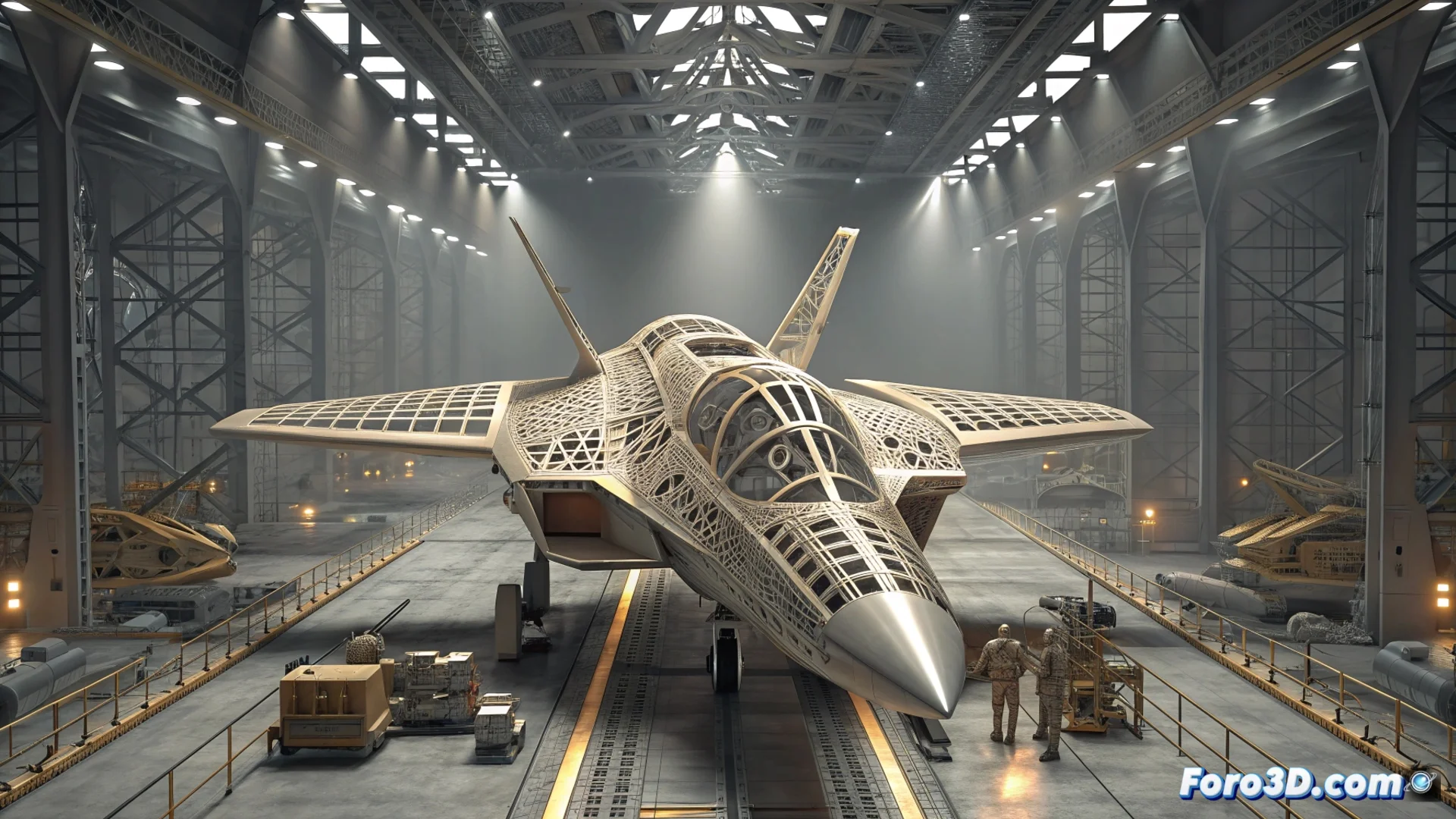
Artificial Intelligence Designs and Manufactures a Fighter Jet Fuselage
The aerospace industry in 2026 combines artificial intelligence with additive manufacturing to produce complex components. A team of engineers has unveiled a main fuselage for a fighter jet, created entirely by an AI system and manufactured with only twenty-six 3D-printed pieces. This approach revolutionizes traditional methods that require thousands of components. 🛩️
AI Generates an Optimized Design for 3D Printing
The artificial intelligence system processes engineering parameters such as aerodynamic loads, structural strength, and thermal requirements. From this data, it generates an organic geometry that a human designer would take much longer to calculate. The resulting shape is only feasible to manufacture using 3D metal printing, as it consolidates into a single piece functions that previously required assembling multiple parts.
Key Advantages of the AI-Generated Design:- Allows creating structures with internal lattice that lighten the weight without compromising integrity.
- Optimizes material topology to withstand specific loads more efficiently.
- Drastically reduces the time needed to iterate and validate complex designs.
This method can reduce material waste by up to 95% compared to traditional milling, and shorten production time from months to weeks.
Additive Manufacturing Consolidates Assembly
The twenty-six printed pieces are joined to form the main fuselage. This process replaces an assembly that normally involved thousands of rivets and individual components. Using titanium and aluminum alloys printed in 3D aims to increase the specific strength of the entire assembly.
Impact of Additive Manufacturing on Production:- Consolidates multiple functions into single pieces, simplifying the assembly line.
- Seeks to reduce the total weight of the aircraft structure, improving fuel efficiency.
- Simplifies supply chains by requiring fewer suppliers and components.
Next Steps and Validation
The prototype must now pass a rigorous battery of structural and fatigue tests to validate its use in real flight conditions. This step is crucial to certify the reliability of components created using AI and 3D printing. The project represents a paradigm shift in how future aircraft are conceived and manufactured, where software and digital manufacturing take center stage. 🔧