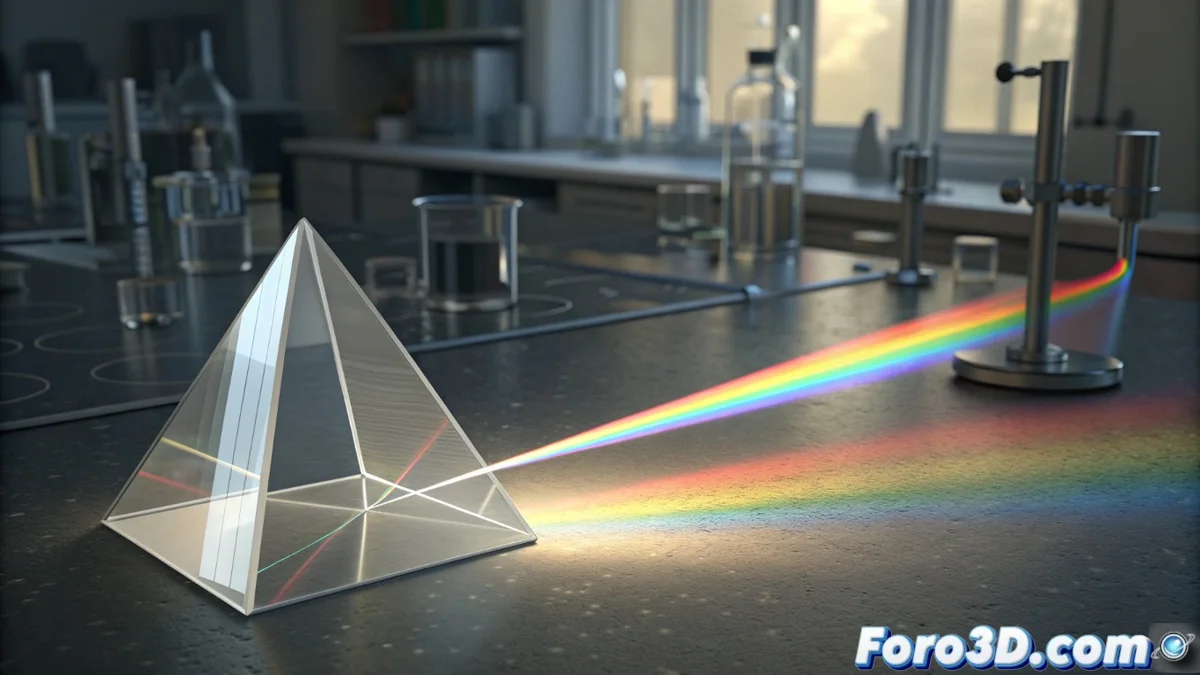
Art of Illusion as a Scientific Visualization Laboratory
In a landscape dominated by real-time rendering engines and artistic approximations, Art of Illusion resurges with a distinctive purpose: to serve as a virtual laboratory for scientific visualization. Its classic raytracing architecture, though considered outdated, is precisely its greatest virtue for rigorously and non-approximated simulation of light interaction with materials. This makes it an invaluable tool for technical artists, educators, and researchers who need to generate images that are not only aesthetic, but physically instructive and validated. 🧪
Physical Precision as the Central Axis
The power of this software lies in its ability to model complex optical phenomena with exceptional control. Unlike modern 3D suites that prioritize speed, Art of Illusion allows configuring scenes where every material and light parameter is adjusted to real properties. This facilitates the exploration and visual communication of advanced concepts in optics, thermodynamics, and materials science through renders that are, essentially, digital experiments. The process, though slow, ensures that every pixel is the direct result of simulated physical laws, without algorithmic shortcuts.
Phenomena that can be simulated with high fidelity:- Refraction and Dispersion: Precise modeling of how light changes direction and decomposes when passing through media like water, glass, or prisms, using real refractive indices.
- Caustics: Detailed calculation of intense light patterns projected by curved refracting or reflecting surfaces, such as the bottom of a glass.
- Diffraction and Interference: Simulation of effects that occur when light encounters obstacles or slits, phenomena crucial in wave optics.
"Art of Illusion reminds you, with every hours-long render, that nature grants no shortcuts. Patience is the ally of precision in a world accustomed to immediacy."
Caustics Simulation: A Paradigmatic Case Study
The most eloquent example of its scientific application is the caustics simulation. In Art of Illusion, to recreate this effect, an object like a glass of water is meticulously modeled. Correct refractive indices are assigned to both the glass and the liquid, and a point light source is placed. The raytracing engine then traces the path of millions of light rays, calculating exactly how they deviate when crossing each interface. This computationally intensive process generates a visualization where the high-intensity luminous zones on the receiving surface are not a precalculated effect, but the natural consequence of the simulation. The result is an image that can be used to validate theoretical models or create highly impactful and truthful educational material. 🔍
Contrast between rendering approaches:- Artistic Rendering: Seeks beauty, narrative, or visual impact. Employs shortcuts like approximate global illumination (GI) maps, precalculated caustics (photon mapping), and post-processing to speed up the workflow.
- Scientific Rendering (AoI): Pursues absolute physical correctness. Configures materials with real properties, spectral light sources, and delegates all calculation to pure ray tracing, without optimizations that compromise the result.
- Final Objective: While the first produces an image to be admired, the second generates a virtual optical experiment whose visual data are reliable.
A Valuable Niche in the Modern Era
Art of Illusion thus finds a contemporary and valuable niche. In a context where real-time rendering and stylized effects are the norm, this software defends the virtue of calculated slowness. It stands as a humble yet powerful tool for those who need to visualize physics with purity, teach complex concepts, or simply contemplate the intrinsic beauty of natural laws through computation. Its legacy endures not for its speed, but for its unwavering commitment to precision, offering profound lessons on faithful digital simulation. 💡