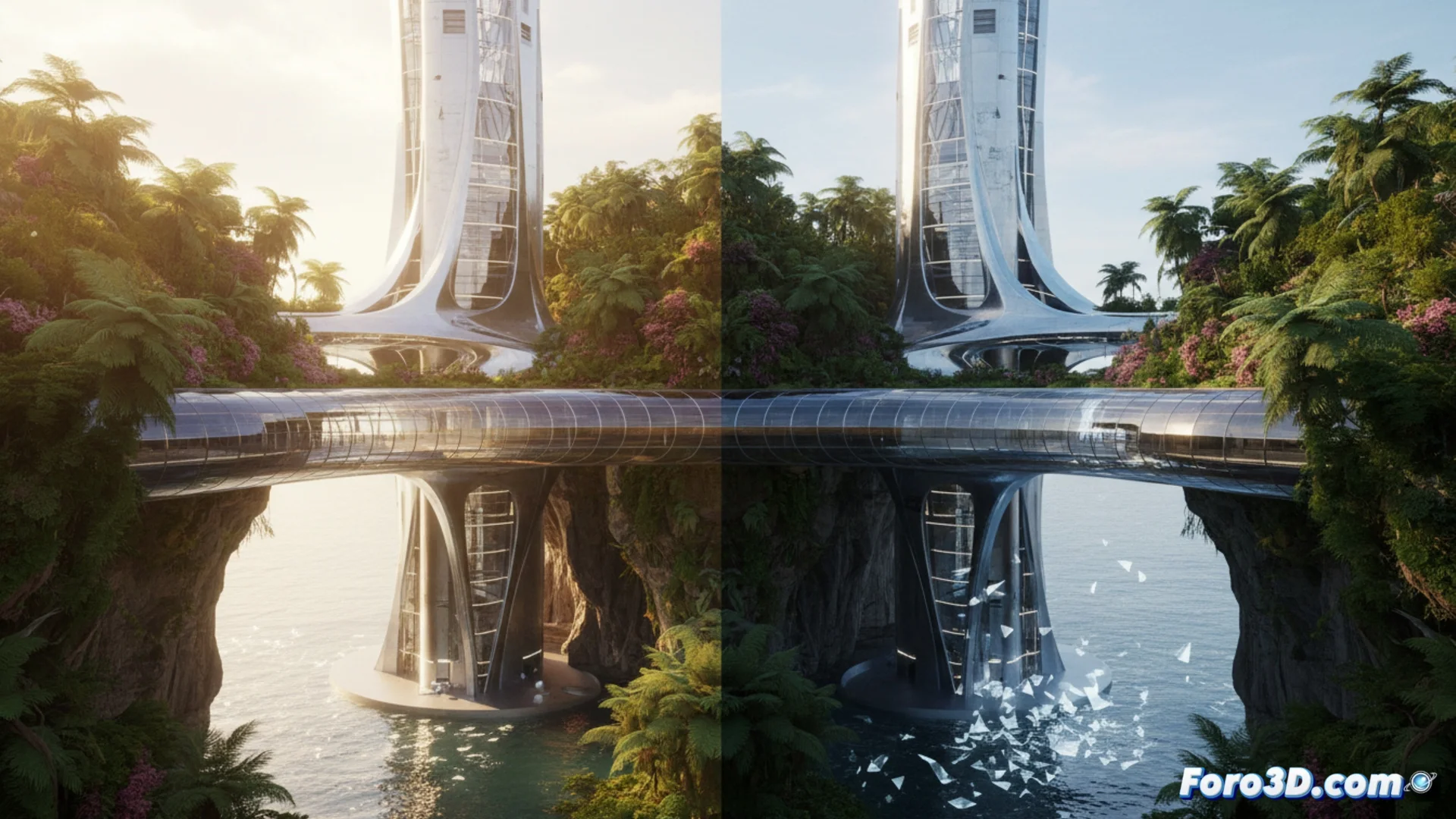
Arnold Render and V-Ray: Rendering Philosophies in Complex Scenes
When working with highly complex 3D scenes, the Arnold Render and V-Ray engines present opposing work philosophies. While one opts for a physical and direct method, the other prefers a hybrid and highly configurable strategy, which directly impacts the artist's workflow. 🎨
Fundamental Technical Approaches
Arnold Render operates as a pure ray tracing engine. It calculates lighting strictly based on physical laws, offering uniformity. This makes it easy to set up global illumination and realistic materials, as the user only needs to define physical properties and the engine handles the rest. On the other hand, V-Ray integrates multiple techniques. It combines ray tracing with irradiance maps, allowing the artist to adjust the balance between calculation time and final result quality. Its optimization toolkit is very extensive.
Key Differences in Processing:- Arnold: Unified approach. Simulates light in a physical and predictable way, simplifying the work.
- V-Ray: Hybrid approach. Offers granular control over almost every rendering parameter to adjust performance.
- Common Goal: Both aim to produce photorealistic images, but the paths and the control they give to the artist are different.
The irony of the process: after hours adjusting parameters to save minutes of rendering, sometimes the final approved result is the first simple lighting test you did.
Managing Light and Shaders
For lighting, Arnold integrates lights that behave like real-world sources, with intuitive parameters like intensity in lumens. Its main shader system, Standard Surface, handles materials from metals to fabrics with a solid physical foundation. V-Ray has a hybrid lighting system; its Dome light with HDRI maps is very fast, and lights like V-Ray Light are highly configurable. In materials, its V-Ray Mtl shader is also based on physical properties, but includes more controls for advanced effects like dispersion refraction and complex BRDF models, which requires more knowledge to fully exploit its potential. 💡
Material Features:- Arnold Standard Surface: Physics-based, intuitive for achieving consistent realism.
- V-Ray Mtl: Physics-based but with more layers of control for specific and advanced effects.
- Complexity vs. Simplicity: V-Ray offers more raw power and adjustments; Arnold prioritizes a more direct and predictable workflow.
Behavior with Complex Geometry and Scaling in Production
When facing dense geometry with millions of polygons, Arnold distributes memory efficiently, although it can demand a lot of RAM in extremely heavy scenes. Its progressive rendering allows for quick previews. V-Ray manages complex geometry through the use of proxies and employs a bucket rendering engine that speeds up the final process. Its distributed rendering system scales very efficiently in render farms. Both engines integrate into popular 3D packages like Maya, 3ds Max, and Cinema 4D, but their workflows differ substantially. Arnold prioritizes a direct approach, while V-Ray offers more layers of control to adjust performance according to the specific needs of the project. ⚙️