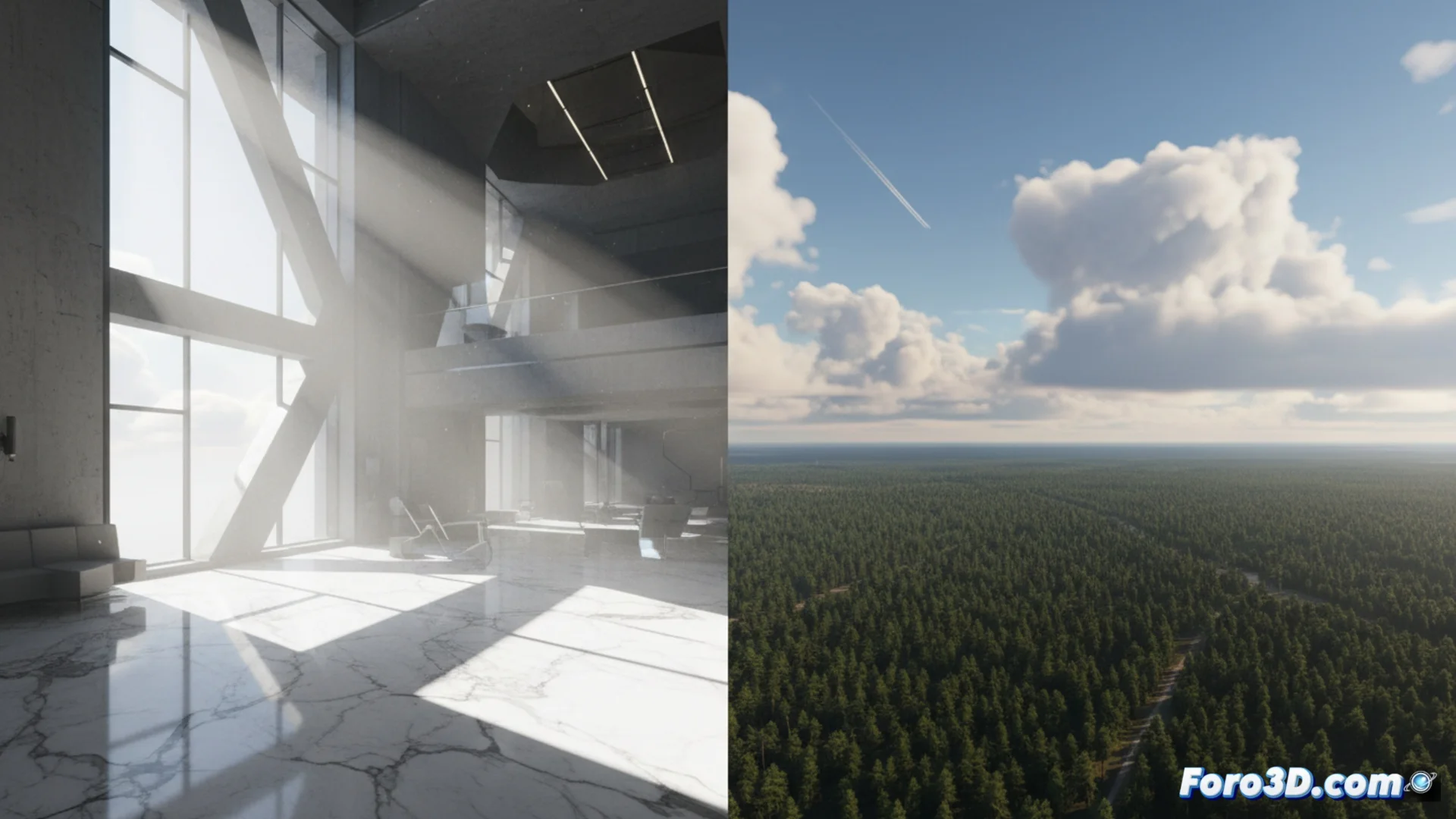
Arnold Render and Unigine: Two Philosophies for Handling Complex Scenes
When working with 3D environments that have a lot of geometry, multiple materials, and volumetric effects, the choice of graphics engine is crucial. Two standout options, Arnold Render and Unigine, represent radically different approaches to solving this challenge. One seeks to replicate light physics with maximum fidelity, and the other prioritizes generating images at high speed for user interaction. 🎯
Arnold's Approach: Physical Fidelity Above All
Arnold Render operates as a pure, unbiased ray tracing engine. This means it simulates the path of light exhaustively, without using shortcuts or approximations, to achieve physically correct lighting and shadows. This method makes it extremely predictable for the artist, as the parameters are directly linked to real-world properties.
Key Features of Arnold:- Calculates every light interaction to achieve maximum realism, ideal for cinematographic production.
- Handles very detailed geometry, complex displacement maps, and materials like skin, hair, or metals with ease.
- The computational cost is high, resulting in long render times, especially in scenes with many volumetric effects or caustic reflections.
Arnold is like a high-end cinema camera: it captures every detail perfectly, but requires time to "develop" the image.
Unigine's Strategy: Speed and Interactivity
Unigine is built as a real-time engine. Its main goal is to maintain a high and stable frame rate per second, which is essential for simulators, virtual reality, and interactive applications. To achieve this, it doesn't rely solely on ray tracing, but uses a hybrid combination of rasterization and limited ray tracing, along with screen-space techniques like SSAO or SSS.
Key Features of Unigine:- Combines methods to simulate advanced visual effects, like particles and fog, efficiently.
- Can manage extensive virtual worlds with a large number of objects and geometry, maintaining smooth performance.
- The visual quality, although high, may make concessions in absolute physical precision in exchange for responsiveness.
Deciding Between Precision or Speed
The final choice between Arnold Render and Unigine is not about which is better, but about which fits the project's needs. If the goal is to achieve reference image quality for cinema or still images, where render time is not the main factor, Arnold is the option. If, on the other hand, the project requires interactivity, such as in video games, training, or real-time architectural visualizations, Unigine provides the necessary performance. Choosing is defining the fundamental priority of the workflow. ⚖️