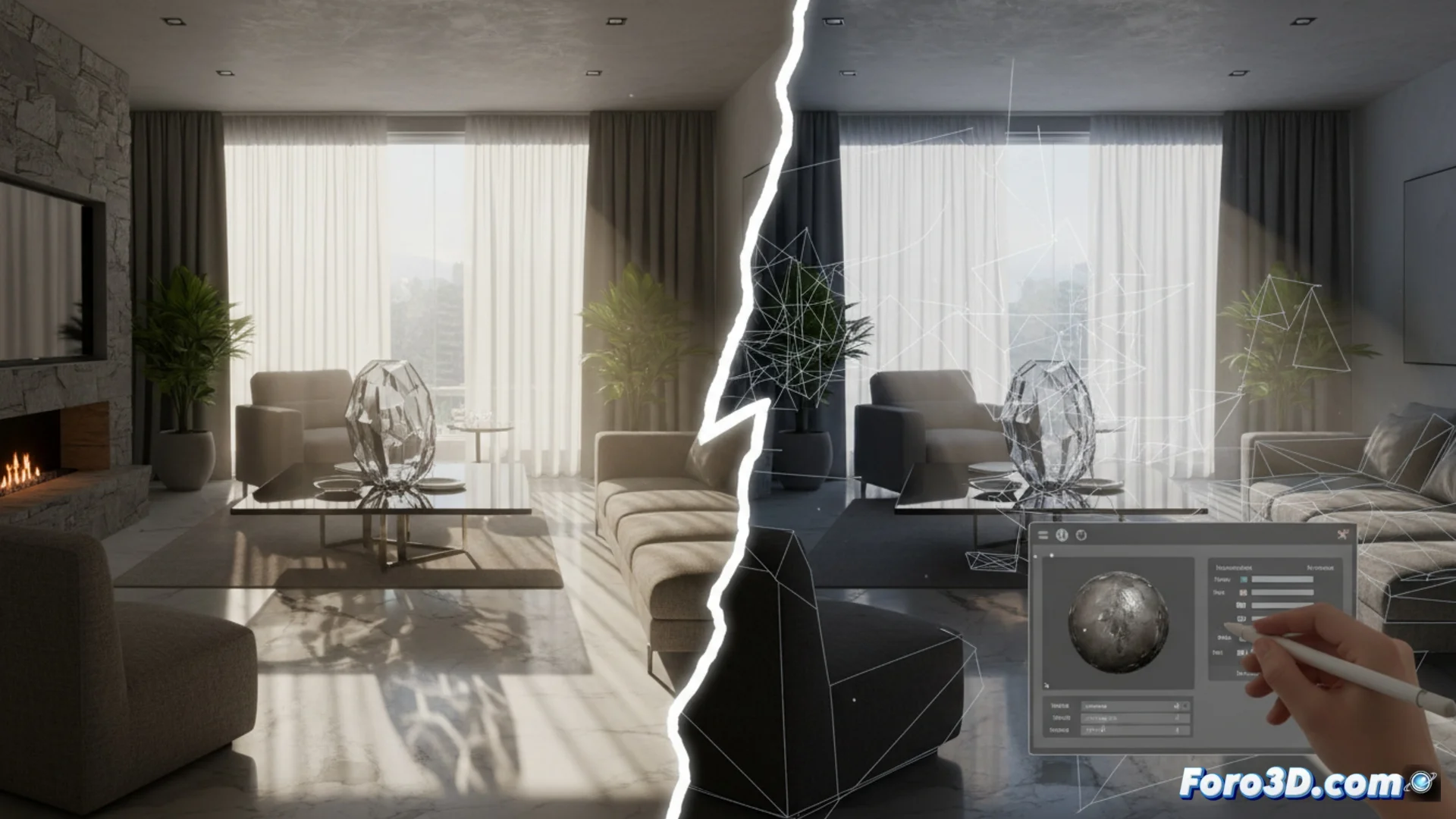
Arnold Render and Redshift: Two Philosophies for Complex Scenes
In the field of professional 3D rendering, choosing the right engine makes all the difference. Arnold Render and Redshift represent two opposing paths for tackling projects with dense geometry, high-resolution textures, and extensive particle systems. While one seeks to emulate light with precision, the other aims to provide immediate feedback to the artist. 🎨
Arnold's Method: Precision and Predictability
Arnold Render operates with a pure ray tracing method that calculates lighting following physical principles. Its CPU-based engine processes light progressively, accumulating samples to eliminate noise in a deterministic manner. This allows the user to control the final result without surprises. It handles complex phenomena like light scattering on translucent surfaces (SSS) and refractions that generate caustics. Although it may demand more time, the quality of its global illumination and smooth transitions in shadows are distinctive features. It integrates advanced shaders and AOV channels for comprehensive control in post-production.
Key Features of Arnold:- Processes with a pure and physical ray tracing method on the CPU.
- Reduces noise progressively and predictably, accumulating samples.
- Manages complex lighting effects like subsurface scattering and caustics.
- Offers powerful AOV integration for compositing.
When your computer starts sounding like a nuclear reactor during a final render, it's time to ask yourself if physical perfection is worth it or if you prefer to finish today.
Redshift's Proposal: Speed and Interactivity
Redshift was designed as a GPU-based ray tracing engine that prioritizes speed. It leverages the parallel processing power of modern graphics cards and employs intelligent approximation techniques to accelerate calculations. This allows for rapid design iteration and near-instant visualization of changes. Its nodal system is flexible and optimizes memory usage to manage very heavy scenes. Some effects may require manual adjustments to match Arnold's precision, but its ability to produce final renders in a fraction of the time is its main advantage. It supports features like the real-time denoiser to streamline the workflow.
Key Features of Redshift:- Executes optimized ray tracing for GPU, maximizing speed.
- Allows fast iteration and near-instant viewing of changes.
- Its node system efficiently manages memory in heavy scenes.
- Includes a real-time denoiser to speed up visualization.
Deciding Between Precision or Speed
The choice between Arnold Render and Redshift depends on the project's priorities. Arnold offers a predictable workflow and unbeatable physical lighting quality, ideal when realism is paramount. Redshift provides unmatched interaction speed, perfect for tight deadlines and quickly testing many ideas. Both can handle complex scenes, but their core philosophy—precision versus immediacy—defines their use in production. ⚖️