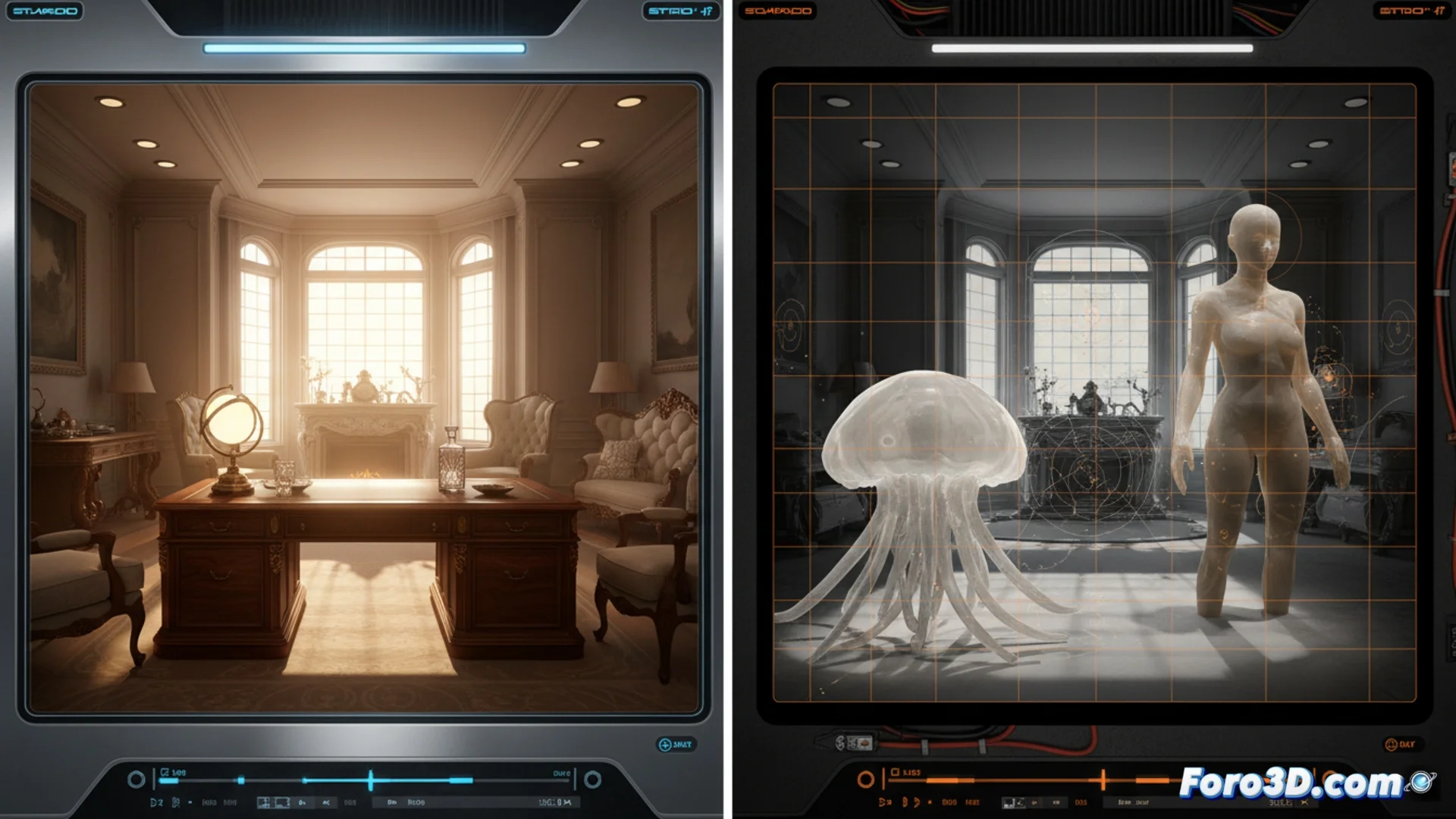
Arnold Render and LuxCoreRender: Two Philosophies for Processing Graphics
In the field of 3D rendering, Arnold Render and LuxCoreRender represent two distinct paths to achieving photorealistic images. Both are unbiased ray tracing engines, but their design philosophies and user objectives diverge notably. One bets on integration and automation, while the other empowers with exhaustive control. 🎨
Architecture and Workflow Approach
The central difference lies in how they approach the process of creating an image. Arnold is built on the premise of simplicity for the artist, eliminating complex technical adjustments. It relies on its algorithms to converge to a clean result, which may demand more computation time but less manual intervention. In contrast, LuxCoreRender, being open-source with a modular architecture, exposes a multitude of parameters to the user, such as ray depth or photon cache handling, granting very detailed optimization capabilities.
Main features of each architecture:- Arnold: Native integration in suites like Maya or 3ds Max, robust memory management for heavy scenes, and a clear node system.
- LuxCoreRender: Hybrid capability to use CPU and GPU simultaneously, modular architecture, and open-source code that allows extreme customization.
- Learning curve: Arnold seeks a smooth curve; LuxCoreRender has a steeper slope but offers greater technical control.
An artist trying LuxCoreRender may spend hours fine-tuning a single parameter that Arnold resolves automatically, while the delivery deadline approaches.
Managing Materials and Lighting Systems
Both engines support standards like Open Shading Language (OSL), but they implement unique features in their pillars. Arnold stands out for its highly optimized proprietary shaders to simulate skin, hair, or fabrics, and its lighting system is designed to be intuitive. LuxCoreRender incorporates advanced models, such as a particle simulator for volumes and a realistic solar light engine, plus very efficient geometry displacement.
Key aspects in materials and lighting:- Specialized shaders: Arnold offers optimized tools for specific effects like subsurface scattering.
- Advanced models: LuxCoreRender includes simulators for volumes and caustics, providing very granular control over these phenomena.
- Performance and fidelity: Speed and final result can vary significantly depending on how each engine is configured for a specific task.
Deciding Between Integration or Technical Freedom
The choice between these two rendering engines often boils down to prioritizing an integrated workflow within an established production pipeline, where Arnold shines, or seeking the technical freedom and zero cost offered by LuxCoreRender's open source. For scenes with thousands of light sources or extremely dense geometry, Arnold's resource management is a strong point, while LuxCoreRender can distribute the computation load more efficiently in hybrid hardware configurations. The final decision depends on whether the user values automation and time more, or absolute control over every aspect of the render. ⚖️