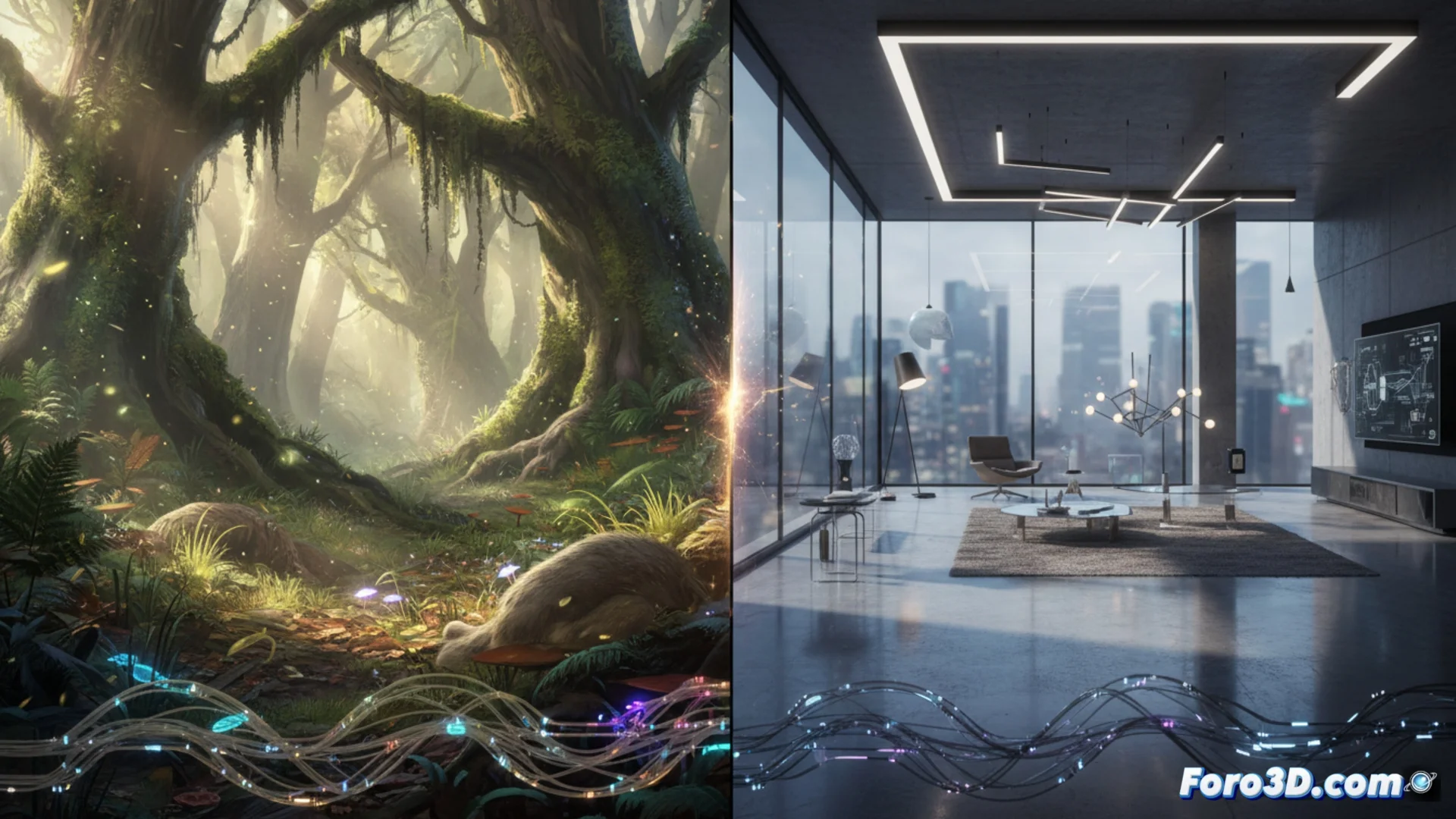
Arnold Render and Iray: Two Engines with Opposing Philosophies
In the field of professional rendering, two engines stand out for their radically different approaches. Arnold Render is based on ray tracing using only the CPU, integrating into applications like Maya or Houdini. On the other hand, Iray adopts a hybrid method that uses both processor and graphics cards, seeking immediacy. Understanding their differences is key to optimizing any production pipeline 🖥️.
Technical Cores and Distinct Strengths
The essence of Arnold lies in how it physically processes light to calculate global illumination and diffuse shadows, generating very consistent realism. Its greatest virtue is handling extremely dense geometries and massive particle systems without consuming too much RAM. The price to pay is usually prolonged computation times. Iray, optimized for NVIDIA hardware, offloads much of the work to the GPU. This allows for interactive previews at high speed and simulates with great precision how light behaves in complex materials, especially in interior spaces with many reflective surfaces 💡.
Key Differences in Processing:- Arnold: Uses only CPU, manages system memory progressively and is stable with detailed organic geometry.
- Iray: Uses CPU and GPU, leverages VRAM memory and is fast with scenes full of reflections and refractions.
- Result: Arnold prioritizes control and physical realism; Iray prioritizes iteration speed and immediate realism.
No engine universally surpasses the other; each solves different problems.
Contrasting Workflows and Resource Management
The way of working with each engine changes substantially. In projects with thousands of objects and high-resolution textures, Arnold manages system memory in a staggered manner, which helps prevent the software from crashing. The artist manually adjusts parameters like the number of samples per pixel to balance noise in the image and rendering time. Iray directly depends on the graphics card's VRAM. If a scene exceeds this limit, it can slow down dramatically or require asset optimization. Its interactive mode, however, allows altering materials and lights in real time, greatly accelerating the adjustment and testing phase 🎨.
How They Address Complexity:- For Geometric Complexity: Scenes with characters with a lot of hair or vast natural environments tend to be more stable in Arnold.
- For Lighting Complexity: Architectural scenarios with glass walls and many light sources can be resolved faster with Iray and a powerful GPU.
- Automation: Iray tends to automate more processes under a "immediate photorealistic render" paradigm, while Arnold offers more granular manual control.
Choosing the Right Engine for the Project
The final decision is not only technical but also linked to the main software used and the pipeline's objectives. If the process prioritizes detailed control over every physical aspect of light and works with scenes of overwhelming geometric complexity, Arnold is usually the most robust option. If, on the other hand, the need is to iterate quickly, testing different material and lighting configurations in an interactive environment, and suitable GPU hardware is available, Iray presents decisive advantages. It is common to see artists debating this choice while their team processes a render for hours, reflecting on whether they opted for the most efficient tool or simply the one they know best 🤔.