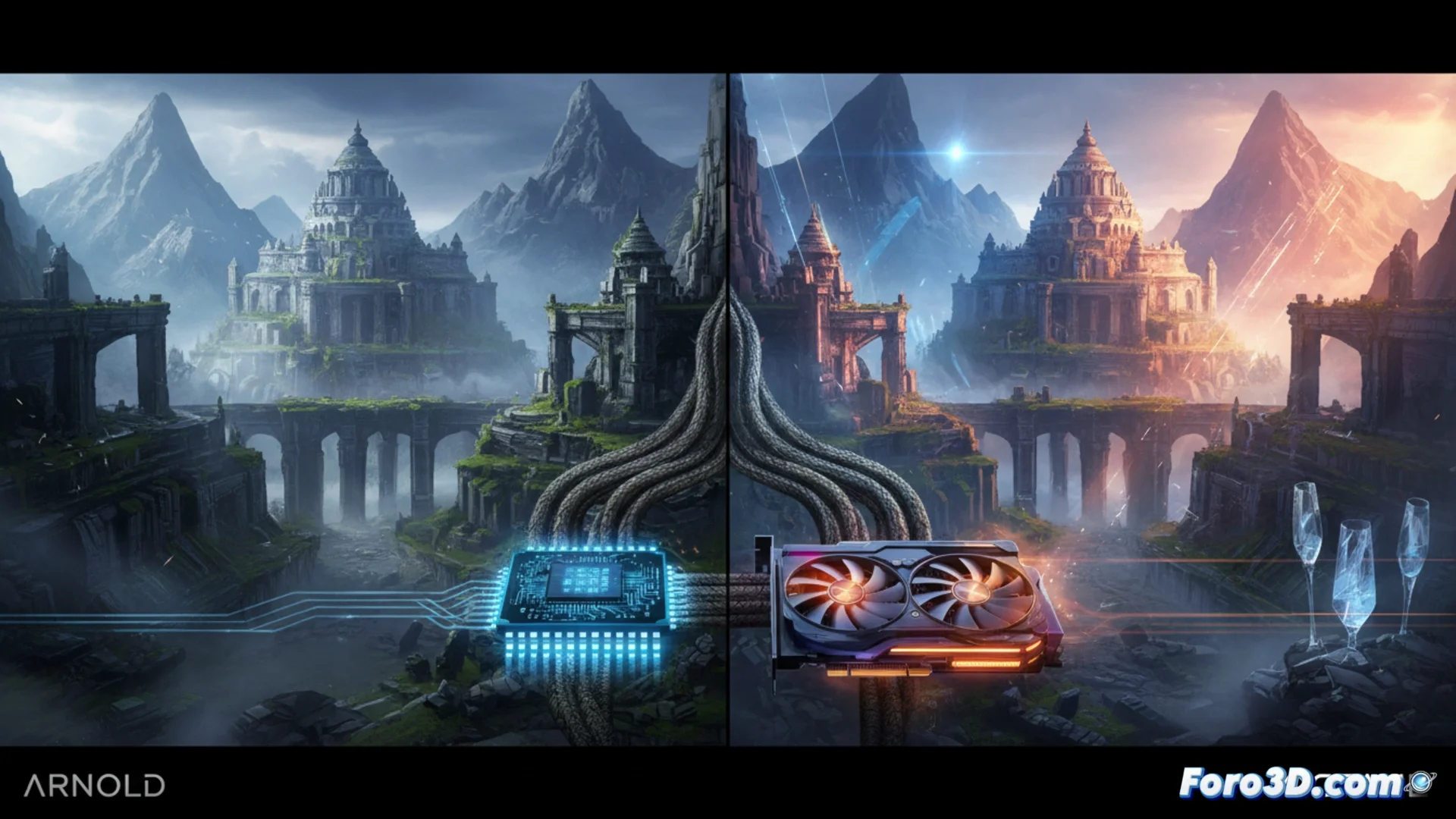
Arnold and Octane: two ways to process complex scenes
When working with scenes that have millions of polygons, volumetric effects, and elaborate lighting systems, the Arnold and Octane render engines take different architectural paths. One relies on the system's general processing power, while the other prioritizes the raw speed of graphics cards. 🎨
Arnold: stability and CPU-based scalability
Arnold operates as a ray tracing engine that uses the processor cores and RAM memory. This foundation allows it to integrate natively into software like Maya or Houdini and handle very heavy geometries with great reliability. Since it does not depend on video memory, it can load enormous datasets that would exceed a GPU's capacity.
Key features of Arnold:- Scales its power by adding more CPU cores and system RAM.
- Uses an adaptive sampling system and handles instances natively.
- Is predictable in productions where stability is a critical factor.
The trade-off is that every change in lighting or materials requires recalculation, which can slow down the creative adjustment process of the scene.
Octane: interactive speed limited by VRAM
Octane operates as a path tracing engine that makes the most of the GPU. Its greatest virtue is offering near real-time preview, allowing lights and materials to be modified and results seen instantly. However, all scene information must be transferred to the graphics card memory.
Determining aspects of Octane:- Its performance is directly tied to the amount of available VRAM.
- Scenes with high-resolution objects, dense volumetrics, and 8K textures can saturate video memory.
- When VRAM is exceeded, performance degrades noticeably or the engine may fail.
The practical paradox in heavy projects
This fundamental difference creates an irony in the workflow. In Octane, an artist may spend a lot of time optimizing the scene, reducing textures, and using instances to fit everything into the VRAM. In contrast, with Arnold, that same time could be dedicated directly to fine-tuning the final lighting, as the engine manages complexity with the system's general resources. The choice between one and the other, therefore, is not only technical but defines how the creative process is organized and executed in demanding productions. ⚖️