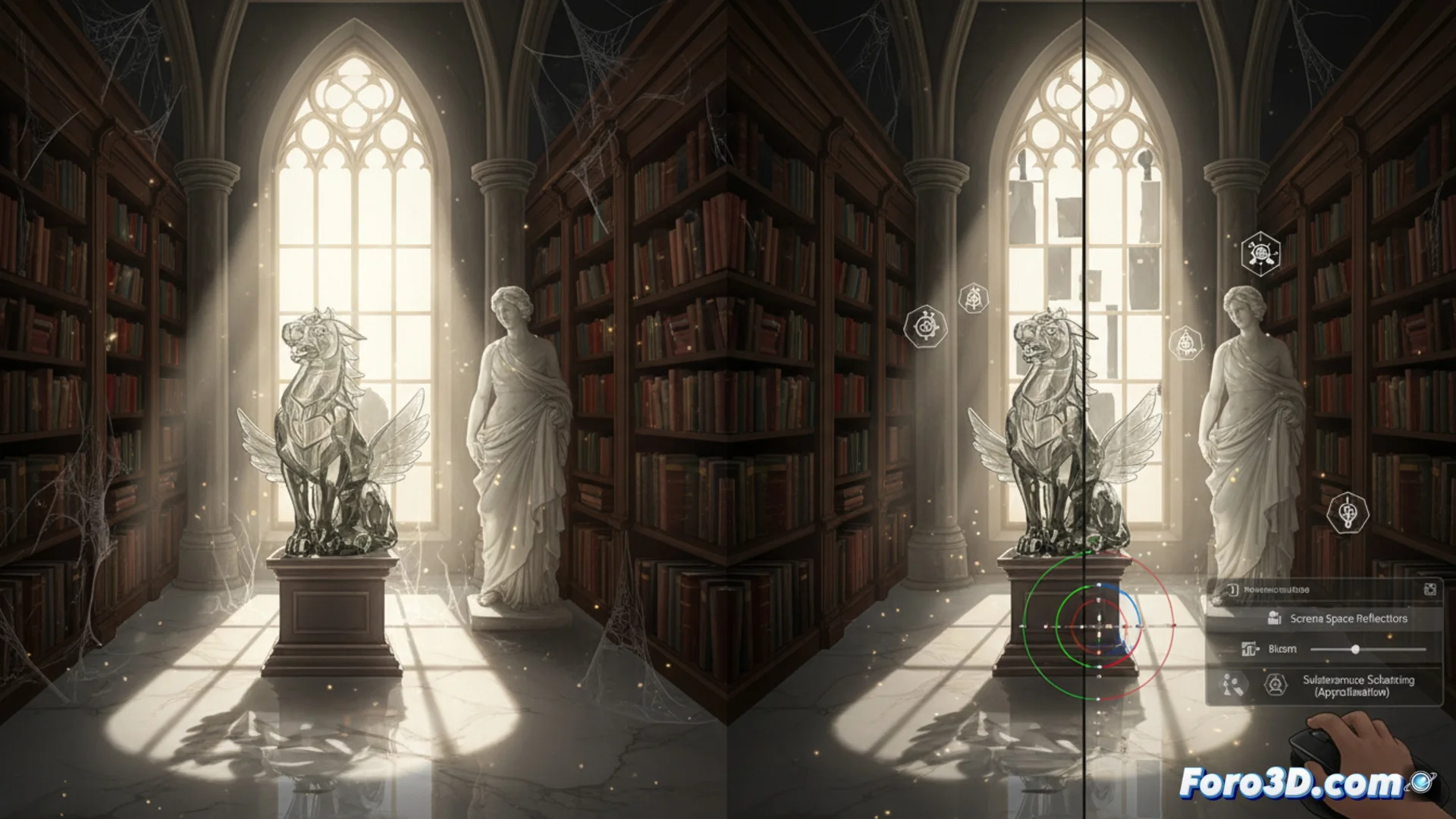
Arnold and Eevee: two rendering philosophies for complex scenes
When working with 3D environments that contain a large amount of geometry, light sources, and shaders, the Arnold and Eevee engines present radically different approaches. One prioritizes physical fidelity, while the other focuses on immediate response, marking two essential paths in digital production 🎨.
The path of physical precision with Arnold
Arnold operates as a ray tracing engine. Its core meticulously calculates the path of light, how it collides with objects, and how it scatters. This method generates images with high photorealism, but demands considerable time to process each frame. The computational load scales directly with the scene's density.
Key features of rendering with Arnold:- Simulates complex lighting phenomena like subsurface scattering or precise refractions.
- Requires high processing power, whether on CPU or GPU, and a lot of system memory.
- Delivers a high-fidelity final image without the need to manually adjust many visual "tricks."
Arnold's strength lies in its ability to consistently produce physically credible results.
The path of speed and interaction with Eevee
Eevee operates as a real-time rendering engine, based on rasterization techniques. Instead of calculating precisely, it approximates effects like reflections, shadows, and global illumination. This allows seeing changes instantly, although some physical accuracy is sacrificed to maintain a smooth framerate 💨.
Central aspects of the Eevee workflow:- Uses methods like environment maps and light probes to simulate light interaction.
- Allows artists to iterate quickly, moving objects and adjusting lights with immediate feedback.
- In very heavy scenes, maintaining performance may require optimizing textures or simplifying effects.
Choosing between fidelity or immediacy
The choice between both engines defines the workflow. An artist can spend time optimizing a scene in Eevee to visually approximate an Arnold render, and then wait hours for Arnold to process that same scene with maximum precision. Understanding their fundamental differences is key to planning any 3D graphics project and allocating the right resources, whether computation time or interaction capacity 🚦.