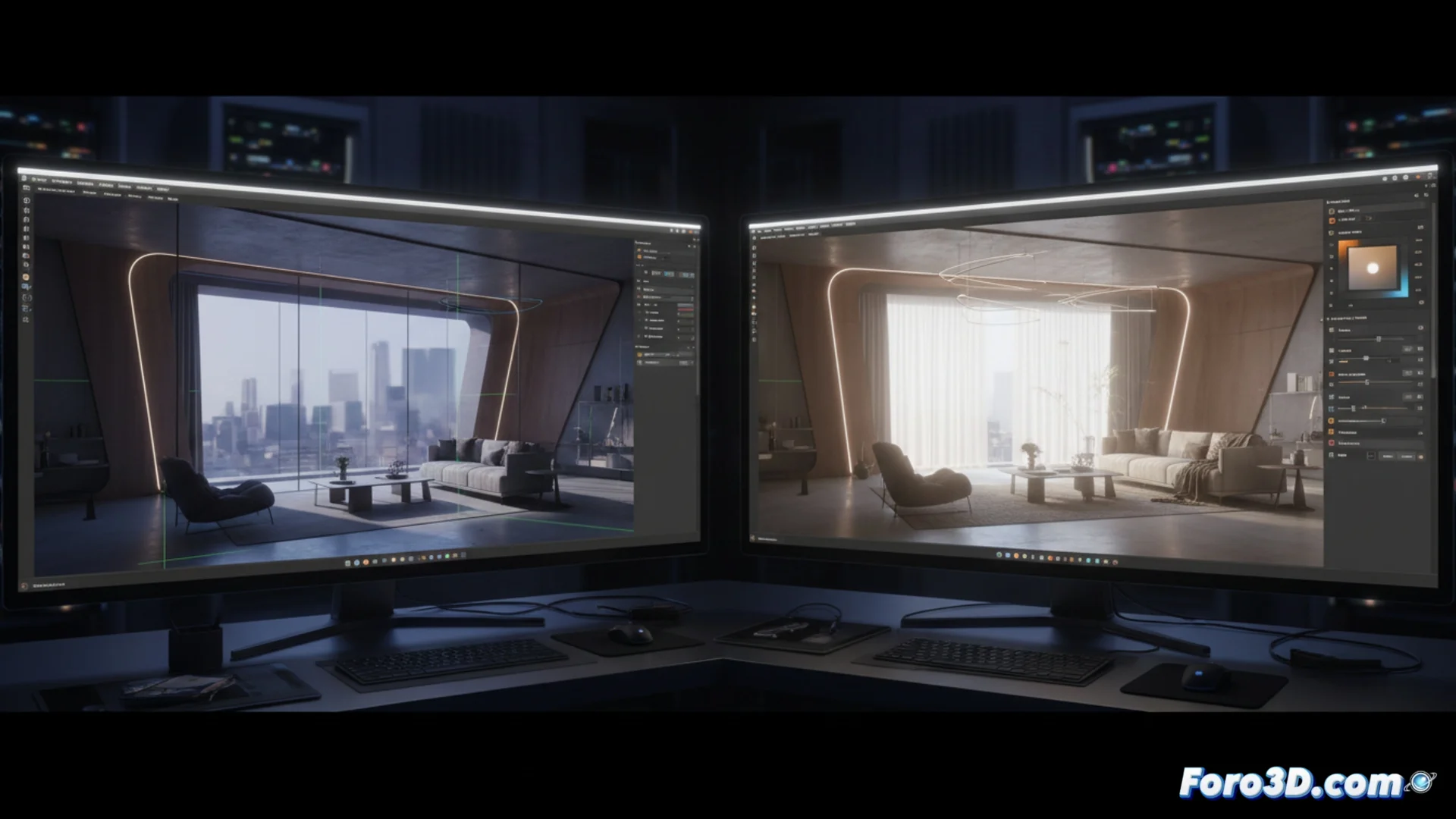
Arnold and Corona: key differences in complex production environments
When working on projects with highly detailed geometry, large textures, and elaborate lighting, the render engine decisions have a significant impact. Arnold and Corona, two popular solutions, adopt opposing philosophies to address these challenges. 🎨
Sampling approaches and artist control
Arnold, as a pure ray tracing engine, delegates to the user the configuration of its sampling system. This allows fine-tuning how shadows, reflections, and light are calculated, offering precise control for very specific results or with custom shaders. Corona, on the other hand, focuses on operational simplicity. Its automatic sampling seeks to balance noise in the image without the artist having to adjust many parameters, which speeds up work in scenes with many diverse elements.
Managing system resources:- Arnold usually loads all geometry and texture data into RAM before rendering, which can limit equipment with less memory.
- Corona implements methods to handle large volumes of data more efficiently, often allowing the use of less powerful hardware.
- In terms of speed, Corona usually shows a noise-free preview faster, while Arnold may require more time to clean noise in complex lighting, but provides more detailed control of the process. ⚡
The choice often comes down to preferring to have all the knobs to turn or letting the engine decide which ones are the most important for you.
Philosophies in materials and lighting
Creating realistic materials in complicated environments tests each engine. Arnold provides a standard physical material node with multiple layers and advanced options, perfect for integrating procedural assets or custom effects. Corona simplifies this path with its preconfigured materials, like the Corona Physical Material, which achieves realistic appearances with few changes.
Light handling:- Both engines work well with area lights and HDRI environments.
- Corona natively integrates its LightMix system, which allows modifying the intensity and color of lights after rendering.
- This capability is a decisive advantage in scenes with numerous light sources, where balancing lighting is complex. 💡
Conclusion for choosing the tool
The final decision between Arnold and Corona depends on the workflow and project needs. Arnold is ideal for those who require granular control over every aspect of the render, even if it involves a steeper learning curve. Corona excels in productivity and simplicity, delivering high-quality results with less manual intervention, ideal for iterating quickly on heavy scenes. The key is knowing what you value most: absolute control or automated efficiency. 🤔