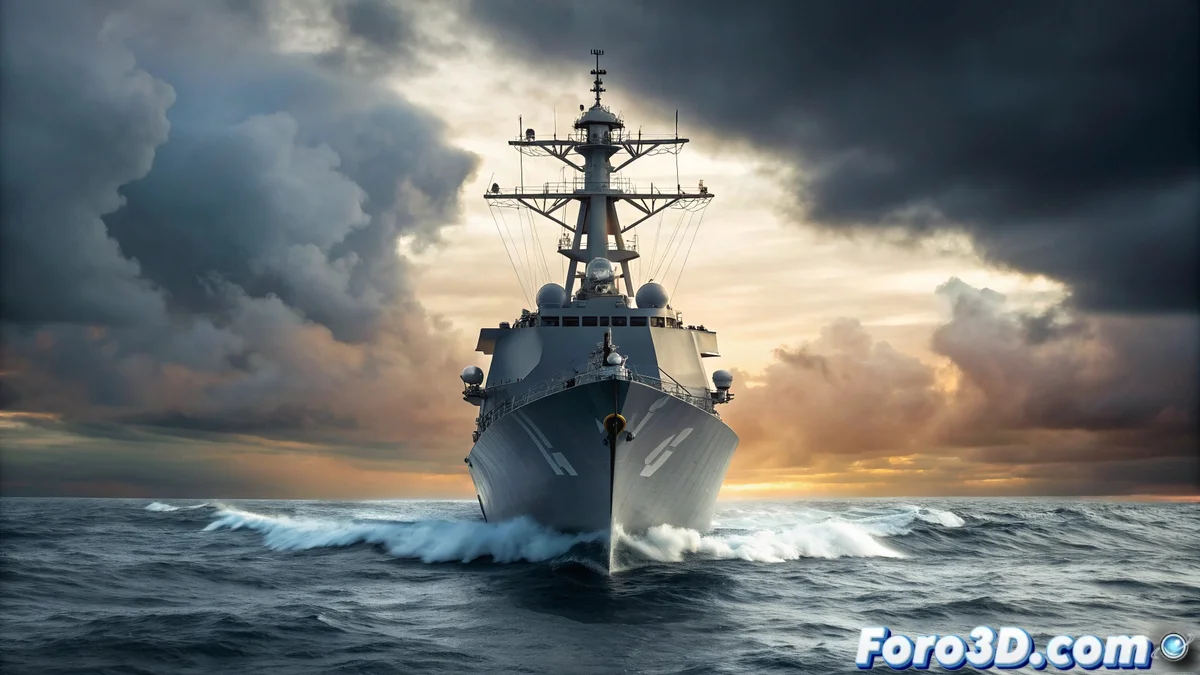
Arleigh Burke-class Destroyer: Complete Guide for 3D Modeling
The Arleigh Burke-class destroyer represents the pinnacle of modern naval technology, standing out for its exceptional versatility and comprehensive combat capabilities. With a constantly evolving design, this vessel has become a benchmark for naval 3D modeling projects 🚢.
Dimensional Characteristics and Propulsion
This naval colossus features impressive measurements that must be replicated with precision in any modeling project. The length overall reaches between 154-155 meters, while the beam varies from 18 to 20 meters depending on the specific version. The draft is maintained between 9-10 meters, and the displacement ranges from 8,300 to 9,700 tons depending on the operational configuration.
Key technical specifications:- Propulsion system with LM2500 gas turbines in a CODAG/T configuration
- Extended operational autonomy for blue-water missions
- Naval structure optimized for multiple combat scenarios
Modeling this destroyer can be as complex as keeping it operational, where every piece must fit perfectly or risk the project sinking before it even sets sail.
Advanced Weapon Systems and Sensors
The primary armament includes the 127 mm Mk-45 gun and the innovative Vertical Launch System (VLS) with a capacity for 90-96 cells. This configuration allows for the deployment of surface-to-air, anti-ship, and land-attack missiles, providing a multidimensional response capability.
Critical components to replicate:- AN/SPY-1 or AN/SPY-6 radars depending on the ship's generation
- Integrated Aegis Combat System for air and missile defense
- Complex network of antennas and distributed communication systems
Essential Techniques for Accurate 3D Modeling
To achieve a faithful representation in 3D models, it is crucial to capture the characteristic angular superstructure with its distinctive Aegis profile. Modelers must pay special attention to the multiple flat surfaces and defined angles that make up the ship's stealth design. The aft flight deck, designed for helicopter operations, requires meticulous detailing along with the prominent funnels and sensor distribution 🎯.