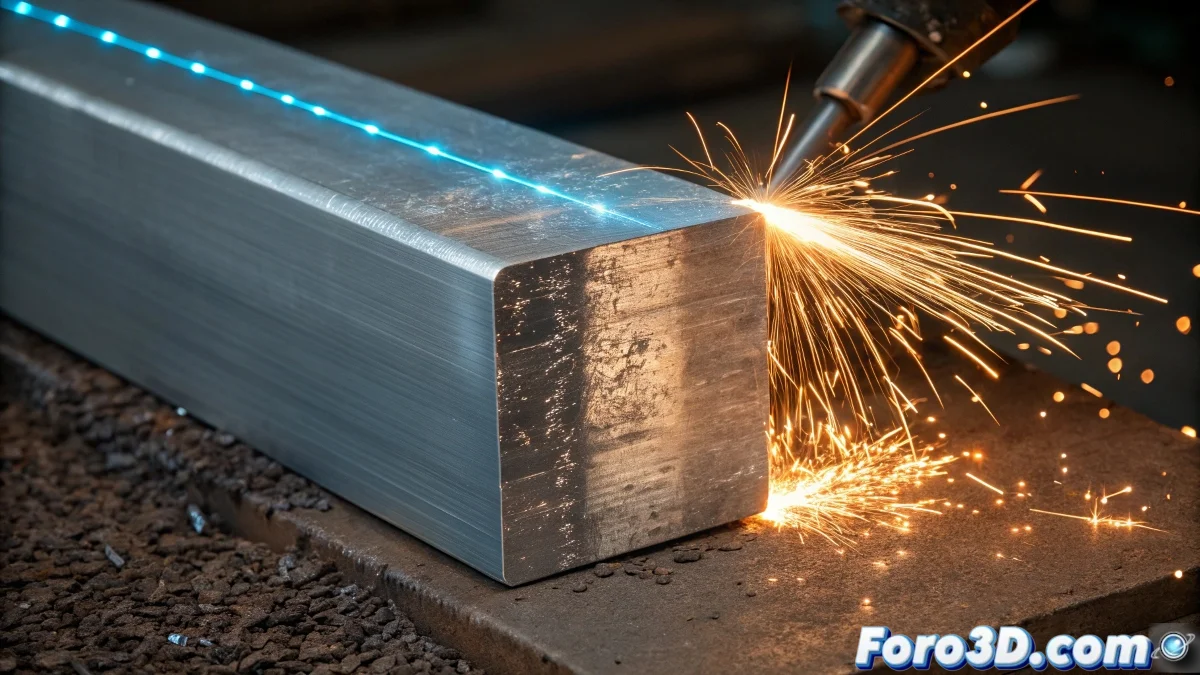
When 3D Printing Meets the Nuclear Challenge
Argonne National Laboratory is writing a new chapter in the history of additive manufacturing. The research focuses on 3D-printed stainless steel for critical nuclear reactor components, a territory where precision and durability are not optional. This advancement could revolutionize how we build and maintain the energy infrastructure of the future.
The scientific team is exploring how the unique microstructures created through 3D printing affect the material's behavior under extreme conditions of radiation and temperature. Preliminary results suggest that printed components could outperform their traditionally manufactured counterparts in some aspects. Nuclear has never sounded so high-tech. 🔬
3D printing allows us to design components that were impossible to manufacture with traditional methods, opening new possibilities for nuclear engineering
Potential Advantages of Additive Manufacturing in Nuclear Energy
Argonne's approach could solve several persistent challenges in the nuclear industry. The customization and speed of 3D printing offer tangible benefits over conventional methods.
- Complex geometries optimized for coolant flow and thermal management
- In-situ repair of damaged components without the need for complete replacement
- Reduced manufacturing times for specialized spare parts
- Local customization tailored to the specific needs of each reactor
Researchers particularly highlight how the ability to create complex internal structures could significantly improve the efficiency of cooling systems, a critical aspect of nuclear safety. 💡
Technical Challenges on the Path to Implementation
It's not all optimism in the lab. Validating components for nuclear use requires exceptionally rigorous standards. Each part must demonstrate its reliability for decades under extreme conditions.
- Long-term behavior under constant, high-intensity radiation
- Structural integrity after repeated thermal cycles and mechanical stress
- Compatibility with other reactor materials throughout its service life
- Regulatory certification for safety-critical applications
Argonne scientists are using advanced characterization techniques to understand how microscopic defects behave and evolve under the unique conditions of a nuclear reactor.
The Future of Manufacturing in Nuclear Energy
This research could set new standards for the manufacturing of nuclear components. The ability to produce parts on demand would transform plant logistics and maintenance.
If results continue to be promising, we could see the first 3D-printed components in experimental reactors within the next five years. The additive manufacturing revolution would finally reach one of the most conservative fields of engineering. 🚀
And if the components perform as well as hoped, perhaps soon nuclear reactors will have more in common with a 3D printer than with a traditional forge... though let's hope they don't start printing fuel rods by mistake 😉