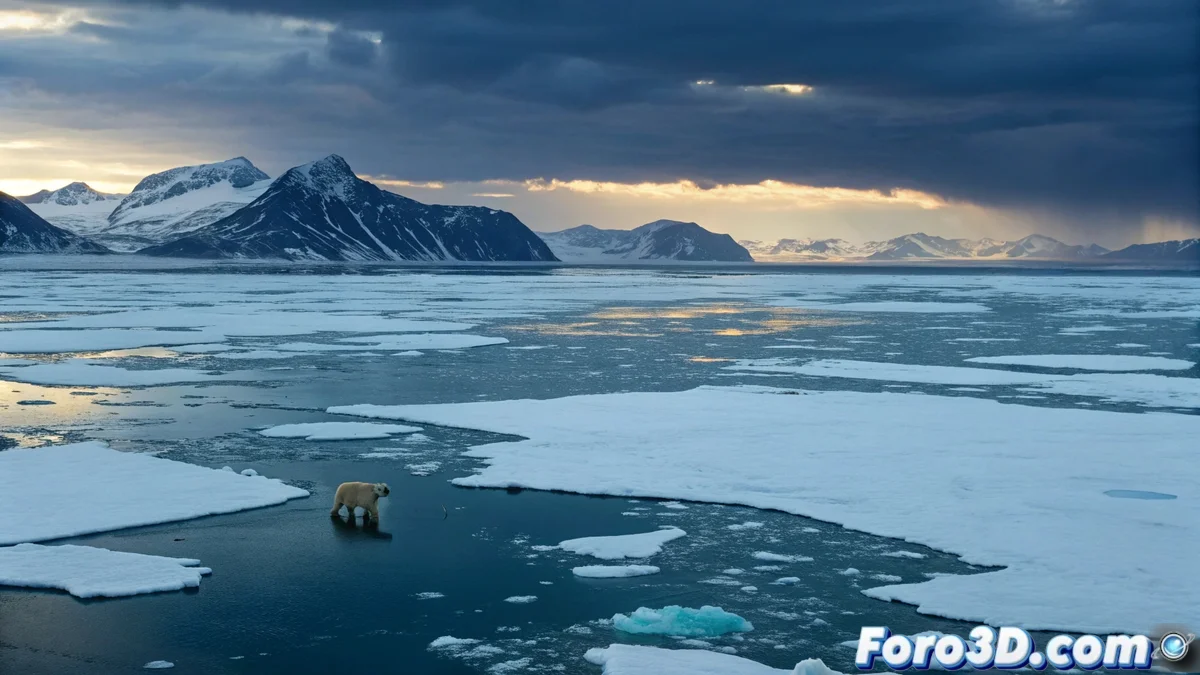
Arctic warming is already causing irreversible changes
A recent study confirms that some effects of warming in the Arctic are already irreversible, even if carbon dioxide in the atmosphere is successfully reduced. Scientists modeled a scenario where CO2 emissions are completely eliminated after the region exceeds a key temperature threshold. They discovered that certain changes do not reverse when CO2 levels drop, suggesting that the Arctic climate system has crossed tipping points. 🌍
The climate model reveals a new reality
The research, published in Nature Climate Change, used a complex climate model to simulate a future where CO2 concentrations peak and then decline to pre-industrial levels. The main result is that the Arctic Ocean could become practically ice-free in summer permanently, regardless of reductions in greenhouse gases. The accumulated heat in the ocean and changes in atmospheric circulation maintain these new conditions. This phenomenon is known as hysteresis, where the system does not return to its original state when the cause is reversed. ❄️➡️🌊
Changes identified as irreversible in the model:- Increase in precipitation: Rain on snow intensifies and does not decrease when CO2 is lowered.
- Decrease in sea ice cover: Summer ice loss becomes a permanent state of the system.
- Alteration of oceanic and atmospheric circulation: Heat and cold patterns are reconfigured in a lasting way.
It seems the Arctic has long-term memory and does not easily forget a warming, even if we later try to apologize by lowering CO2.
Consequences extend beyond the ice
The irreversible loss of sea ice affects the entire Arctic ecosystem. Additionally, the increase in rain on snow accelerates terrestrial thawing and releases more methane, another potent greenhouse gas. These local changes also influence Northern Hemisphere weather patterns, potentially altering jet streams and extreme weather events in mid-latitudes. The window to prevent these permanent damages is closing rapidly. 🐻❄️
Chain impacts of irreversible changes:- Arctic ecosystem: Threatens the survival of species like polar bears and affects human communities that depend on ice.
- Methane release: Permafrost thawing releases this gas, further enhancing the global greenhouse effect.
- Global climate: Alteration of extreme weather patterns, such as heatwaves and storms, in regions far from the Arctic.
A future with a transformed Arctic
The findings underscore that some transformations in the Arctic are already locked in, with no possibility of reversal simply by reducing emissions. This redefines climate mitigation goals, which must now also focus on adapting to inevitable changes and preventing more tipping points from being crossed in other regions of the planet. Immediate climate action remains crucial to limit the extent of these permanent damages. ⏳