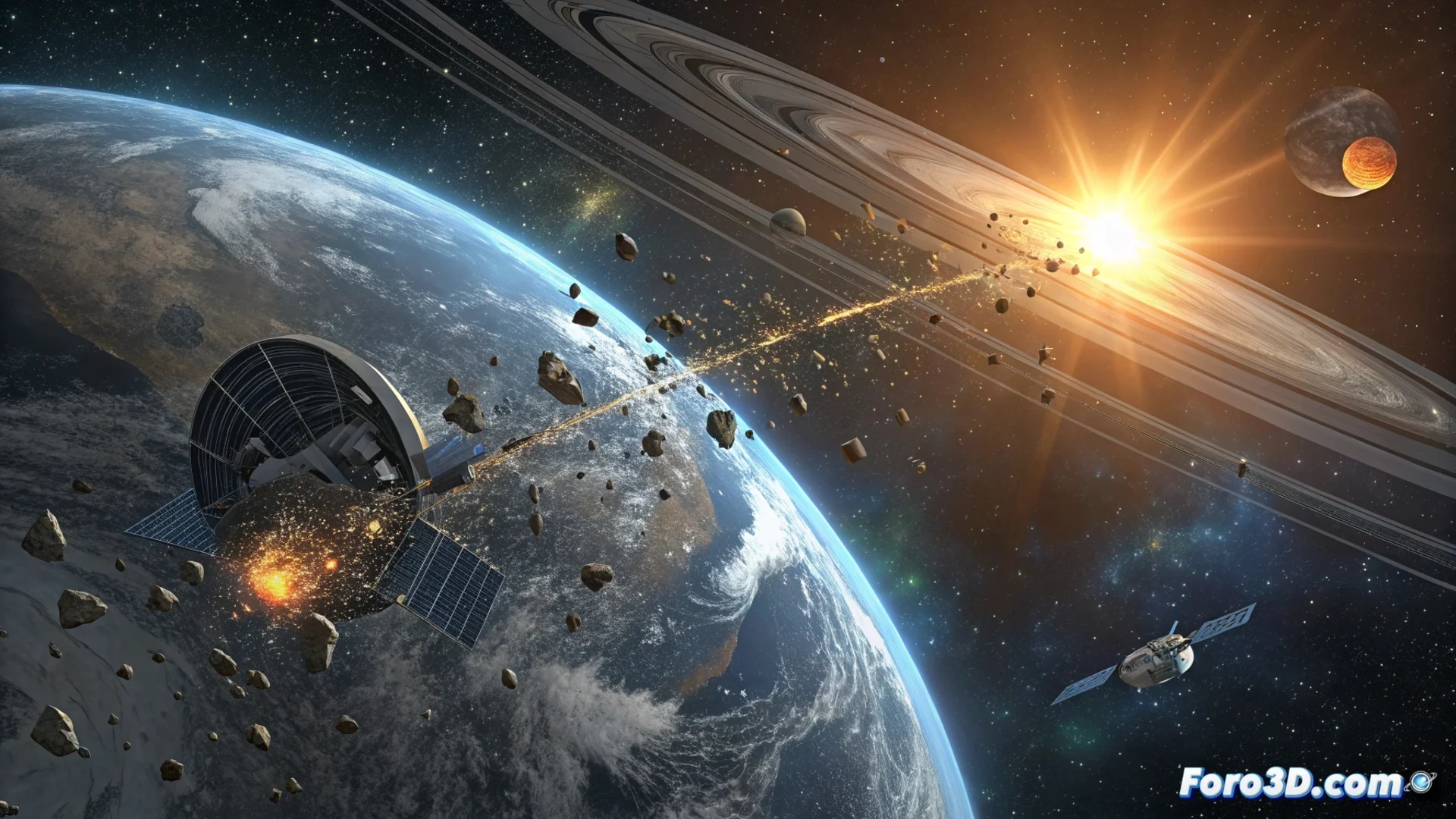
Archimedes Applies His Principle to Solve Orbital Congestion
Imagine the genius from Syracuse tackling one of the greatest challenges of the modern space age: the growing cloud of orbital debris. Instead of complex mechanical methods, his mind would delve into fundamental physics to devise an elegant and passive solution. 🧠✨
Reinventing a Millennial Principle for Space
Archimedes' famous buoyancy principle, which explains why objects float in a fluid, finds a new interpretation in the vacuum of space. Here, the dominant forces are gravity and magnetism. The conceptual proposal suggests that operational satellites could generate a controlled force field, creating an analogy of magnetic buoyancy.
Key Mechanism of Action:- Operational satellites displace the space-time around them with their field.
- Inert objects, with a different magnetic density, experience a net thrust.
- This thrust does not destroy the debris, but rather moderates its trajectory in a predictable manner.
“The passive system keeps useful orbits clean, without the need for special spacecraft to actively capture each fragment.”
A Self-Sustaining System to Clean Orbits
The ultimate goal is not to capture, but to redirect. The magnetic field would act as a constant and gentle force, gradually pushing scrap fragments towards denser regions of the atmosphere. This process leverages atmospheric friction to disintegrate the debris naturally.
Advantages of the Passive Approach:- Eliminates the risk and high cost of active capture missions.
- The system is powered by the normal operation of the satellite constellation.
- Directs the debris towards its reentry and atmospheric disintegration autonomously.
The Eureka Shout in the Space Age
Today, Archimedes would exclaim Eureka! upon seeing how active satellites can displace space junk towards its destruction, cleaning the fluido
Related Links