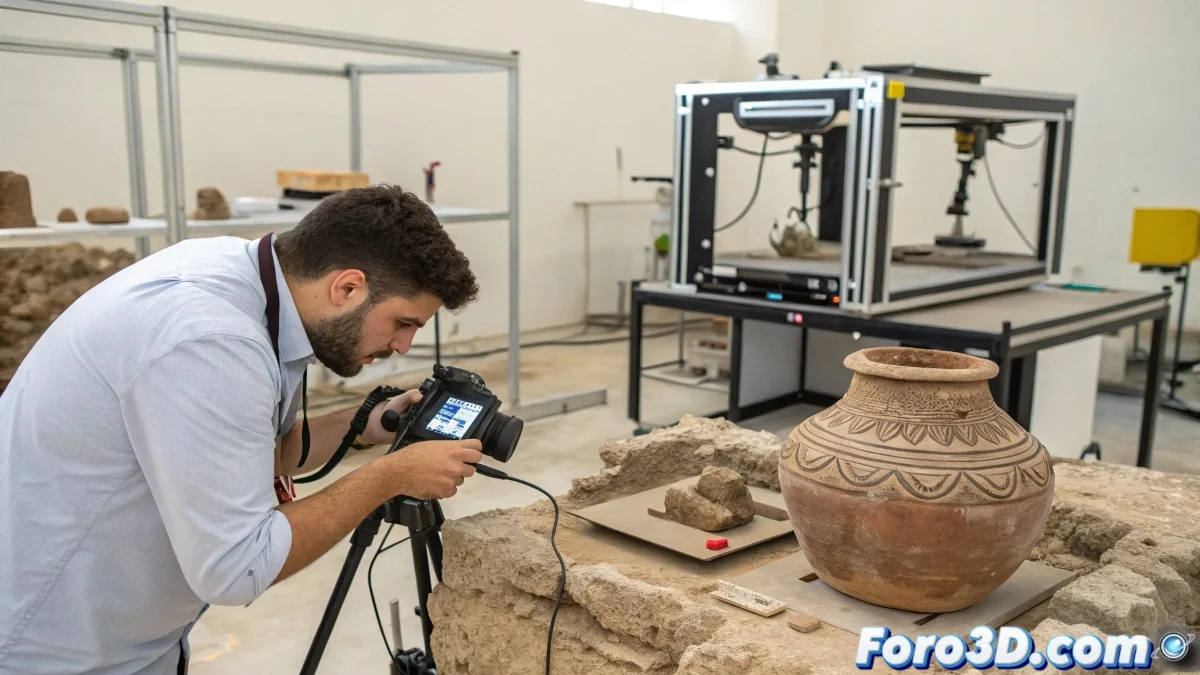
When Archaeology Meets 3D Technology
Amid the dust of centuries and the delicate work with brushes, a new ally has emerged for archaeologists: the hum of a 3D printer. Don't expect it to dig for us (yet), but it does create those perfect replicas that make researchers lose less sleep and gain more knowledge. That said, it still can't print that enthusiastic volunteer who always arrives late to the excavations.
"The new perfect field assistant: brush, saintly patience... and a 3D printer for when the original is too valuable to touch"
Rescuing the Past with Future Technology
In the meticulous world of archaeology, where every fragment tells a story, 3D printing appears as that tireless digital restorer. From exact replicas to specialized tools, it is now possible to study the past without risking valuable originals. That said, the machine still can't distinguish between an ancient vase and a common stone... what a relief for apprentices.
- Identical copies of fragile artifacts
- Interactive models of sites
- Custom tools for excavations
- Supports for pieces during study
From Fragment to Complete Model
Beyond simple reproduction, 3D printing allows reconstructing incomplete pieces, creating tactile models for the visually impaired, or even producing replicas for school museums. The only limitation is imagination (and patience to clean the filament full of archaeological dust). That said, be careful about promising "any replica," because then they ask for a scale pyramid and you end up becoming an Egyptian architect.
What No Archaeology Manual Mentions But 3D Solves
Between excavation and excavation, there are hundreds of small miracles that a printer can make real:
- Guides for assembling complex fragments
- Protective cases for safe transport
- Educational models for workshops
- Supports for technical photographs
Past and Future, Printed in 3D
In the end, 3D printing doesn't come to replace the expert eye of the archaeologist, but to give them more tools for their work. Because when it comes to deciphering our history, it doesn't matter if the solution comes from a centuries-old method or an STL file. The important thing is that knowledge is preserved, now with a touch of smart plastic. And who knows, maybe soon they can even print that colleague who always returns borrowed tools... though that would already be ancient magic. 🏺😉
So now you know: the next time you see a 3D printer at an archaeological site, it's not that they've opened a tech workshop. It's simply the natural evolution of a science where precision and conservation have always gone hand in hand.