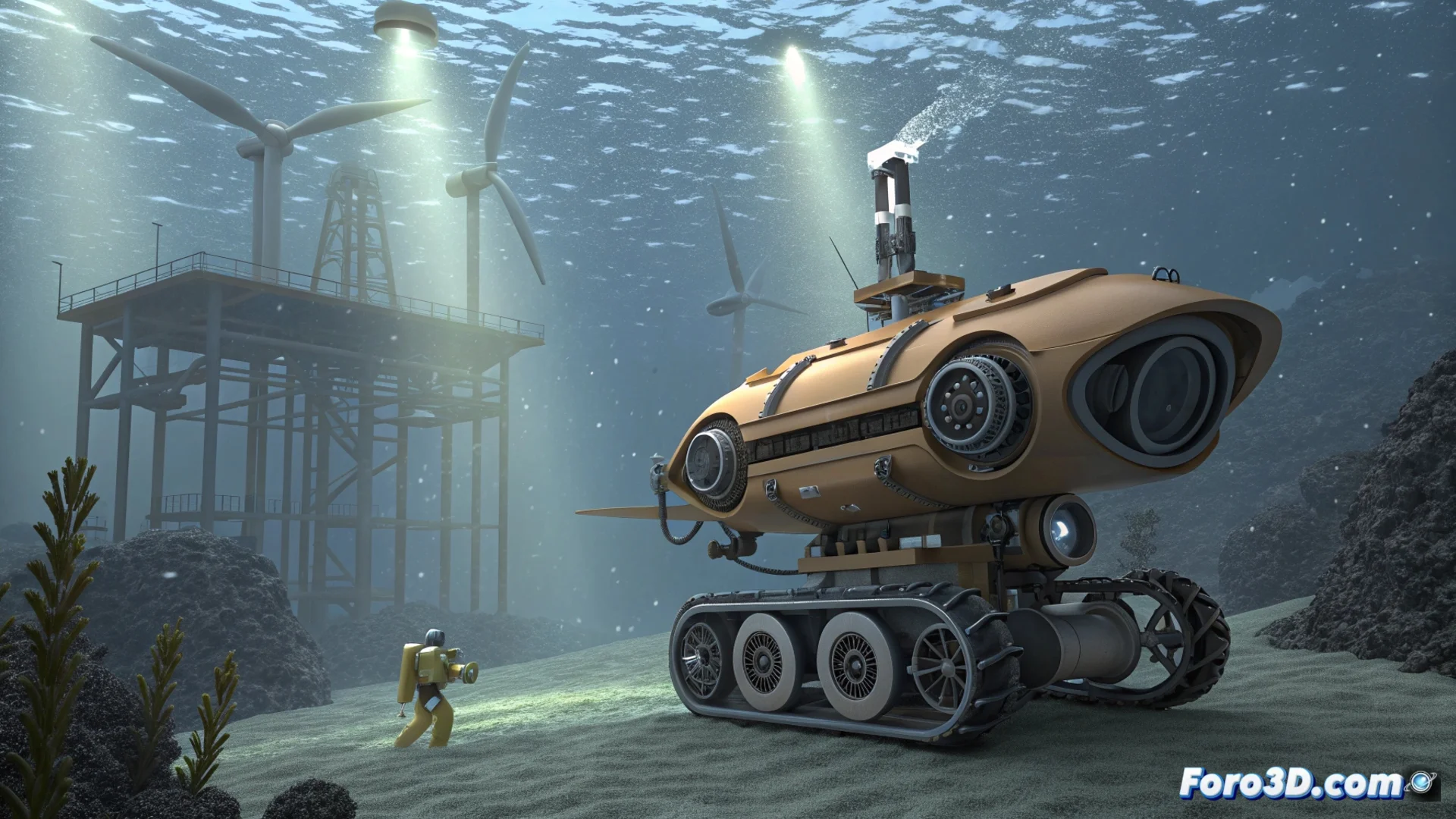
Aquanaut, the Submarine Robot that Transforms for Complex Tasks
In the field of marine robotics, a versatile solution emerges: Aquanaut. Developed by the company Nauticus Robotics (formerly Houston Mechatronics), this system represents a significant advancement by combining efficient mobility with physical intervention capability in a single autonomous device. 🦾
A Dual Design for Maximum Adaptability
Aquanaut's main innovation lies in its variable physical configuration. It begins its missions with a compact and hydrodynamic profile, similar to a torpedo, which allows it to travel long distances while consuming little energy. Upon reaching the work area, its structure modifies: a section of the fuselage rotates and separates, deploying two semi-humanoid manipulator arms. This transformation allows it to shift from being a transport vehicle to an active work platform.
Key Operational Capabilities:- Underwater Inspection: Uses cameras and sonar to evaluate infrastructures such as oil platforms or cables from offshore wind farms.
- Manipulation and Maintenance: Its arms, equipped with grippers or specialized tools, can turn valves, clean surfaces, or cut elements.
- Advanced Autonomy: Integrates artificial intelligence and sensors to navigate, perceive the environment, and decide how to act without constant control from the surface.
Aquanaut eliminates the thick umbilical cable that usually tethers remotely operated robots, gaining unprecedented freedom of movement for complex operations.
Optimizing Submarine Industrial Operations
This robot is designed to optimize work in sectors such as oil, gas, and offshore wind energy. Its operation seeks to reduce dependence on expensive manned support vessels. It can be deployed from remote platforms or non-dedicated vessels, simplifying logistics. Human operators supervise its work and send high-level commands via underwater acoustic communication or satellite when it surfaces, maintaining control without physical tethers.
Main Operational Advantages:- Reduces Costs: Minimizes the need to use and maintain large crewed support vessels.
- Increases Safety: Decreases risks to human personnel in hostile underwater environments.
- Gains Efficiency: Allows inspection and intervention tasks to be performed in a single mission, saving time.
- Lower Environmental Impact: Its autonomous and precise operation can help protect the marine ecosystem.
Challenges and Future of Transformable Robotics
Although Aquanaut promises to revolutionize underwater maintenance, it still faces the challenge of demonstrating long-term reliability. Its complex joints and mechanical systems must withstand extreme pressure, corrosion, and constant wear from the ocean depths, an environment that forgives no failures. Overcoming these obstacles will be crucial for this technology to be widely and reliably adopted in the industry. 🔧