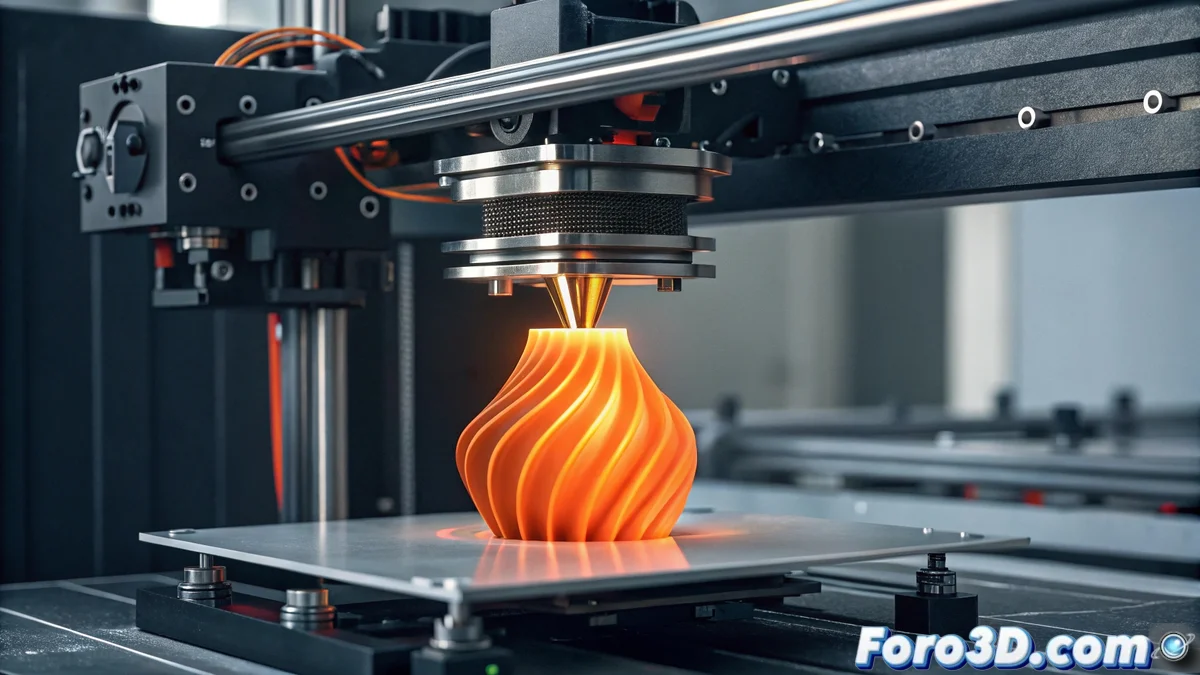
AON3D Launches Software Update with Physical Models to Optimize G-Code in FFF 3D Printing
The company AON3D has introduced a revolutionary update to its software platform that implements advanced physical models to redefine G-Code generation in Fused Filament Fabrication (FFF) systems. This innovation promises speed increases of up to 54% in print times while maintaining the mechanical properties and surface finish of the produced parts intact 🚀.
Fundamentals of Optimization Through Physical Simulation
The core of the system lies in predictive algorithms that recreate the real behavior of materials throughout the entire manufacturing process. These computational models consider critical variables such as the dynamic viscosity of the filament, the inertial forces of the print head, and heat transfer patterns on the heated bed. The ability to accurately anticipate the behavior of each printed segment allows for intelligent speed adjustments based on the specific needs of each geometric zone.
Key parameters analyzed by the system:- Rheological behavior of the material under different temperature and flow conditions
- Dynamics of print head movements and acceleration/deceleration effects
- Heat distribution patterns at the bed-part interface and between successive layers
The implementation of physical models represents a paradigm shift in printing path generation, enabling optimizations that were previously impossible to achieve with traditional methods.
Benefits in Productive Efficiency and Dimensional Quality
This methodology allows users to maintain established quality standards while experiencing substantial reductions in total cycle times. AON3D's internal validations demonstrate that components with complex geometries and fine details particularly benefit from this technology, as the software identifies areas where it is possible to increase speed without affecting structural integrity or the resolution of critical features 🔍.
Advantages documented in laboratory tests:- Average reduction of 40-54% in manufacturing times with no compromise to mechanical properties
- Improved dimensional consistency thanks to more precise thermal compensations
- Automatic parameter optimization for different families of polymeric materials
Future Perspectives on Efficiency Measurement
With these advances in temporal optimization, it will soon be necessary to implement more precise timing systems to quantify the real savings obtained. Users will be able to spend less time waiting for their prints to finish and more time on value-added activities, marking a milestone in industrial additive manufacturing productivity ⏱️.