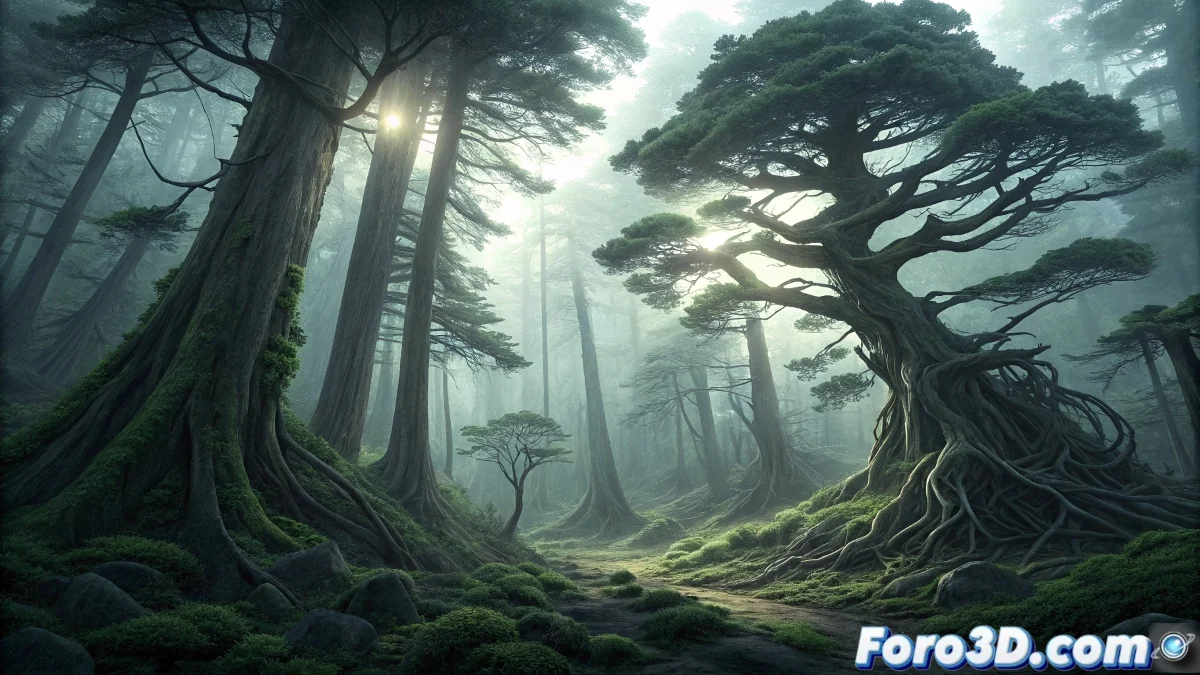
Aokigahara Forest Lighting in Lightscape for Ambient Horror
The Aokigahara forest in Japan represents one of the world's most atmospheric natural environments, where the extreme density of firs and cedars creates perpetual twilight and legends speak of trees whispering the last words of those lost in its thicket, offering the perfect setting to master advanced global illumination techniques and ambient light effects in Lightscape. 🌲
Ecological Context and Supernatural Folklore
This volcanic forest at the base of Mount Fuji is characterized by its exceptionally dense growth due to the lava soil, creating unique conditions where sunlight barely penetrates the forest canopy. Local folklore suggests that this near-perpetual darkness allows the forest to develop its own consciousness, absorbing human pain through its roots and recommunicating it through audible whispers in the wind.
Unique Environmental Features:- Extreme vegetal density with nearly complete closed canopy
- Porous volcanic soil that absorbs sound
- Constant twilight with less than 5% direct sunlight
- Intertwined growth of roots and trunks
- Deep silence broken only by inexplicable whispers
The roots of the trees grow until they intertwine with the bodies, allowing the forest to whisper the last words of the lost - Aokigahara Legend
Forest Lighting and Atmosphere Research
It is essential to study the behavior of light in dense forests, the sound absorption properties of volcanic soils, the visual effects of prolonged twilight, and to develop techniques to represent the forest's "consciousness" through subtle lighting effects and atmospheric particle systems.
Essential Research Areas:- Light behavior in closed-canopy forests
- Optical properties of different conifer species
- Filtered light effects and subsurface scattering in foliage
- Acoustic absorption in porous volcanic soils
- Visual representation of sound and whispers
Step by Step: Lighting in Lightscape
1. Initial Project Setup
Open Lightscape 3.2 and set units to meters. Import the dense forest 3D model. Set base material properties for organic surfaces and configure the light measurement system for twilight conditions.
2. Definition of Natural Light Sources
Set up indirect solar lighting: - Define a very dim sunlight source (200-500 lux) - Set low solar angle for twilight conditions - Configure cool color temperature (4500-5500K) - Adjust intensity for 2-5% direct lighting
3. Canopy Filtered Light System
Implement twilight effects: - Create area lights in canopy openings - Configure gobo patterns for leaf effects - Develop volumetric light for visible rays - Set fast light decay for depth
4. Materials and Surface Properties
Set up forest reflectivity: - Develop bark materials with low reflectance - Create leaves with high subsurface scattering - Configure moss with light absorption properties - Set volcanic soil with high visual porosity
5. Radiosity and Global Illumination
Run indirect light calculation: - Configure radiosity parameters for high precision - Set number of rays to capture diffuse light - Develop adaptive meshing for complex areas - Optimize process to maintain twilight details
6. Visual Whisper Effects
Create sound representation: - Develop particles emanating from specific trees - Configure subtle animation in windless foliage - Create distortion effects in "whisper" areas - Develop color shifts for different emotions
7. Integration of Atmospheric Elements
Add ambient depth: - Configure volumetric fog for low mist - Develop depth-based desaturation - Create aerial perspective effects - Set atmospheric lighting for cohesion
8. Exposure and Contrast Adjustments
Optimize for twilight visibility: - Adjust gamma for shadow details - Configure tonemapping for high dynamic range - Develop highlight compression - Set black level for shadow depth
9. Rendering and Post-Processing
Generate the final result: - Render in high resolution with anti-aliasing - Generate passes for compositing control - Create versions with different light intensities - Export with complete lighting information
10. Verification and Final Adjustments
Perfect the visual atmosphere: - Verify shadow and light coherence - Adjust color balance for melancholy - Refine atmospheric effects for naturalness - Optimize for different display devices
Advanced Global Illumination Techniques
For cinematic results, master the use of photon mapping for caustic effects, develop final gathering techniques for shadow details, and use image-based lighting for integration with real footage. 💡
Recommended Advanced Techniques:- Photon mapping for complex light effects
- Final gathering for details in dark areas
- Image-based lighting for realistic integration
- HDRi lighting for precise atmospheric conditions
Integration with Modern Pipelines
When exporting for modern render engines, configure light maps for real-time rendering, develop PBR materials that respond to the calculated lighting, and create dynamic lighting systems that maintain the perpetual twilight atmosphere.
Illuminating the Forest's Consciousness
Working with the Aokigahara forest in Lightscape explores the boundary between technical lighting and emotional narrative, demonstrating that light can be both a physical tool and a vehicle to communicate psychological states and supernatural atmospheres, where the twilight itself becomes a character and the filtered light a messenger of untold stories. 🌫️