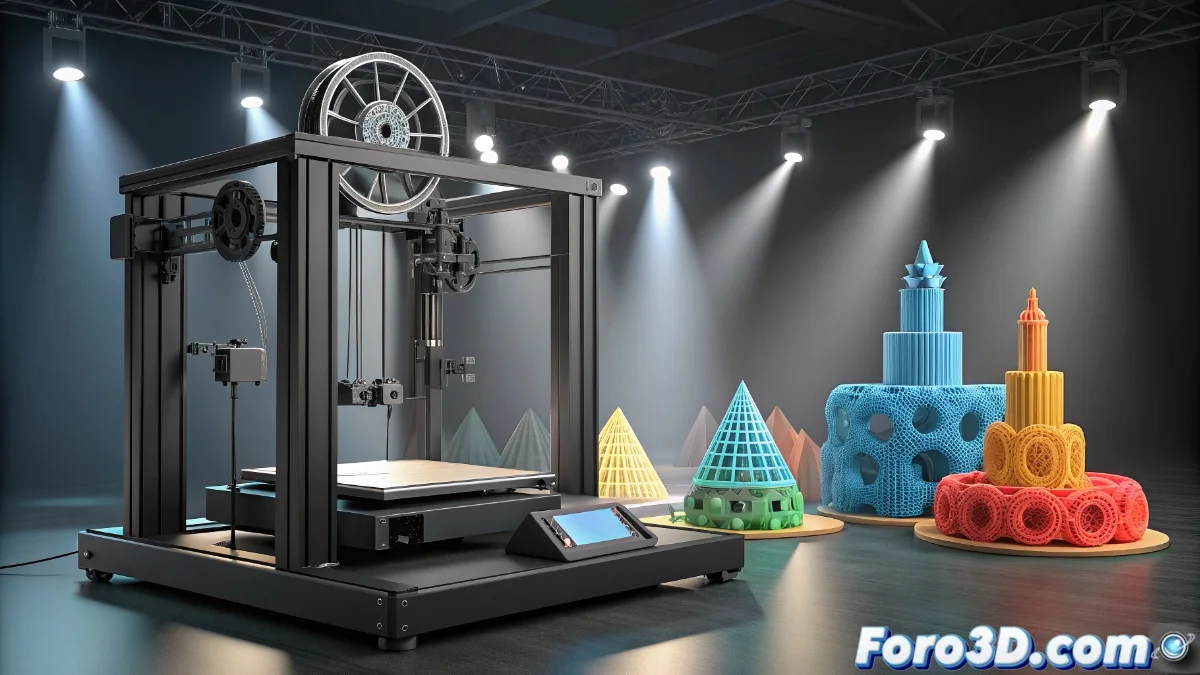
Anycubic Revolutionizes Formnext 2023 with Multi-Material 3D Printing and Ultra-Precision Resins
At the Formnext 2023 event, Anycubic made a huge impact by unveiling two product lines that redefine its technical capabilities. The company has made a strategic leap towards more professional and specialized markets, combining multi-material FDM technology with ultra-high-resolution resin systems. 🚀
Innovation in Multi-Material FDM Printing
Anycubic's new development incorporates an interchangeable print head that handles up to four different materials in a single session, eliminating manual interruptions for filament changes. This allows for the creation of complex parts with color variations and different mechanical properties in one process, optimizing workflow.
Key Features of the FDM System:- Interchangeable head for up to 4 different materials simultaneously
- Elimination of manual pauses, speeding up the production of complex models
- Ability to combine colors and materials with different properties in one print
Anycubic demonstrates that, in the evolution of 3D printing, fewer machines can translate to more creative opportunities.
Advances in High-Precision Resin Systems
Simultaneously, Anycubic has presented resin printers with a resolution of 10 microns, aimed at sectors demanding extreme detail, such as dental, jewelry, and high-end prototyping. These devices include improvements in the light source for uniform exposure and automatic filtering systems that simplify post-processing.
Improvements in Resin Technology:- Resolution of up to 10 microns for microscopic details
- Enhanced light sources ensuring homogeneous exposure across the entire build plate
- Automatic filtering systems that reduce user handling of liquid resins
Impact on the Creative Workflow
With these new developments, users can free up space on their workbenches by printing multiple materials without the need to physically switch printers. Anycubic thus consolidates its transition towards integrated solutions that expand creative and technical possibilities in the field of additive manufacturing. 💡