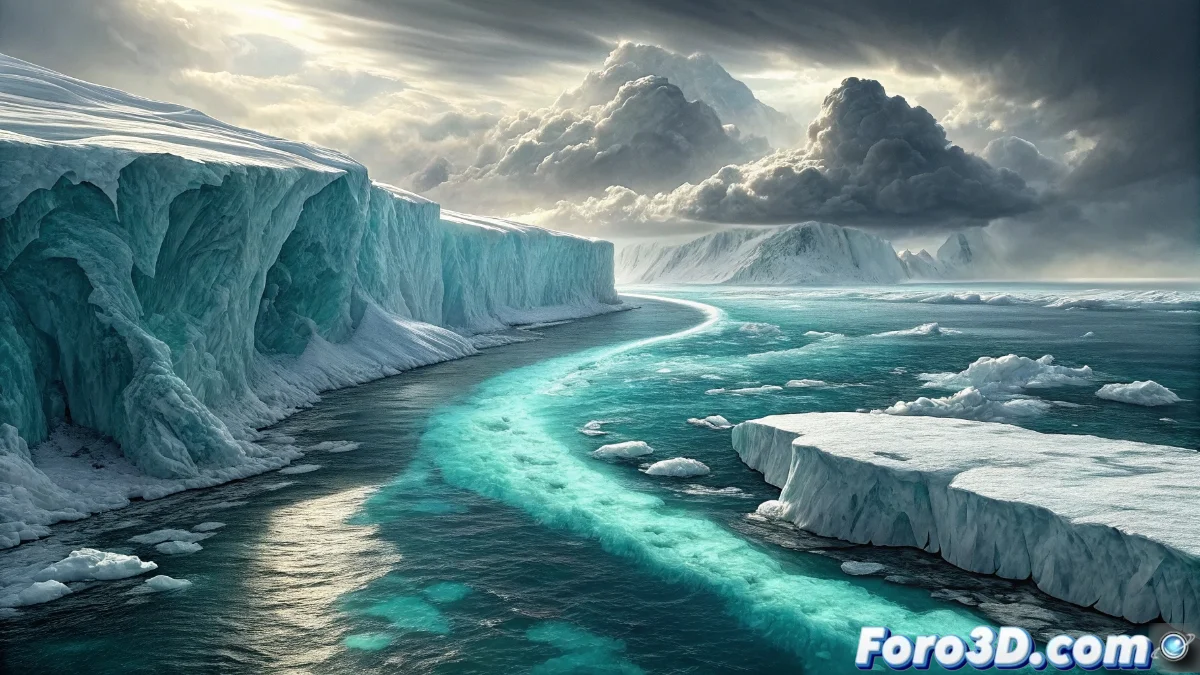
Antarctic Melting and Its Paradoxical Effect on Global Climate
A recent scientific study has discovered that the accelerated melting of Antarctic ice is producing a completely unexpected climatic phenomenon that could be temporarily helping to maintain the stability of the global climate system 🌍.
Compensatory Mechanism Contrary to Predictions
The research reveals that freshwater from glacial melt is integrating into the ocean current system in a way that strengthens circulation, a result that contradicts the projections of numerous climate models. This less dense water forms a surface layer that interacts with deeper, saltier water masses, altering convection patterns and sustaining the flow of the Antarctic Circumpolar Current which influences climates as distant as Europe and North America 🔄.
Key Elements of the Phenomenon:- Interaction between surface freshwater and deep ocean masses
- Modification of ocean convection patterns
- Temporary reinforcement of the Antarctic Circumpolar Current
"It seems that in our attempt to alter the planet, we have accidentally found a way to keep it running a little longer, like when you fix the car by hitting the engine until it starts again" - Reflection from the researchers
Temporary Stabilization with Imminent Risks
Scientists emphasize that this stabilizing effect is transient and could reverse abruptly when melting reaches specific critical thresholds. The scientific community is conducting constant monitoring using oceanographic buoys, specialized satellites, and advanced computational models, attempting to identify the tipping points where the climate system could collapse irreversibly ⚠️.
Scientific Monitoring Methods:- Global network of high-precision oceanographic buoys
- Satellites specialized in polar observation
- State-of-the-art computational models
Race Against Climatic Time
This situation creates a race against time to understand the exact mechanisms before irreversible changes occur in the global climate. The Antarctic paradox represents both a learning opportunity and a warning about the complexity of climate systems and the urgency to act before the critical limits of polar ice melt are reached 🕰️.