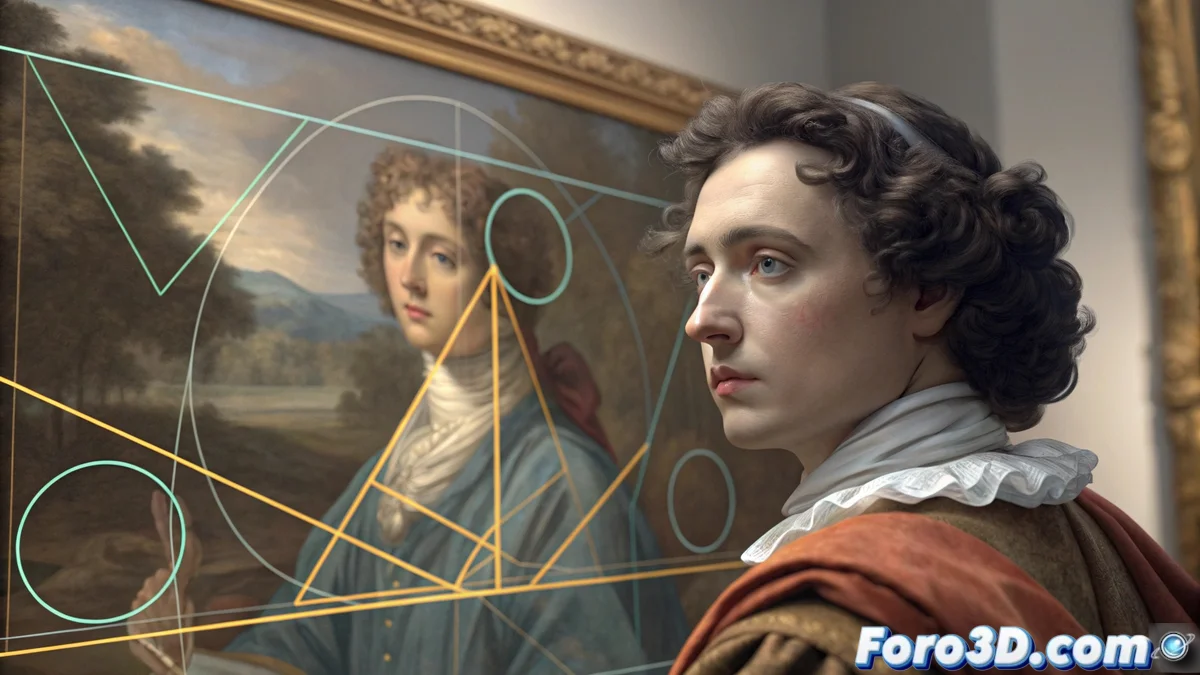
Analyze the Composition of a Masterpiece with Digital Deconstruction
This exercise proposes studying how a classical painting is organized. The goal is not to replicate its aesthetic appearance, but to decipher its internal visual architecture. To achieve this, a work by a recognized master is selected, and digital software such as Photoshop, Krita, or GIMP is used. On a new layer, only the guiding lines, essential geometric shapes, and attention foci are traced. This process reveals the choices that guided the artist in constructing the scene. 🎨
Practical Process to Deconstruct a Composition
First, the reference image is imported and its opacity is reduced. Then, using line and shape tools, the key components are marked. Diagonals that generate movement, triangles that organize characters, or circles that focus on a face are identified. A grid is also overlaid to check if the painter applied the rule of thirds, placing crucial elements at their intersections. The result is an abstract scheme that exposes the visual framework of the piece.
Key Steps in the Analysis:- Reduce the opacity of the original work to use it as a guide background.
- Use new layers to trace lines of force and dominant geometric shapes.
- Look for repetitive patterns and structures that direct the viewer's gaze.
Discovering that your favorite masterpiece is supported by a simple triangle can be as revealing as it is disillusioning. In the end, genius sometimes lies in knowing where to place a line.
What is Gained by Visually Disassembling a Work
By making this skeleton visible, principles such as balance, rhythm, and visual flow are understood. It becomes clear how lines lead attention to the main focus or how repeated shapes create unity. This knowledge is transferable: when producing your own illustration, an analogous structure can be implemented to achieve a more solid and communicative image. It is a system for training perception rather than manual technique.
Principles that are Internalized:- Balance between elements and negative space.
- Rhythm created by the repetition of shapes or lines.
- Visual flow that guides the eye through the image's narrative.
Applying Structural Knowledge
The ultimate value of this method lies in its practical application. Analyzing others' compositions provides a visual vocabulary that can be used when creating. Instead of starting with a blank canvas without direction, the artist can first establish a robust geometric structure, making conscious compositional decisions from the beginning. Thus, one moves from merely admiring art to understanding its mechanisms and, ultimately, using them. It is the difference between seeing and understanding. 👁️