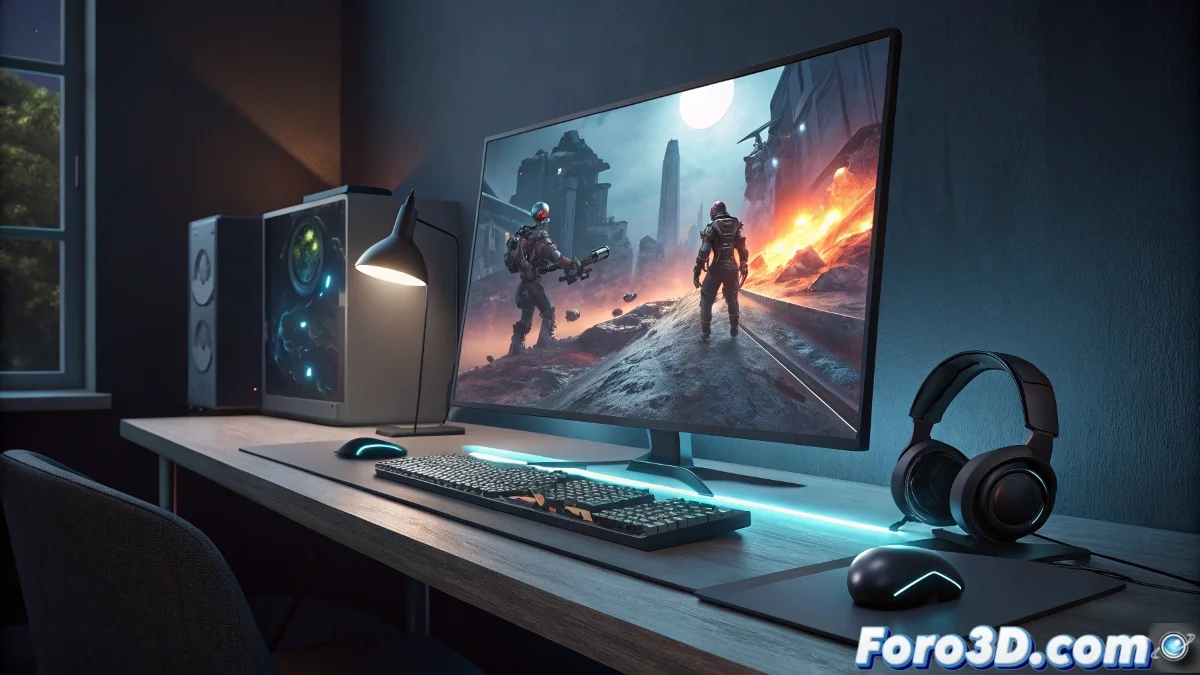
Analysis of the Alienware QD-OLED 280Hz Monitor: Real Innovation or Marketing?
Exploring the new 27-inch Alienware QD-OLED, we are faced with a proposition that promises to revolutionize the gaming experience with its impressive 280Hz refresh rate. This figure far exceeds the 144Hz standard that many of us consider more than adequate, raising doubts about the real-world utility of these extreme numbers 🎮.
The Race for Hertz: Real Need or Empty Specification?
The law of diminishing returns is clearly evident in the realm of refresh rates. While the jump from 60Hz to 144Hz represents a dramatically visible improvement for any user, the additional increase to 280Hz offers much subtler benefits that will only be appreciable by professional gamers with years of experience.
Key Aspects of High Refresh Rates:- Casual gamers will hardly perceive significant differences beyond 144Hz
- Esports professionals could leverage marginal advantages in competitive titles
- Every millisecond counts in high-competition scenarios where reaction is crucial
The difference between 144Hz and 280Hz is like running a marathon with state-of-the-art sneakers: the improvement exists, but it doesn't completely transform the experience
The Real Challenge: Hardware Needed to Utilize 280Hz
Achieving and maintaining stable 280 fps in modern games requires a very high-end graphics setup, such as RTX 4090s in optimized configurations. This technological requirement makes the 280Hz feature irrelevant for most gamers who do not have such rendering power 💻.
Requirements to Utilize 280Hz:- Latest-generation graphics cards with massive rendering capacity
- Optimized configurations that prioritize performance over visual quality
- Significant financial investment in high-end components
QD-OLED: The True Star of the Show
Where the AW2725D truly shines is in its QD-OLED technology, which combines perfect blacks, extraordinarily vibrant colors, and near-instant response times. These characteristics impact the overall visual experience much more profoundly than the extra hertz, transforming any content from gaming to multimedia with an immersion that no traditional LCD panel can match 🌈.
Final Reflection: Specifications versus Real-World Experience
While QD-OLED technology represents a significant and tangible advance in visual quality, the 280Hz primarily functions as a marketing argument to justify premium prices. The reality is that few systems can maintain stable 280 fps in complex scenarios with ray tracing enabled, and even fewer human eyes can consistently detect those minuscule differences during intense gameplay 🎯.