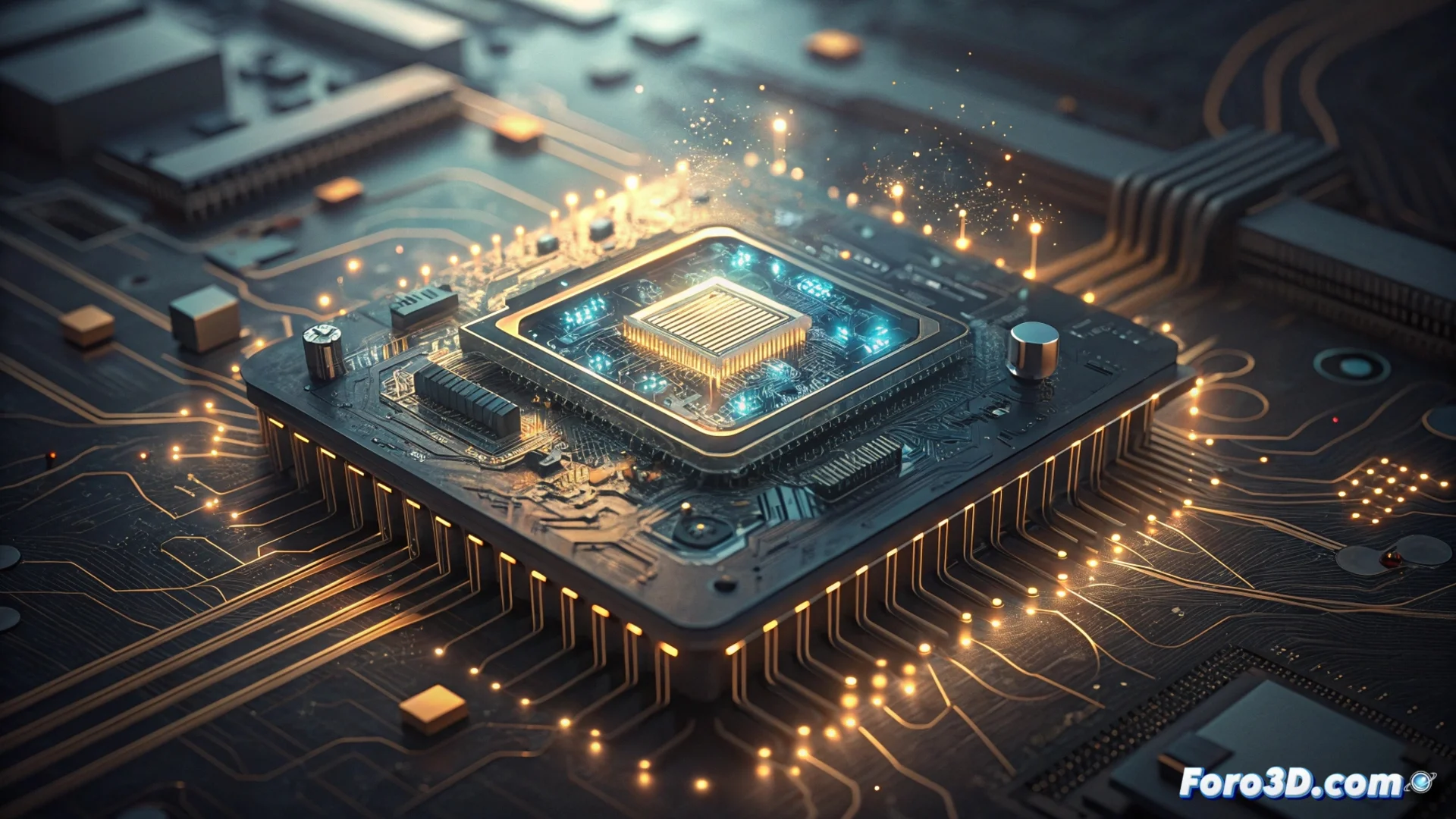
An Italian Prototype Processes Analog Data in Memory
A group of scientists in Italy has presented an innovative analog processor that can transform how robotics and artificial intelligence systems handle information. Unlike digital chips, this prototype operates directly within storage modules, a concept that challenges traditional architecture. 🤖
Eliminating the von Neumann Bottleneck
The key to this advance lies in how it avoids the main problem of current computers: the constant need to transfer data between memory and the central processing unit. This movement generates delays and consumes a lot of energy. The Italian chip integrates both functions, executing mathematical operations right where the information is stored, radically accelerating the entire process. ⚡
Main advantages of the approach:- Extreme energy efficiency: In tests, the prototype uses up to five thousand times less energy than a digital solution for the same task.
- Inherent acceleration: By processing continuous electrical signals in parallel, it solves complex operations almost instantly.
- Enabling autonomous devices: Allows running more powerful AI algorithms in robots or sensors without relying on the cloud.
The old idea of in-memory processing, now with an analog twist, could be the key to making our devices stop overheating so much.
A Specialized Complement, Not a Replacement
This technology does not seek to replace digital processors in everything. Its niche is specific mathematical operations that are fundamental for machine learning and analyzing large datasets. Specializing allows it to be incredibly fast and efficient in those specific tasks. 🎯
Areas of immediate impact:- Autonomous robotics: Robots that can perceive and decide with greater autonomy and less battery.
- Edge computing: Sensors and IoT devices that process data locally without sending it to a center.
- AI algorithms: Accelerate training and inference of neural network models.
The Future of Efficient Computing
The resurgence of in-memory analog computing points to a path toward more specialized and sustainable hardware. By drastically reducing the energy needed for calculations, it opens the door to implementing complex artificial intelligence anywhere, making future systems not only faster, but also cooler and more efficient. ❄️