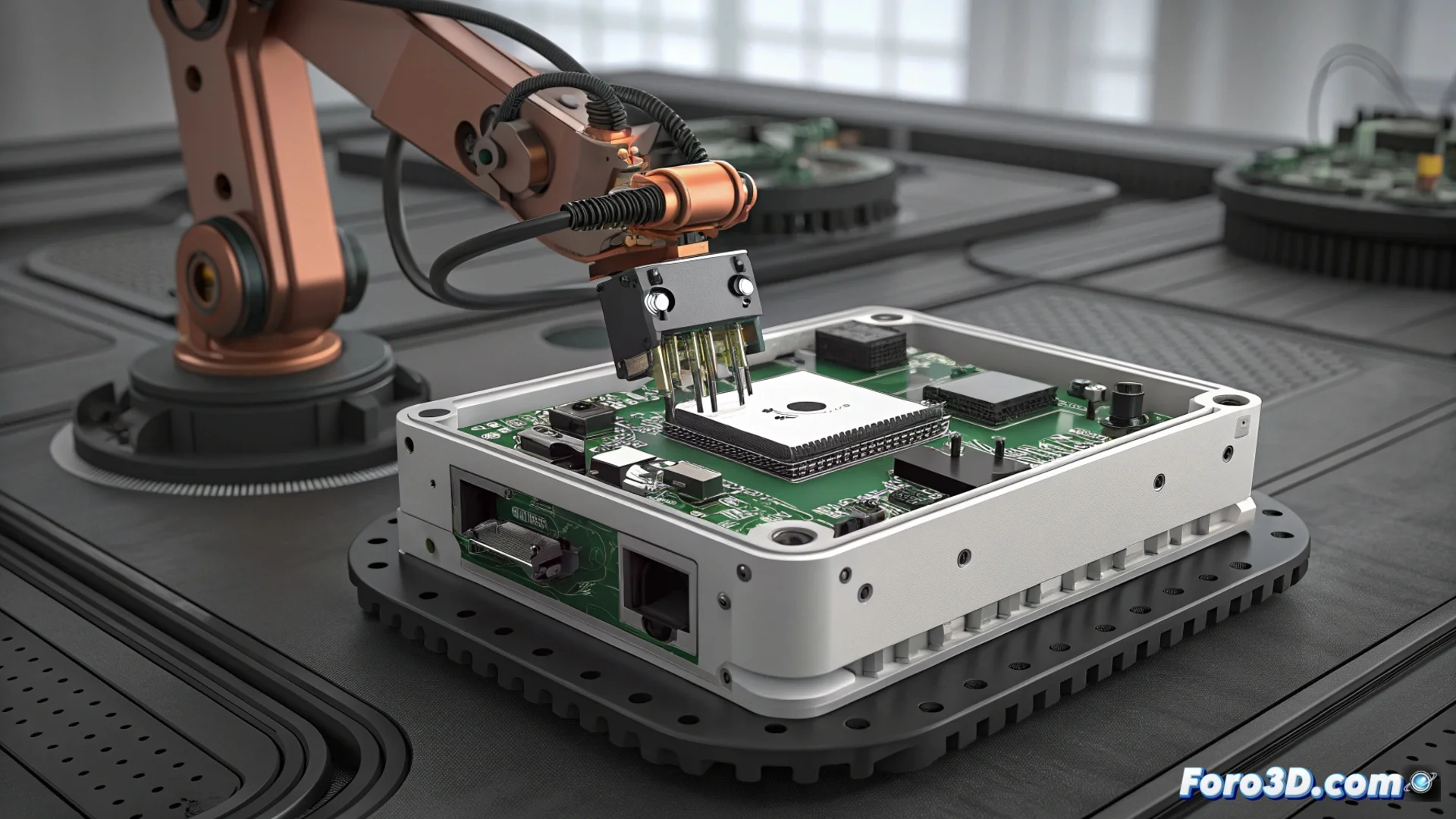
An Industrial-Grade IMU: Precision Beyond Mobile
An Inertial Measurement Unit (IMU) at the industrial level, such as the ADIS16505 model from Analog Devices, operates in a different league from the sensors in a smartphone. These modules integrate gyroscopes and accelerometers that stand out for their extremely low noise and ability to maintain stability with temperature changes. Their role is fundamental in areas where failing is not an option, such as self-driving vehicles, robots, and systems that stabilize platforms. 🎯
How Does an IMU Determine Orientation?
The core of its operation lies in fusing data from multiple sensors. Gyroscopes capture the speed at which an object rotates, while accelerometers detect changes in its linear motion. An internal processor executes complex algorithms to combine these readings in real time and thus accurately calculate the attitude, heading, and relative position of the device that houses it. This allows a drone or robot arm to operate autonomously even indoors or in places without satellite coverage. 🧠
Components and Critical Parameters:- Gyroscopes: Measure angular velocity. Their drift or accumulated error over time is a key limiting factor.
- Accelerometers: Detect linear acceleration. Their noise level directly affects the precision of measurements.
- Sensor Fusion Processor: Executes the algorithms (such as a Kalman filter) that interpret and combine all data inputs.
In inertial navigation, a small error in measurement amplifies rapidly, generating a large deviation in the calculated position.
Applications Demanding Maximum Performance
The utility of an industrial IMU unfolds in fields where long-term precision is non-negotiable. In a mission of an autonomous underwater vehicle or in the navigation system of a logistics robot, there is no option to recalibrate frequently. Manufacturers like Analog Devices design these modules to maintain their calibration and minimize errors over time and with thermal variations. 🔧
Environments Where a Precise IMU is Indispensable:- Pure Inertial Navigation: When GPS signal is lost, blocked, or not sufficiently accurate.
- Mobile Robotics: So that robots perceive their orientation and move safely in dynamic spaces.
- Stabilization Platforms: In cinema cameras, antennas, or marine systems that must counteract unwanted movements.
Sensor Choice Makes the Difference
Opting for a consumer sensor for a critical application can lead to unpredictable results. The thermal stability and low noise of an industrial IMU are not luxuries, but requirements for systems to function as designed. If a robot prototype mysteriously deviates from its path, the problem might not be in the code, but in the low-grade IMU taking its own "navigation decisions." Investing in the right component avoids these setbacks and ensures project reliability. ⚙️