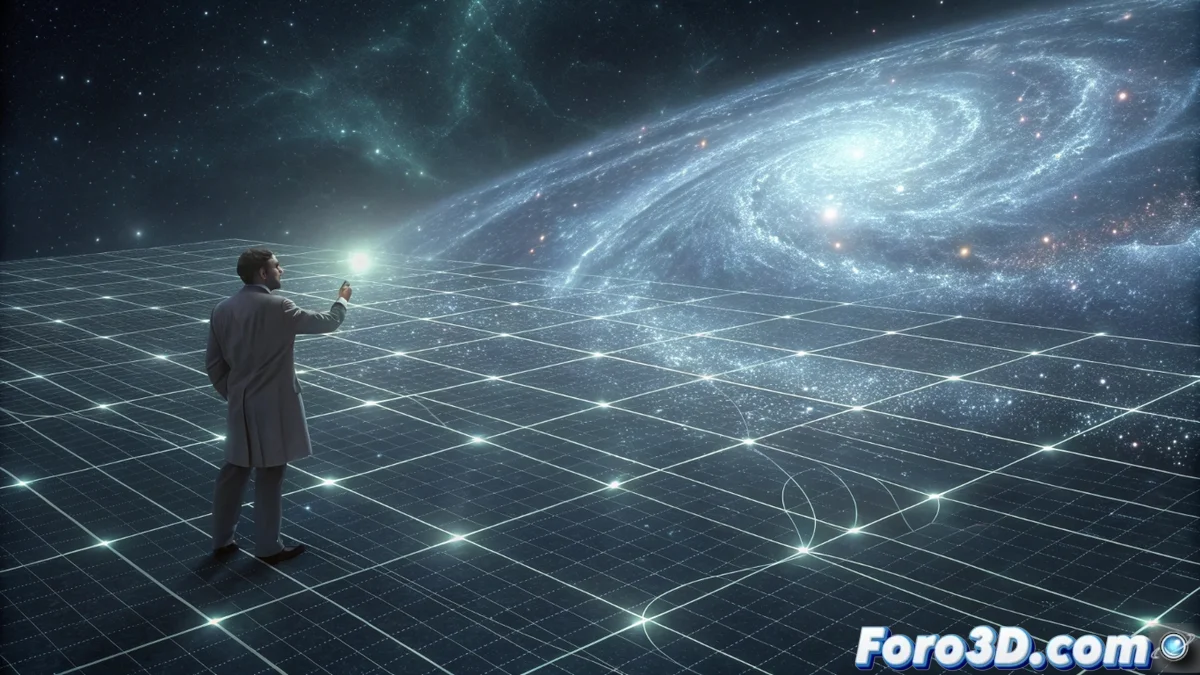
An experiment seeks proof that the universe is a simulation
A group of physicists has designed an experimental method to search for evidence that our reality might be a computer program running on unknown hardware. The central premise is that, if we exist within a simulation, the fundamental physical laws would exhibit detectable computational imperfections. 🧠
The theoretical basis: searching for the source code of reality
The proposal is based on random matrix theory, used to model complex systems. The researchers argue that if the fabric of space-time is a discrete computational grid (pixelated), the energy levels of elementary particles would not be distributed genuinely randomly. Instead, they would exhibit specific correlation patterns, similar to those generated by a pseudorandom number algorithm in any computer simulation.
The pillars of the approach:- Computational discrepancies: Analogous to rounding errors that arise when processing numbers with finite precision.
- Statistical signature: The energy distribution would show a statistical fingerprint that would reveal the digital substrate.
- Continuous vs. discrete: The experiment seeks to test whether reality is fundamentally continuous or composed of minimal units (pixels) of space-time.
If we detect the statistical signatures predicted by our models, it would be strong evidence that the universe is not fundamentally continuous, but pixelated, like in a simulation.
How to conduct the test: scanning the firmament
To track these hidden patterns, the proposed experiment would analyze the cosmic microwave background radiation and ultra-high-energy cosmic rays. The scientists would scrutinize these signals from the primitive cosmos for anomalies in particle distribution reaching us. Finding the predicted signature would be solid evidence of a simulated universe.
Methodology and implications:- Data analysis: Large volumes of data from cosmic ray observatories and microwave telescopes would be examined.
- Results interpretation: A positive finding would suggest that we live in a computational construct.
- Test limitation: A negative result would not prove that we are not a simulation; it would only indicate that the hardware running it is so powerful that its imperfections are undetectable with our current technological level.
Implications of a possible discovery
This approach brings a speculative philosophical question into the realm of verifiable experimental physics. Regardless of the outcome, the experiment challenges our understanding of fundamental reality and the limits of what we can measure. The mere fact of being able to pose and design a test for the simulation hypothesis represents a significant conceptual advance. 🔬