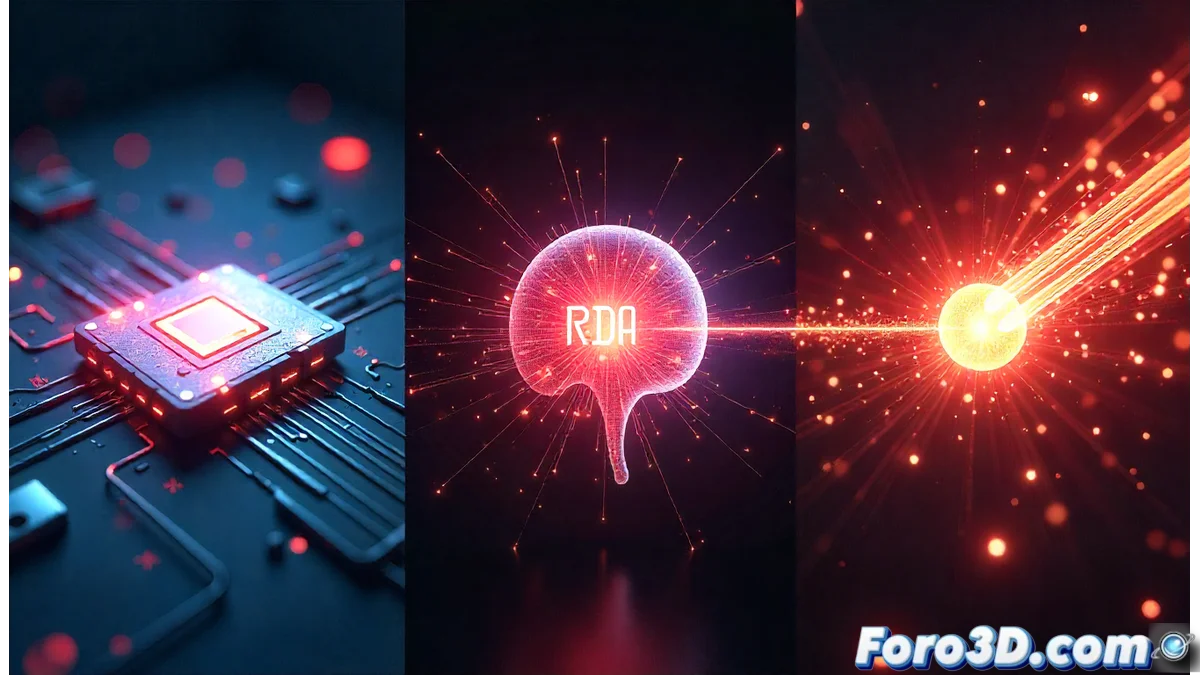
AMD has unveiled what could be the biggest qualitative leap in its RDNA architecture with the announcement of three fundamental technologies: Radiance Cores, Neural Arrays, and Universal Compression. This technological triad promises to radically transform how GPUs handle lighting, artificial intelligence, and memory management. 🚀
What makes this announcement special is how each component addresses a different bottleneck in modern rendering. While the Radiance Cores specialize in real-time ray tracing, the Neural Arrays accelerate AI workloads and Universal Compression intelligently optimizes memory bandwidth.
An architecture that thinks before it renders
Radiance Cores: The Soul of Realistic Lighting
The Radiance Cores represent the natural evolution of ray tracing accelerators, but with a more comprehensive approach. They are not limited to calculating ray intersections; they understand the physical behavior of light on different materials and surfaces.
The most notable capabilities include:
- real-time global illumination calculation
- efficient handling of diffuse and specular reflections
- integration with volumetric particle systems
- automatic ray sampling optimization
Neural Arrays: When AI Becomes a Graphics Co-pilot
The Neural Arrays are specialized units that operate in parallel with traditional shaders. Their primary purpose is to offload machine learning tasks that improve visual quality without significantly impacting overall performance.
Immediate practical applications:
- neural upscaling with detail reconstruction
- intelligent denoisers for ray tracing
- procedural generation of textures and geometry
- dynamic level of detail optimization
Universal Compression: Doing More with Less
The Universal Compression technology might be the most revolutionary of the three. It uses adaptive algorithms that analyze the type of data being compressed and automatically apply the most efficient method, whether for textures, geometry, or frame buffers.
And so, while the industry prepares for another generation of specification wars, AMD demonstrates that true innovation is not about having more transistors, but about making them work smarter. The irony that universal compression could infinitely expand our graphical possibilities. 💡