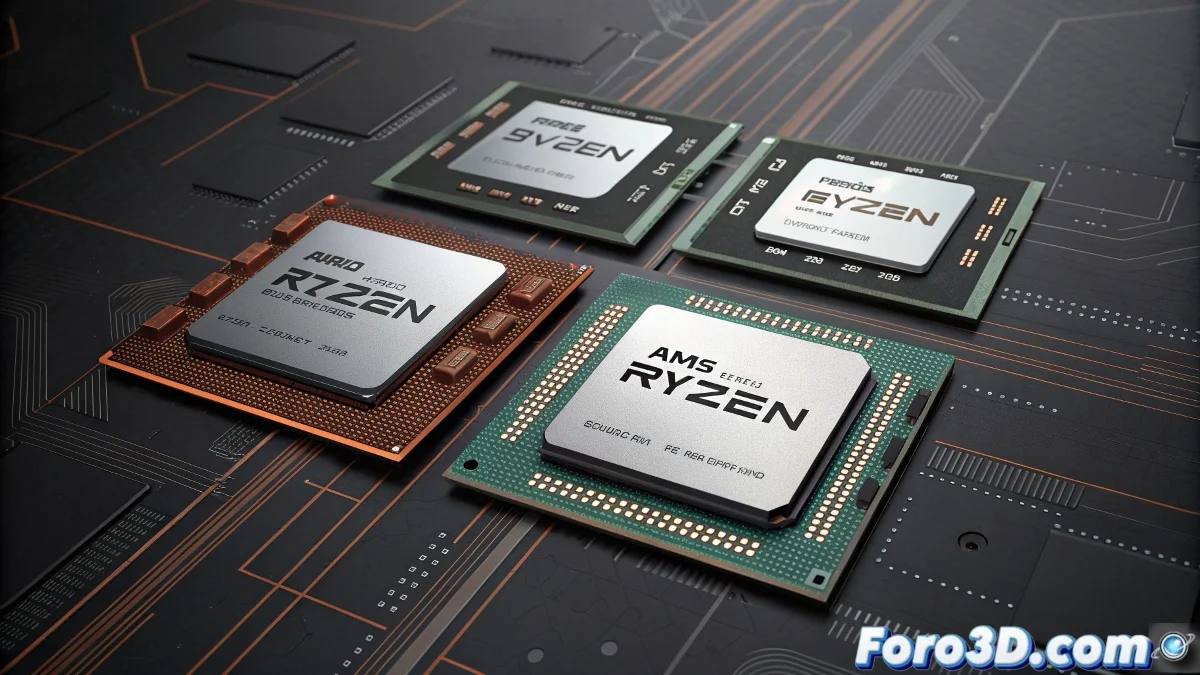
AMD Doubles Down on Elite Gaming
The battle for the gaming CPU crown has a new heavyweight contender. 🏆 AMD has officially unveiled its new Ryzen 9 9000 series processors, led by the 9950X3D and 9900X3D models, both equipped with the now-legendary 3D V-Cache technology. This launch is not a simple iteration; it's a statement of intent aimed directly at gamers who accept no compromises on performance and smoothness, solidifying the AM5 platform as the home of the high-end.
The Power of Stacked Cache
The differentiating element of these processors is, without a doubt, the 3D V-Cache technology. This innovation involves stacking additional L3 cache memory directly onto the processor chip. 🚀 The result is a drastic reduction in access latency for the data that games constantly demand, which translates into a significant increase in frames per second, especially in titles that are sensitive to memory speed. For gamers, this means fewer bottlenecks and noticeably smoother gameplay.
3D V-Cache is AMD's secret weapon for gaming.
Two Options for the Top
AMD offers two main options in this segment. The Ryzen 9 9950X3D positions itself as the absolute beast, with the highest core count and the widest cache for those who also do streaming or heavy productivity tasks alongside gaming. Meanwhile, the Ryzen 9 9900X3D seeks the perfect balance for the pure gamer, offering most of the gaming performance at a potentially more accessible price. Both share compatibility with the AM5 platform, which guarantees long-term support.
- Modern Platform: Native support for DDR5 memory and PCIe 5.0.
- Improved Efficiency: Zen 5 architecture that delivers more performance per watt.
- Gaming Focus: The benefit of the extra cache is more evident in games than in professional applications.
Who Needs That Much Power?
The answer is clear: any gamer using resolutions like 1440p or 4K with high refresh rates. 🎮 The advantage of 3D V-Cache is more pronounced when the graphics card is not the limit, allowing the CPU to deliver a substantially higher frame count. However, for users who prioritize tasks like 3D rendering or code compilation, a processor without the stacked cache but with more cores might be a more balanced option.
It's the paradox of gaming hardware: having a processor capable of calculating the physics of a virtual universe, only to use it mainly for titles that prioritize 8-bit style graphics. 😉 But hey, the peace of mind of knowing you can handle anything is priceless.