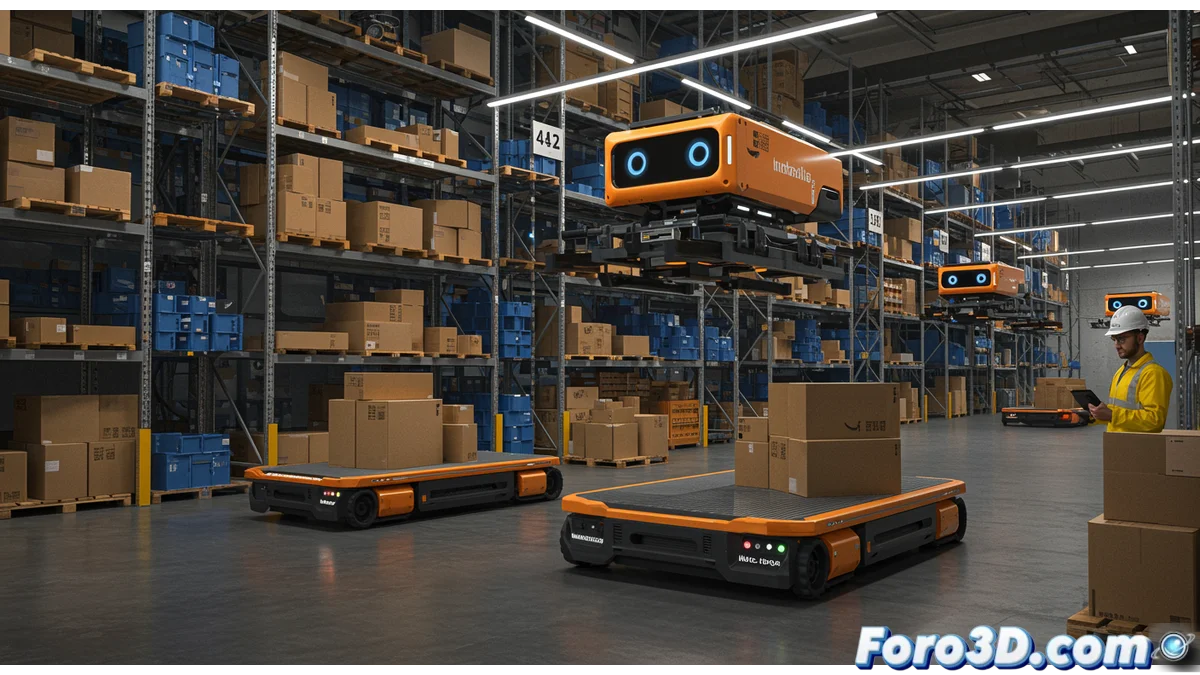
Amazon Proteus: the autonomous robot redefining internal logistics
Robotic automation is rewriting the rules of logistics management, and a clear protagonist of this revolution is Amazon Proteus. This autonomous mobile robot, heir to Kiva Systems technology, is not a simple improvement, but a paradigm shift in distribution center operations. Its mission is clear: to autonomously move mobile shelves or merchandise containers, freeing human personnel from the most exhausting physical displacements. This collaborative ecosystem between people and machines results in a radical optimization of workflows, exponentially accelerating critical processes such as picking and packaging. 🤖➡️📦
Intelligent navigation and safe coexistence
What distinguishes Proteus from previous generations of warehouse robots is its ability to integrate safely and fluidly into shared environments. To achieve this, it employs a sophisticated autonomous navigation system that dispenses with fixed infrastructure like magnetic lines. Instead, it uses a fusion of sensors, high-resolution cameras, and powerful computer vision algorithms to create a dynamic map of its environment in real time. This perception allows it to plot optimal routes, dodge unforeseen obstacles, and, most importantly, interact safely alongside human operators.
Key features of its navigation system:- 360º perception: Sensors and cameras constantly scan the environment to detect shelves, other robots, and, crucially, people.
- Dynamic routing: Calculates and adjusts its trajectory instantly to avoid collisions and find the most efficient path.
- Advanced safety protocols: Its software is programmed to stop or perform evasive maneuvers in the presence of humans, ensuring a collaborative workspace without risks.
Proteus marks the transition from robots operating in cages to robots collaborating shoulder to shoulder with humans, a qualitative leap essential for the logistics of the future.
Revolution in operational efficiency and future vision
The implementation of fleets of Proteus robots has a tangible and profound impact on logistics efficiency indicators. The "merchandise goes to the operator" model completely eliminates the downtime an employee spends walking long aisles. Shelves arrive automatically at the workstation, translating into faster order processing, a significant reduction in errors, and better utilization of physical space, allowing for denser storage. For Amazon, this technology is an indispensable pillar in its obsession with ultra-fast deliveries.
Consequences and projections of this automation:- Order cycle acceleration: Picking speed increases dramatically, meeting the demands of modern e-commerce.
- Resource optimization: Workers can focus on higher-value tasks that require judgment and skill, improving ergonomics and satisfaction.
- Industry standard: Proteus's success sets a model to follow, pointing toward fully autonomous warehouses where AIs coordinate fleets of robots in perfect sync with management systems.
A new paradigm of collaboration
Beyond cold efficiency numbers, Amazon Proteus symbolizes the evolution toward a symbiotic collaboration between humans and machines in the industrial environment. It is not about replacing the workforce, but empowering it, freeing it from monotonous and physically demanding tasks. This autonomous robot is, in essence, a steel and silicon collaborator that works tirelessly, demonstrating that the future of logistics lies not in isolated automation, but in intelligent integration. A future where, ironically, a mobile device may indeed have more purpose at 3 a.m. than a human, so that human can dedicate themselves to what really matters. 🚀