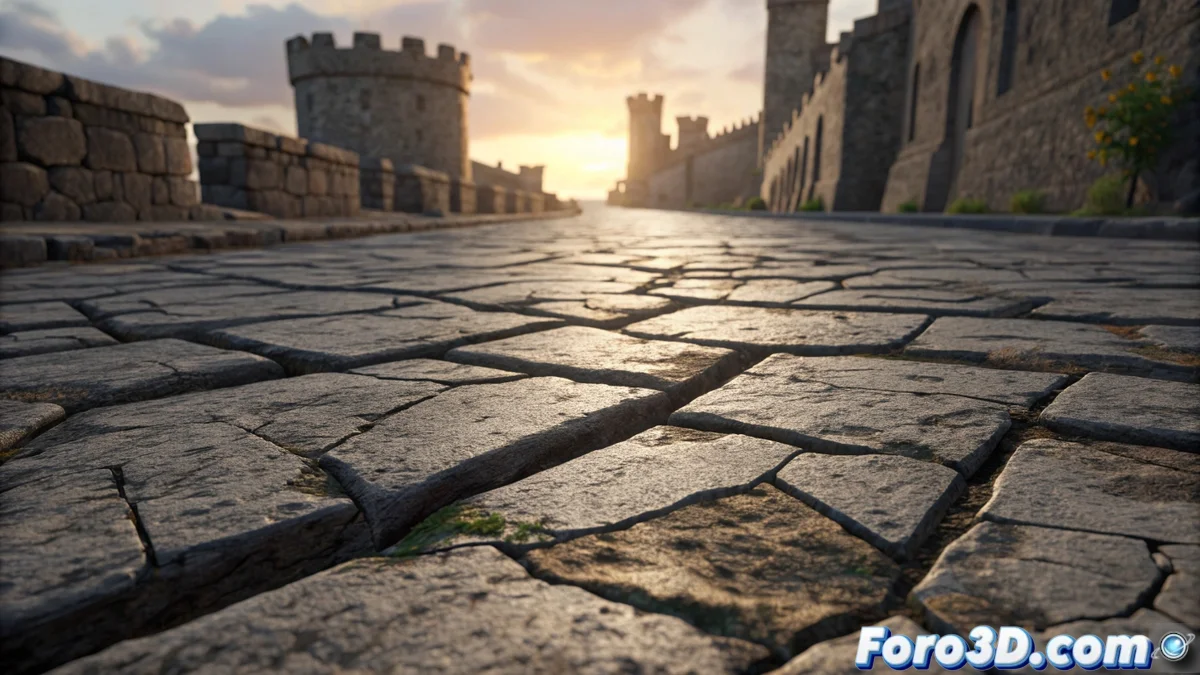
Parallax Occlusion Mapping: virtual depth in real-time graphics
In the constant pursuit of visual realism without compromising performance, Parallax Occlusion Mapping (POM) emerges as an advanced shading technique. It represents a crucial evolution beyond normal mapping, allowing the simulation of complex three-dimensional geometry on a mesh that is, essentially, completely flat. Its magic lies in deceiving our perception through the intelligent calculation of the parallax effect, creating a convincing illusion of protrusions, cracks, and reliefs. 🎮
The heart of the technique: beyond a simple map
While normal mapping relies on modifying per-pixel lighting, POM introduces a virtual geometric component. The key is the use of a height map, a grayscale texture where the value of each pixel defines its virtual height. During rendering, the specialized shader traces the view ray from the camera. Through a process of multiple sampling and binary search, it calculates where this ray would intersect with the relief defined by the height map, dynamically adjusting the final texture coordinates. This occlusion calculation is what generates the shadows and "hidden" areas that provide an authentic sense of depth.
Essential components of the POM pipeline:- Diffuse/Albedo Map: Provides the base color information of the surface.
- Normal Map: Defines the microscopic orientation for lighting calculation, working in conjunction with the relief effect.
- Height Map: The differentiating element. A black-and-white texture where white represents the highest points and black the lowest of the simulated relief.
Parallax Occlusion Mapping does not create new geometry, but visually persuades us that it exists. It is a master illusionist on the GPU.
Advantages and challenges in practical application
POM's main strength is its quality-performance ratio. It allows adding extraordinary apparent detail to scenarios like stone floors, brick walls, or uneven terrain, without the computational cost of modeling millions of polygons. The effect is especially noticeable at grazing viewing angles, where parallax displacement is maximized, avoiding the flattening characteristic of normal mapping. However, it is a technique with nuances. Its implementation requires a more intensive per-pixel calculation and can present artifacts like self-occlusion in very abrupt reliefs or texture "wiping" at edges.
Key considerations for developers and artists:- Optimization: The number of ray samples directly affects quality and cost. Finding a balance is crucial for real-time performance.
- Asset Creation: Generating a coherent and high-quality height map is as important as color and normal maps.
- Usage Context: It is ideal for static surface details or moderate displacement. It does not replace real geometry for contoured silhouettes or physical interaction.
Conclusion: a powerful tool in the graphics arsenal
Parallax Occlusion Mapping establishes itself as a fundamental technique in real-time 3D graphics for projects seeking high visual detail. Its ability to convincingly simulate depth makes it indispensable for immersive environments, although it is vital to understand its limits. In the end, the avatar will continue walking on an invisible plane, but our eyes will firmly believe it is treading on rugged, history-filled terrain. 🏔️